Ukraine’s Drone Empire Has a Chinese Heart: The Hidden Vulnerability Behind Kyiv’s Battlefield Revolution
Ukraine has become the world's laboratory for drone warfare.
Its engineers design systems at astonishing speed. Its manufacturers produce unmanned platforms by the thousands. Its armed forces have transformed drones from supporting assets into the decisive weapons of the modern battlefield.
Yet beneath this remarkable success lies a dangerous paradox.
The country that has redefined how wars are fought still depends on critical technology components produced in China, the strategic partner of the nation it is fighting.
That contradiction is increasingly worrying Ukrainian defense innovators.
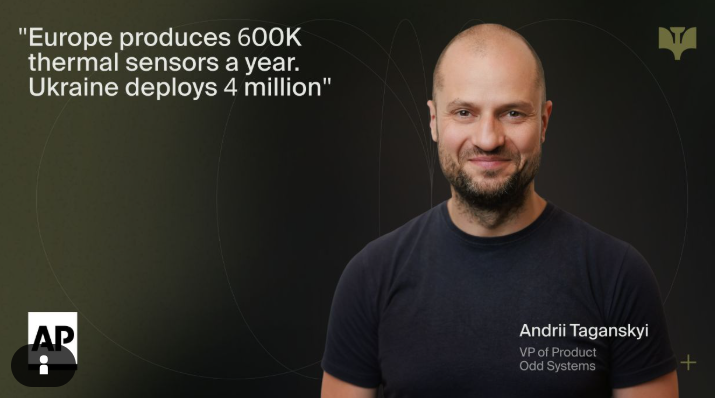
According to comments from Andrii Taganskyi, Vice President of Product at Odd Systems, featured in a recent The Associated Press report, one of the clearest examples can be found inside thermal imaging cameras, among the most important technologies used by modern drones.
Thermal optics have become indispensable on today's battlefield. They allow drone operators to identify targets at night, monitor troop movements through darkness, and maintain surveillance under difficult visibility conditions. In Ukraine's technology-driven conflict, thermal imaging is no longer a luxury. It is essential combat infrastructure.
And that is exactly where the supply-chain problem begins.
Ukrainian companies have learned how to build sophisticated camera systems. They can design the electronics. They can develop software. They can integrate entire sensor packages into military platforms. But key elements, particularly thermal sensors and optical lenses, still need to be imported.
On paper, the dependency appears minor.
According to Andrii Taganskyi, Chinese-origin parts account for only around 5% of the total camera component structure. Yet those 5% represent components without which the system simply cannot function. As he noted, without them, there is effectively no camera.
This is the modern reality of technological warfare.
Winning today is no longer just about manufacturing vehicles, missiles, or drones. Success increasingly depends on controlling the supply chains behind critical technologies. A single unavailable microcomponent can halt production lines worth millions of dollars. A disrupted sensor supply can reduce combat capability across an entire fleet.
The numbers highlight the challenge.
According to the comments cited in the report, European manufacturers currently produce approximately 600,000 thermal sensors annually, while Ukraine's estimated requirement reaches around 4 million units. The gap is enormous. Even if every available European sensor were redirected toward Ukraine, demand would still significantly exceed supply.
That reality creates strategic risk.
Military planners routinely discuss ammunition shortages, vehicle production, and industrial mobilization. Increasingly, however, the critical bottleneck may be far smaller. The wars of the future could be constrained not by steel or explosives but by semiconductors, sensors, optics, and advanced electronics.
Recognizing this vulnerability, Odd Systems is pursuing a far more ambitious objective than simply assembling cameras. The company's long-term vision is technological sovereignty: designing, producing, and controlling every critical element of its thermal-imaging ecosystem, from sensors and lenses to manufacturing facilities.
That ambition gained new momentum with the recent announcement of Project Foundation, an initiative launched by Odd Systems and The Fourth Law aimed at establishing domestic thermal-sensor production capabilities.
The significance extends beyond Ukraine.
Across Europe and North America, governments are reaching similar conclusions. The era of globalization-first defense procurement is giving way to a new priority: resilience. Nations increasingly want control over critical technologies, domestic manufacturing capacity, and trusted supply chains.
Ukraine's experience offers a warning.
A country can become the world's most innovative drone warfare power and still remain vulnerable if key technological building blocks originate elsewhere.
The battlefield victories of tomorrow will not be determined solely by who develops the smartest drones.
They may be determined by who controls the sensors inside them.
And for Ukraine, the next great technological battle may not take place on the front line.
It may take place inside the factory.