Germany’s Rearmament Machine Is Accelerating: Seven More Bundeswehr Deals Head for Decision
Germany’s military transformation is entering a less glamorous but far more consequential phase: turning billions of euros into weapons, ammunition, communications and deployable capability.
Seven Bundeswehr procurement proposals worth more than €25 million each are heading to the Bundestag’s Budget Committee for consideration on 4 November. All are expected to be financed through the Defence Ministry’s departmental budget.
Individually, the projects look unrelated: Eurofighters, night-fighting equipment, beyond-line-of-sight communications, medical facilities, 30 mm training ammunition, anti-tank missiles and one still-obscure programme called PAYLOAD 1.
Together, however, they reveal something more interesting.
Germany is no longer simply buying platforms. It is trying to build the connective tissue of a military designed for high-intensity warfare.
Eurofighter keeps evolving
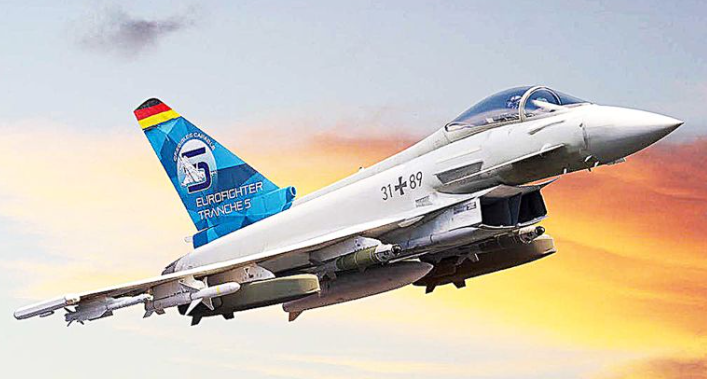
The most visible project concerns the Eurofighter.
Germany currently has production commitments covering 38 Tranche 4 aircraft under the Quadriga programme and 20 newer Tranche 5 fighters. Fifteen Bundeswehr Eurofighters are also being adapted for electronic-combat roles.
The production contract is now expected to be modified again.
That follows an earlier decision to develop, test and certify an Aerodynamic Modification Kit designed to improve the aircraft’s manoeuvrability.
This continuous modification tells its own story. Modern combat aircraft are no longer static products purchased once and flown unchanged for decades. Sensors, weapons, electronic warfare and software evolve continuously.
The aircraft is becoming a platform for permanent technological adaptation.
The unglamorous equipment that actually makes armies work
Other proposals are less headline-friendly, but arguably just as revealing.
Additional image-intensifier attachments are planned for infantry weapons, expanding soldiers’ ability to operate at night and in poor visibility.
Then there is Troposcatter.
Germany’s Tactical Wide Area Network relies partly on radio links connecting military network nodes. Conventional directional radio requires line of sight. Troposcatter communications exploit scattering in the troposphere to enable beyond-line-of-sight connectivity.
That matters in a battlefield where communications infrastructure is attacked, jammed and constantly displaced.
A digitally networked army is only as capable as the network that survives first contact.
Missiles, medics and ammunition
The package also reaches directly into combat capability.
Germany plans to procure SPIKE ER2 anti-tank guided missiles specifically for the H145M light combat helicopter. The H145M weapon platform had already been qualified for SPIKE ER2, making the new procurement a logical move from technical compatibility toward operational armament.
Another proposal concerns protected, highly mobile Role 2B medical facilities. Germany established a framework contract for 24 systems in 2025, initially committing to eight, with deliveries expected from 2030.
Then comes something even less spectacular: 30×173 mm DM58 training ammunition for Puma crews.
Nobody puts training ammunition on a recruitment poster.
But sophisticated vehicles without trained crews are simply expensive machines in storage.
And a force expected to regenerate combat power needs ammunition not merely for war, but for continuous realistic training before one begins.
The real headline: procurement velocity
The seven programmes are numbers 63 through 69 among Germany’s €25 million procurement submissions this year.
More strikingly, the Defence Ministry reportedly intends to put another 38 projects forward before the end of 2026.
With only three committee dates remaining, that would mean more than a dozen major proposals per session.
That is where Germany’s rearmament story becomes genuinely interesting.
For years, criticism of German defence focused on spending levels, procurement bureaucracy and readiness gaps. Now substantially greater resources are moving through the system.
The key question is shifting from:
Will Germany spend?
to:
Can Germany convert spending into combat power fast enough?
Budgets can change quickly. Industrial capacity cannot. Pilots, technicians and crews take years to train. Production lines need suppliers, skilled workers and predictable orders. Communications architecture must be integrated rather than merely purchased.
And approval is not delivery.
Germany’s next defence challenge therefore will not be measured by how many €25 million submissions reach parliamentary committees.
It will be measured by what reaches the Bundeswehr.
The Zeitenwende was the political announcement. The production line, training ground and operational unit are where it becomes real.