Putin Says Russia Is Talking to Musk. The Real Question Is Who Controls the Battlefield’s Internet
A battlefield can lose artillery. It can lose drones. It can lose aircraft.
But what happens when it loses the network connecting them?
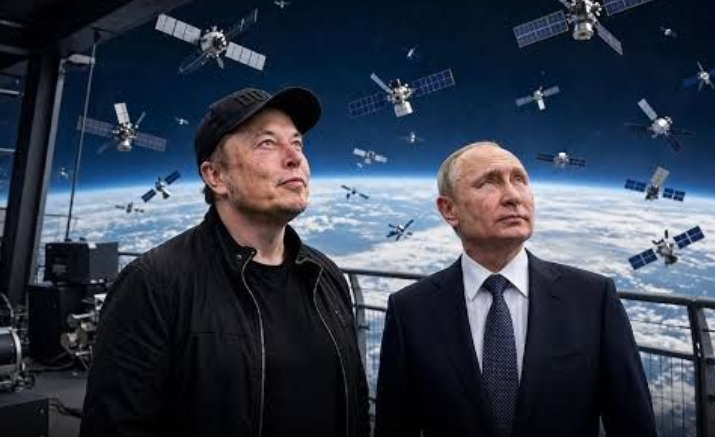
That question has moved uncomfortably close to the centre of modern warfare after Vladimir Putin said on 28 October that Russia was in “close contact” with American partners, including Elon Musk.
Putin’s stated explanation was technical rather than political: avoiding orbital interference as Russia develops its Rassvet satellite communications network.
On its own, that statement proves remarkably little about the controversy surrounding Ukrainian satellite connectivity.
But its timing makes the issue impossible to ignore.
When the network becomes part of the weapon
Days earlier, restrictions affecting Ukraine’s Starlink and Starshield connectivity had reportedly disrupted drone missions and other military activity.
Ukraine’s Ministry of Defence subsequently said on 24 October that connectivity had been restored at movement speeds above 400 km/h.
The episode exposed a reality that militaries can no longer treat as an IT problem:
Satellite connectivity has become part of the kill chain.
Drones, mobile command posts, intelligence feeds and distributed military units increasingly depend on resilient communications. If that connectivity disappears unexpectedly, operators may lose far more than internet access.
They can lose operational capability.
That is what makes the questions surrounding the October disruption significant.
Contact is not causation
The most provocative interpretation would also be the least responsible one: Putin says Russia communicates with Musk, Ukrainian connectivity was restricted, therefore the two events must be connected.
There is no evidence in the material provided that establishes that chain.
Orbital deconfliction is itself a legitimate technical issue for satellite operators. Putin’s comments do not demonstrate that discussions with Musk concerned Ukraine, Starlink restrictions or military operations.
That distinction matters.
So does another one: commercial Starlink and government-contracted Starshield should not automatically be treated as the same service with identical control arrangements.
The interesting question is not conspiracy.
It is governance.
Who owns the off-switch?
According to the account provided, journalists Simon Shuster and Isaac Stanley-Becker reported in The Atlantic that U.S. officials approaching SpaceX about the disruption were presented with the possibility of moving to an upgraded contract to restore access.
If accurate, that would establish a commercial response to the problem.
It would not prove that service was deliberately degraded to force a more expensive contract.
That distinction is critical.
Six U.S. lawmakers subsequently asked Musk on 26 October whether SpaceX had discussed restrictions with Russian or American officials, who had authorised changes and who currently controls availability.
Again, congressional questions are not findings of misconduct.
But they identify exactly where scrutiny belongs.
Who had authority? What changed? Under which contract? With what notice? And for which missions?
The strategic issue is bigger than Musk
Modern militaries increasingly depend on commercial infrastructure they do not completely own.
Cloud computing, satellite imagery, artificial intelligence, communications networks and launch services can all depend on private companies.
That creates extraordinary capability.
It also creates dependency.
A military contract therefore cannot merely specify bandwidth, terminals and price. It must define permitted mission profiles, geographic and velocity restrictions, authority to modify service, notification procedures, escalation mechanisms and fallback communications.
Because when connectivity has become operational infrastructure, contractual ambiguity can become battlefield risk.
The broader lesson extends well beyond Ukraine.
Western defence has spent decades securing weapons supply chains. It now needs to apply similar seriousness to digital sovereignty and network continuity.
The most important question surrounding the latest controversy is therefore not whether Putin and Musk communicated.
It is much harder:
When a privately operated network becomes essential to national defence, who ultimately decides when, where and how it can be used?
Until documentary evidence establishes what happened in October, speculation should not substitute for facts.
But one conclusion already deserves attention.
In connected warfare, the most powerful component may not be the missile, drone or satellite. It may be permission to connect.