The Three Riders of the Apocalypse: Trump, Xi, and Putin in the Age of Global Upheaval
History rarely announces its turning points.
They arrive quietly, disguised as elections, summits, economic deals, military exercises, or speeches delivered before cheering crowds. Only later do we realize that the world has crossed a threshold.
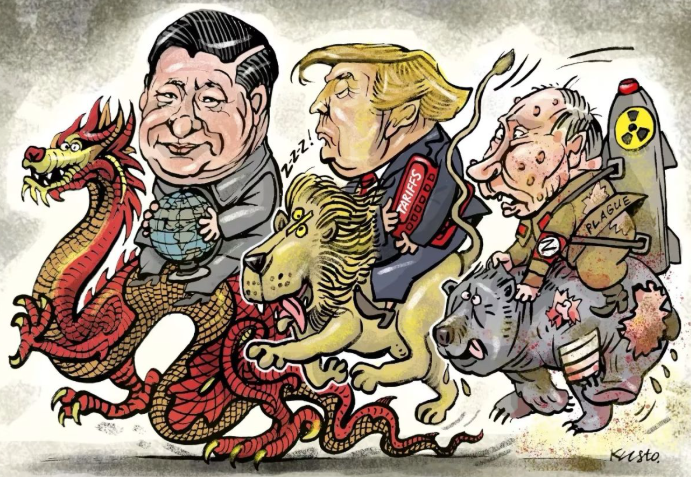
A provocative political cartoon depicts three of the most influential leaders of our time as modern-day Riders of the Apocalypse: Donald Trump atop a lion, Xi Jinping riding a dragon, and Vladimir Putin mounted on a wounded bear.
The image is intentionally controversial. It is not a forecast. It is not an accusation. It is a metaphor for the profound forces reshaping the global order.
And whether one admires or opposes any of these leaders, the symbolism is impossible to ignore.
The dragon comes first.
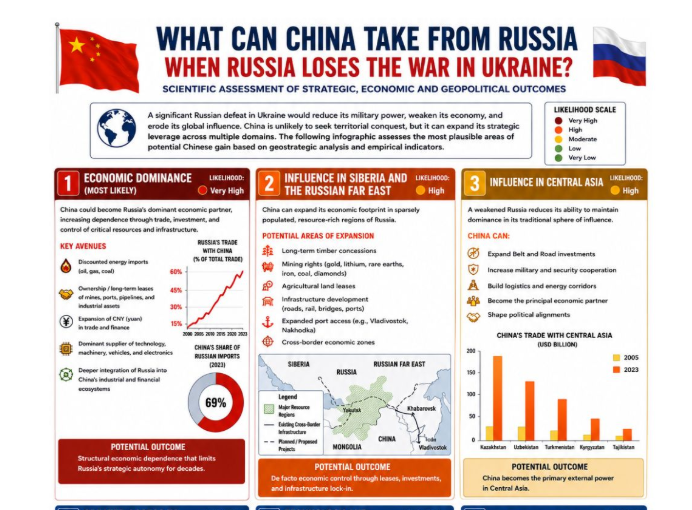
Xi Jinping's China represents perhaps the most ambitious geopolitical project of the 21st century. Over four decades, China transformed from a developing nation into an economic superpower, industrial giant, and technological competitor capable of challenging Western dominance.
The dragon is not rushing forward. It advances patiently.
Its weapons are factories, ports, supply chains, artificial intelligence, rare-earth minerals, and strategic investments stretching from Asia to Africa and beyond.
China's rise has become the defining geopolitical reality of our era.
Every government now calculates its future with one question in mind:
What does China want next?
Behind the dragon rides the lion.
Donald Trump has become something larger than a political figure. He is now a symbol of a political earthquake that continues to shake institutions across the democratic world.
Supporters see disruption.
Critics see chaos.
But both sides agree on one thing: traditional politics has not been the same since.
Trump's political movement exposed deep frustrations with globalization, elite institutions, immigration policies, and economic inequality. Whether celebrated or condemned, the effects extend far beyond the United States.
From Europe to Latin America, from social media to financial markets, the age of political certainty has ended.
The lion does not merely roar.
The lion destabilizes assumptions.
And then comes the bear.
Scarred, aggressive, and burdened by the consequences of prolonged confrontation, Vladimir Putin's Russia represents the return of hard power to international politics.
For decades, many believed economic integration would make major conflicts obsolete. Instead, military competition has returned to the center of global affairs.
Missiles, drones, cyber warfare, sanctions, energy pressure, and information campaigns have become permanent features of international relations.
The wounded bear depicted in the cartoon is symbolic of a nation that remains formidable despite economic pressure, international isolation, and prolonged conflicts.
It reminds the world that military power still matters.
Perhaps more than many expected.
Yet the true message of the image is not about three men.
It is about three forces.
The dragon symbolizes strategic ambition.
The lion symbolizes political disruption.
The bear symbolizes coercive power.
Together they form a triangle that increasingly defines global affairs.
Every major global crisis now sits somewhere within that triangle.
Trade disputes become geopolitical struggles.
Technology becomes a battlefield.
Economic dependencies become security vulnerabilities.
Political campaigns become international events.
Even artificial intelligence has become an arena of competition among great powers.
The result is a world that feels less predictable than at any time since the end of the Cold War.
Investors worry about markets.
Governments worry about security.
Citizens worry about the future.
The old assumptions are disappearing faster than new rules can replace them.
That is why the cartoon resonates.
Not because it predicts catastrophe.
But because it captures a growing sense that the world is entering a new chapter whose rules are still being written.
The dragon, the lion, and the bear are not marching toward apocalypse.
They are marching toward a future defined by competition, uncertainty, and the struggle to shape the next world order.
Whether that future brings prosperity or confrontation remains the question that will define the coming decade.