Europe Is Building a Gym for War AI: Agon Raises $70M to Train the Machines of the Future
Europe’s next defence champion may not build a tank, missile or drone.
It may build the place where all of them learn to think.
Agon has raised a massive $70 million Series A at a $450 million valuation, taking its total funding to $100 million. The round was led by Northzone, bringing together private capital and British government-backed strategic investment around one increasingly urgent idea:
Europe needs its own intelligence infrastructure for autonomous warfare.
And the money isn’t even the most interesting part.
The idea is.
Agon is building what it calls a synthetic battle arena, a virtual environment where autonomous defence systems can be trained, challenged and validated across thousands of scenarios before encountering the chaos of a real battlefield.
Think of it as a gym for military AI.
Except the athletes are algorithms.
Modern autonomous systems increasingly have to operate in conditions where communications disappear, GPS is degraded, electronic warfare disrupts sensors and adversaries change tactics faster than traditional military procurement can respond.
You cannot realistically reproduce every possibility on a physical test range.
You cannot destroy thousands of expensive drones just to discover every software weakness.
And you certainly do not want a war to be the place where you discover which assumptions were wrong.
Simulation changes the economics of learning.
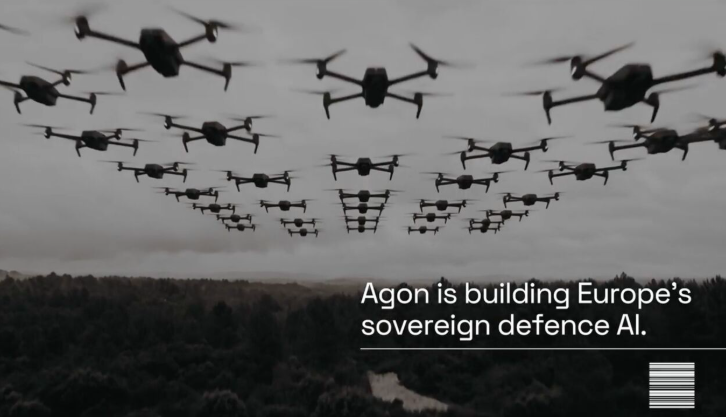
Inside a synthetic battlefield, an autonomous system can confront drone swarms, degraded navigation, communications failures and rapidly changing adversaries.
It can fail.
Restart.
Learn.
Fail again.
And repeat the process thousands of times.
That creates a provocative possibility:
The most important defence factory of the AI age might manufacture experience rather than weapons.
Agon is also assembling the kind of team that makes that proposition difficult to dismiss.
The company was founded by former British Army officer Tristam Constant and Junaid Hussain, co-founder of Cambridge Aerospace. Chairman David Helgason founded Unity Technologies, the company behind one of the world's most influential real-time development platforms.
Its wider talent pool draws experience from companies including Anduril, Applied Intuition, Google, Helsing, Palantir and Amazon.
That mixture of defence, gaming, simulation and AI says something important about where warfare is heading.
Weapons are becoming software-defined.
The question is no longer simply whether Europe can manufacture enough drones, missiles or autonomous vehicles.
The question is whether those machines can understand, adapt and improve faster than an adversary can defeat them.
And that transforms the meaning of defence sovereignty.
For decades, European strategic dependency was measured mainly in fighter aircraft, missiles, satellites, ammunition and engines.
The age of AI creates another layer.
Who owns the models?
Who controls the training data?
Who provides the compute?
Who builds the simulation environment?
And who decides whether an autonomous system is actually ready for deployment?
Europe could eventually manufacture impressive autonomous hardware while remaining dependent on someone else's intelligence stack.
That would be sovereignty with an asterisk.
This is why Agon's funding round matters beyond venture capital.
Defence AI is moving from experiment to infrastructure.
The first defence-tech boom gave Europe faster drones, better sensors, autonomous vehicles and new missile companies.
The next boom could build the intelligence layer connecting all of them.
And whoever controls that layer may occupy an unusually powerful position in the future defence ecosystem.
Because tomorrow's military advantage may not belong to the country possessing the single smartest machine.
It may belong to the country whose machines can learn faster than the enemy can adapt.
That is the race Europe is entering.
For years, Europeans worried that the continent had missed the defence-tech revolution.
Now the capital is arriving. The talent is moving. Governments are paying attention.
And this time, Europe isn't simply building another weapon.
It is building the school where the machines learn to fight.