Putin’s Great Miscalculation. Is Russia Becoming China’s Largest Vassal State?
When Vladimir Putin launched his invasion of Ukraine, he presented it as a historic mission to restore Russia's power and sovereignty.
More than four years later, a different reality is emerging.
Russia has not become isolated from the West only. It has become increasingly dependent on China.
And some observers inside Russia are beginning to ask a question that would have been unthinkable just a decade ago:
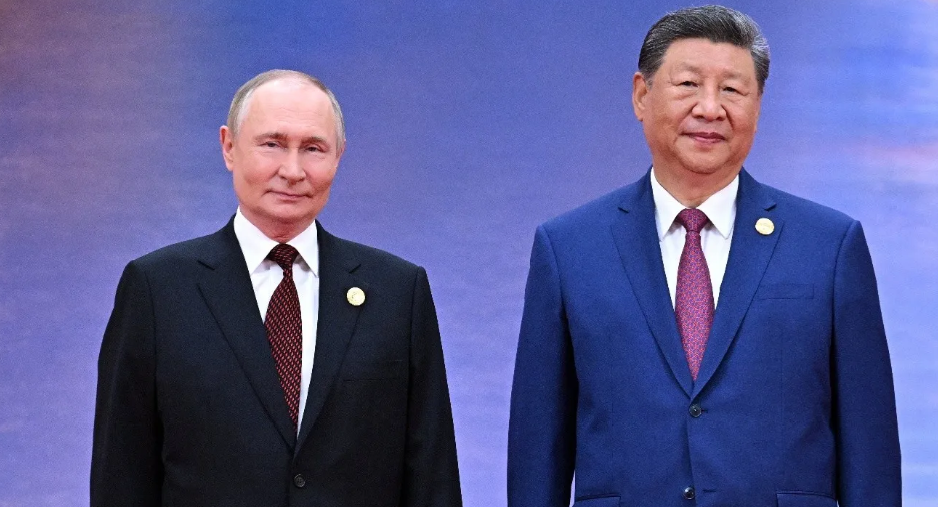
Has Putin's war transformed Russia from a great power into China's junior partner?
The Pipeline China Doesn't Need
Few projects symbolize the changing balance of power better than the proposed Power of Siberia 2 pipeline.
For nearly twenty years, Moscow has promoted the project as a cornerstone of its energy future. The pipeline would deliver 50 billion cubic meters of natural gas annually to China through Mongolia.
For Russia, the project is critical.
The loss of European energy markets following the Ukraine war has left Moscow desperate for alternative buyers. China appears to be the obvious answer.
Yet despite repeated Russian lobbying and multiple high-level meetings, Beijing continues to delay a final commitment.
The message is unmistakable.
China knows Russia needs the pipeline far more than China does.
The relationship is no longer one between equals negotiating mutual benefit.
It increasingly resembles a supplier waiting for approval from its most important customer.

A New Economic Dependency
Before 2022, Russia could balance relationships between Europe, China, India and other partners.
Today that flexibility has largely disappeared.
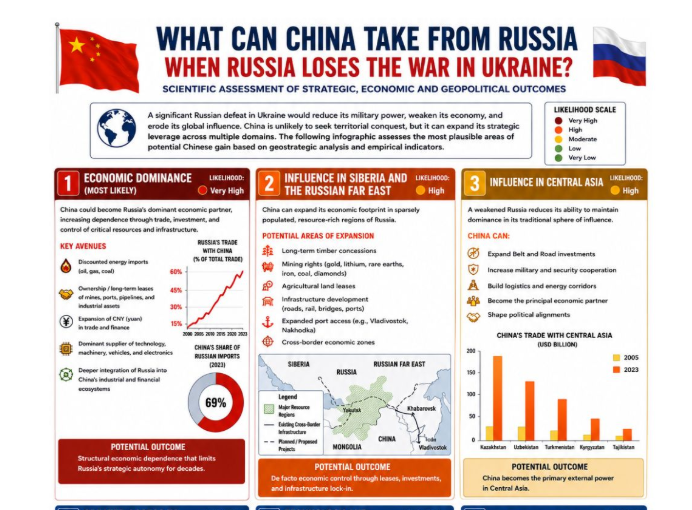
China has become Russia's dominant economic lifeline.
Chinese manufacturers now occupy significant positions in sectors ranging from automobiles to telecommunications and consumer technology. Chinese financial institutions have become crucial channels for trade and investment.
Most importantly, Russia's industrial base has become increasingly reliant on Chinese machinery, components and technology.
This dependence reaches deep into strategic sectors.
As Western markets closed and sanctions expanded, Chinese suppliers became harder to replace.
What began as cooperation is increasingly evolving into structural dependence.
History teaches a simple lesson:
Countries rarely lose influence overnight.
They lose it when key economic choices disappear.
The Silent Fear in Moscow
Officially, Russia and China describe their partnership as stronger than ever.
Unofficially, concerns appear to be growing.
Reports have pointed to anxieties among parts of Russia's security establishment regarding Chinese intelligence activities and Beijing's long-term intentions.
Some Russian nationalists regularly warn of demographic and economic imbalances in the Russian Far East.
Others point to historical territorial disputes and the continued use of Chinese names for cities and regions that today belong to Russia.
These concerns remain politically sensitive, but they reveal a deeper reality:
Russia's elites increasingly understand that dependence creates vulnerability.
The stronger China's leverage becomes, the less room Russia has to maneuver.
The Strategic Trap
The irony is remarkable.
Putin justified the Ukraine war as a struggle against dependence, encirclement and foreign influence.
Yet the resulting geopolitical landscape may have produced exactly what he sought to avoid.
Russia now faces growing asymmetry in its relationship with Beijing.
The imbalance extends beyond economics.
China's economy is vastly larger.
Its technological sector is more advanced.
Its global influence is expanding.
Its military modernization continues at a pace Russia would struggle to match.
In virtually every measurable category, the gap is widening.
And unlike the Soviet era, Moscow is no longer the senior partner.
Can China Weaponize Its Leverage?
At present, China benefits from stability.
A weakened but functioning Russia provides Beijing with energy resources, strategic depth and diplomatic support in international forums.
But geopolitics is rarely static.
Future tensions could emerge in Central Asia, the Arctic or the Russian Far East.
Economic disagreements could intensify.
Competing strategic interests could surface.
If that occurs, Beijing would possess substantial leverage over Moscow.
Trade flows.
Technology access.
Investment.
Industrial supply chains.
Energy purchases.
All have become tools of influence in the modern geopolitical era.
The question is not whether China possesses leverage.
The question is whether it may one day choose to use it.
The Historical Irony
History is filled with leaders whose ambitions produced outcomes opposite to their intentions.
Napoleon's invasion of Russia strengthened his enemies.
Germany's invasion of the Soviet Union accelerated its own downfall.
Now Putin faces a similar possibility.
His objective was to restore Russia's status as an independent pole of global power.
Instead, the war may be accelerating Russia's integration into an economic and strategic system dominated by China.
That does not mean Russia is becoming a formal satellite state.
It remains a nuclear superpower with significant resources and military capabilities.
But power is not only measured in weapons.
It is measured in choices.
And the fewer choices a nation possesses, the less independent it becomes.
The greatest geopolitical consequence of the Ukraine war may not be Russia's confrontation with the West.
It may be the emergence of a Eurasian order where Moscow increasingly follows a path shaped in Beijing.
.jpg)