The Tanks Get the Glory. The Machines That Keep Them Alive Win the War.
The most important armored vehicle on tomorrow’s European battlefield may not be the one firing the first shot.
It may be the one arriving afterward.
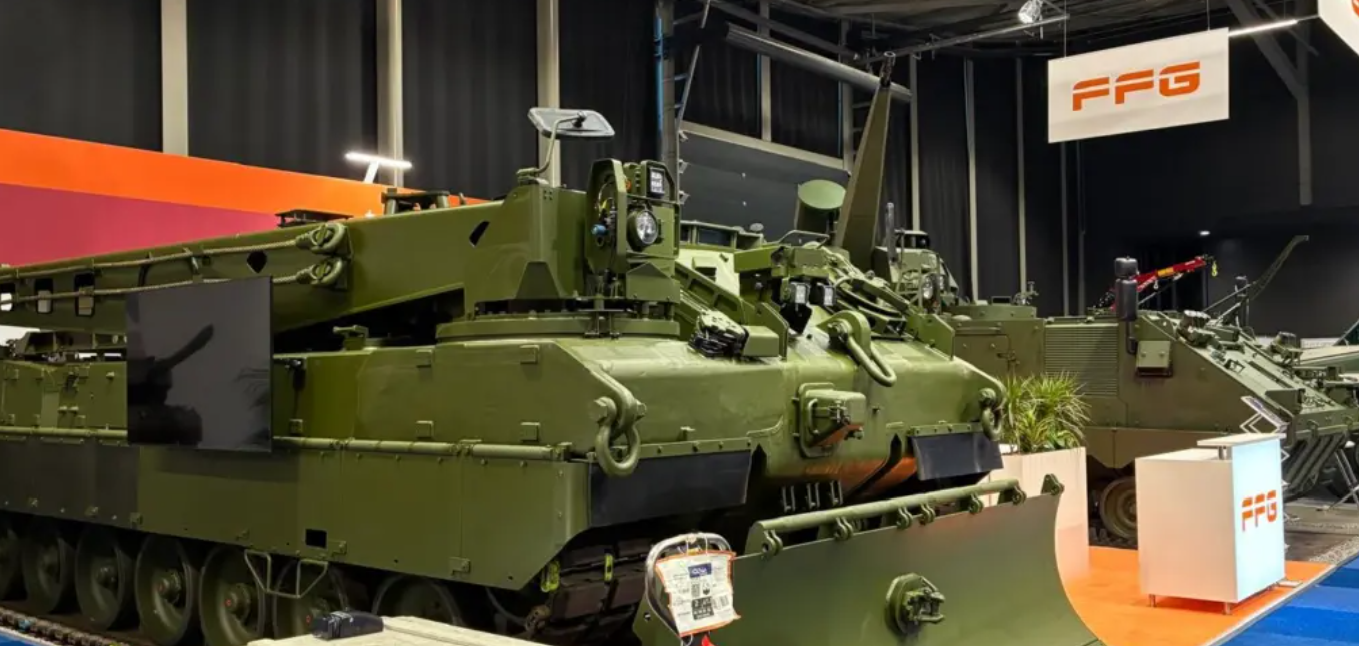
The Netherlands is strengthening its rebuilding armored forces with two German-designed platforms that rarely generate the headlines of a Leopard 2 tank, but could determine whether those Leopards are still fighting after the first week of a high-intensity war.
Dutch procurement authority COMMIT has selected FFG Flensburger Fahrzeugbau Gesellschaft to supply WiSENT 2 armored recovery vehicles and multiple variants of the ACSV armored support platform.
No contract value or final quantities have been disclosed.
But the direction is unmistakable.
Europe is rediscovering the machinery behind the machinery of war.
The WiSENT 2 is built on the Leopard 2 chassis. That matters because a recovery vehicle has to go where the tanks go, survive where the tanks fight and possess enough muscle to bring dozens of tonnes of immobilized armor home.
Its equipment reads like a battlefield mechanic’s heavyweight toolbox: a 32-tonne crane, a recovery winch delivering 40 tonnes of constant pulling force, a dozer blade and a Combat Recovery System.
Its crew can recover damaged or immobilized armor under protection instead of abandoning valuable vehicles in contested territory.
And WiSENT 2 has another advantage increasingly prized by European armies: commonality.
Sharing its Leopard 2 heritage means mobility characteristics and substantial logistical familiarity with one of Europe's dominant tank families.
In industrial warfare, that is not boring standardization.
It is combat power.
Because a tank destroyed beyond recovery is a lost asset.
A tank damaged, recovered, repaired and returned to service is temporarily unavailable.
That difference becomes enormous during months of sustained fighting.
Then there is ACSV.
The Armoured Combat Support Vehicle is less a single vehicle than a tracked military architecture.
At up to 26 tonnes, including an eight-tonne payload, it uses a modular rear loading area capable of accepting interchangeable mission modules, including compatible 10-foot ISO containers.
The Dutch requirement spans roles including medical evacuation, command, minelaying, transport, maintenance and driver training.
Previous Dutch planning indicated a potential requirement for roughly 100 to 150 ACSV systems.
That tells us something important about Europe's rearmament.
The continent is moving beyond buying individual headline weapons.
It is starting to rebuild formations.
A brigade does not fight because somebody purchased tanks.
It fights because tanks are surrounded by recovery vehicles, engineers, ammunition carriers, command posts, medical teams, air defense, repair facilities and an industrial system capable of replacing what gets destroyed.
Ukraine has provided Europe with a brutal reminder of that reality.
Modern warfare consumes machines.
Vehicles hit mines. Tracks break. Engines fail. Drones locate logistics columns. Artillery damages equipment without necessarily destroying it. Heavy armor becomes immobilized in terrain.
The winner is not simply the army that starts with the largest inventory.
It may be the army that can recover, repair and regenerate combat power fastest.
That makes the Dutch procurement more strategically interesting than another routine vehicle contract.
There is also an industrial message.
FFG emphasized three things increasingly decisive in today's European defense market: performance, price and delivery speed.
That last point deserves attention.
Europe spent decades operating procurement systems optimized for peacetime.
Today, availability itself is becoming a capability.
A theoretically perfect armored vehicle delivered in 2034 may be less strategically valuable than an excellent one available while European armies are rebuilding now.
The Netherlands appears to understand the equation.
Leopard tanks provide the punch.
WiSENT 2 helps keep that punch alive.
ACSV builds the support network around it.
None is particularly glamorous compared with the latest missile, drone or combat aircraft.
But wars are rarely won by glamour.
They are won when damaged machines return, supplies keep moving and combat units remain operational after the opening salvos.
Europe is rebuilding its armored fist.
The Netherlands is making sure it also rebuilds the muscle, mechanics and logistics needed to keep that fist swinging.