The Revolution Behind the Drone / by Diego Bavio
There is a scene toward the end of *Saving Private Ryan* in which the American soldiers defending the bridge try to stop a German tank using what they call a sticky bomb—a rudimentary explosive device designed to adhere to the surface of an armored vehicle.
It is difficult to imagine anything more primitive or inexpensive.
And yet that scene contains a lesson that seems to have been lost in much of today’s debate about drones.
Every time a small FPV drone destroys a tank worth millions of dollars, the immediate conclusion is that we are witnessing an entirely new revolution: cheap has defeated expensive.
But that is not new.
A tank could always be neutralized by something far simpler than itself. During the Second World War, it could be a soldier with a sticky bomb, a Bazooka, or a Panzerfaust. Later came increasingly sophisticated anti-tank systems, eventually leading to weapons such as the Javelin.
All that was required was an infantryman with courage and determination—and, why not say it, a little bit of madness.
What changed was not the existence of asymmetry.
What changed was the way asymmetry could be produced.
From the Sticky Bomb to the Javelin
The evolution of anti-tank weapons can be understood as a progressive transfer of capabilities from the combatant to the system.
The sticky bomb depended fundamentally on the man: get close, place the explosive, and survive.
The Bazooka added range and penetration, but it remained essentially a relatively simple infantry weapon.
Over time, technology incorporated sensors, electronics, guidance, and increasingly sophisticated systems. The Javelin represents one of the high points of that evolution.
The kill chain no longer depended entirely on the soldier’s ability to aim and fire. The weapon itself began to assume an increasing share of that chain.
The logic was perfectly rational: if we can increase accuracy and the probability of a hit, we can achieve the same effect with less ammunition and expose fewer personnel.
Precision thus became a force multiplier.
For decades, technological evolution seemed to confirm that idea. Everything led toward *fire and forget*.
The Illusion of Surgical Warfare
The development of precision-guided weapons, increasingly sophisticated sensors, and platforms capable of striking targets at enormous distances helped shape a particular conception of modern warfare.
The logic seemed simple: better information + greater precision = fewer weapons required.
The Tomahawk became one of the symbols of this transformation. The ability to strike targets at long range and with high precision appeared to make possible a form of warfare in which quality could partially substitute for quantity.
In certain scenarios, that logic works extraordinarily well.
The problem arises when we try to turn it into a universal theory of warfare.
Because wars are not always surgical.
Some are long, industrial, resource-intensive conflicts characterized by enormous rates of attrition.
And in that kind of war, an old variable that never disappeared returns to the equation: volume.
And Then Volume Returned
The war in Ukraine is demonstrating that technological sophistication has not eliminated the need for quantity.
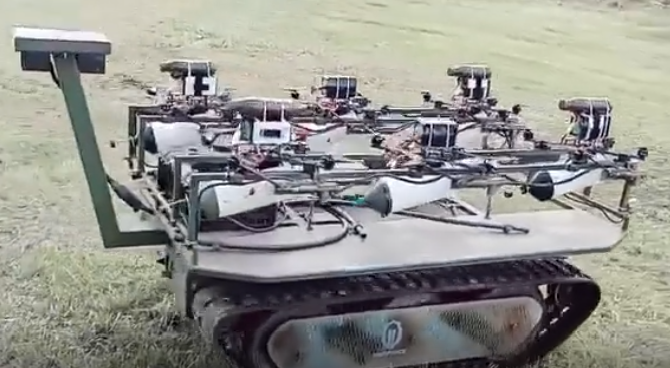
The emergence of FPV drones, loitering munitions, and low-cost unmanned systems has dramatically reduced the cost of producing certain military effects.
But it would be a mistake to interpret this simply as the cheap drone replacing the expensive missile. Not necessarily.
What we are seeing is more interesting.
The drone makes it possible to combine relatively low cost, sufficient precision, mass production, rapid replacement, and the ability to adapt.
That combination brings volume back into an equation from which, for decades, we believed we could do without it.
A Javelin can be extraordinarily sophisticated and effective. But we cannot think about it in the same way as thousands of inexpensive systems that can be employed, lost, replaced, and continuously modified.
The difference is not merely technological. It is industrial.
For years, we treated quality and quantity as if they were opposing concepts. The war we are witnessing today appears to demonstrate that this dichotomy was false.
The question is not whether to choose sophisticated systems or inexpensive ones. It is to discover what combination of sophistication, volume, and cost can produce sustainable military effects.
Precision and technology remain fundamental. Guided missiles and manned combat aircraft remain fundamental. But a prolonged war may simultaneously require something that for a long time seemed to belong to another era: volume.
And the great paradox is that technology may be precisely the tool that allows us to recover it.
The Drone Did Not Invent Asymmetry
The current fascination with drones can lead us into an analytical error: confusing an extremely visible tool with the military transformation taking place behind it.
The drone did not invent the possibility of destroying an expensive system with a cheap one. What it is doing is industrializing that asymmetry.
And that changes the equation—not because the drone is magical, but because it is part of a system.
The Real System Behind the Drone
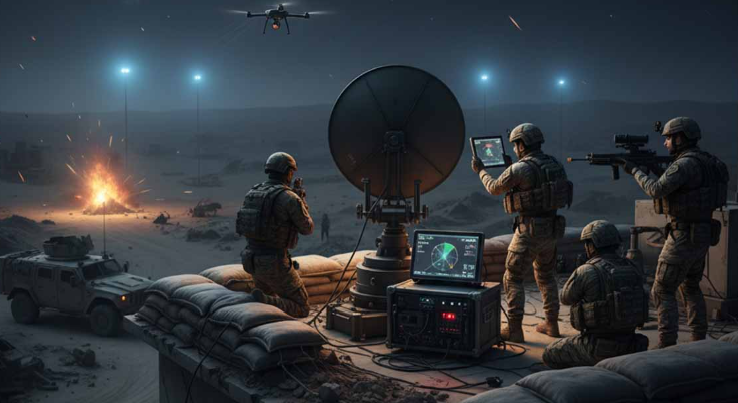
When we see an FPV drone destroying a tank, we are seeing the final moment of a much longer chain.
The target first had to be detected, identified, and tracked. The information had to be transmitted, someone had to decide to attack, and the result then had to be assessed.
The drone is only one component of the system.
The real military capability emerges when the entire chain works quickly enough, cheaply enough, and repeatedly enough.
And this raises a much more interesting question: how quickly can an organization learn to employ, produce, replace, and modify it?
The Automation Bias
Here we encounter an even deeper issue.
The problem is not only that we may trust machines too much. We may also begin to think too much through them.
The spectacular success of drones creates an obvious temptation: to begin explaining warfare through the drone.
A tank destroyed by an FPV is a powerful image. But that image can conceal everything that made the result possible.
The risk is confusing the visible effect with the system that produced it.
This can become a particular form of automation bias: not necessarily an operator blindly trusting an algorithmic recommendation, but an analyst beginning to accept technology as a sufficient explanation for a much more complex phenomenon.
If the drone shows us a solution, we risk starting to look for problems that can be solved by drones.
And intellectually, that can be just as dangerous as ignoring technology altogether.
The Real Revolution
The real revolution is not the drone.
Nor is it artificial intelligence, loitering munitions, or the ability to manufacture thousands of inexpensive systems.
The revolution lies in the ability to integrate technology, industry, information, and people into a system capable of learning and adapting faster than the adversary.
The drone is merely the most visible manifestation of that change.
What is genuinely new is that an organization can identify a problem on the battlefield, design a solution, produce it, employ it, lose it, modify it, and produce it again in increasingly shorter cycles.
War therefore ceases to be merely a competition between platforms.
It also becomes a competition between learning systems.
And there, once again, the human being reappears.
Because behind every sensor, every algorithm, every link, and every drone is someone who must interpret information, make a decision, design a solution, produce it, employ it, and learn from the results.
Technology did not eliminate the combatant. It expanded him.
And it did not eliminate volume either. It gave volume new forms.
Perhaps that is the true lesson of the war in Ukraine: we are not witnessing the replacement of industrial warfare by technological warfare, but a new stage in which technology can turn knowledge into volume—and volume into combat power.
The real revolution, then, is not in the machine.
It lies in an organization’s ability to learn, produce, and adapt before its adversary does.