The Return of Asymmetry: How Technology, Mass and Learning Are Redefining Military Power / by Diego Bavio
For more than three decades, military thinking was dominated by a seemingly simple assumption: the future of warfare would belong to increasingly sophisticated platforms.
The 1991 Gulf War appeared to confirm that vision. Precision weapons, advanced sensors, air superiority and information dominance allowed the United States and its allies to defeat a much larger army with a fraction of the resources that previous conflicts would have required.
The conclusion seemed obvious: technology had defeated mass.
For an entire generation of military planners, the future appeared to belong to whoever could see farther, strike more precisely and process more information than the adversary.
But something has changed.
The wars in Ukraine and Iran suggest that asymmetry is returning to the centre of military competition.
Not the asymmetry of the Cold War era, when weaker actors relied on guerrilla warfare, improvised explosive devices or unconventional tactics to compensate for material inferiority.
This is something different.
Technology has become sufficiently accessible for asymmetry itself to be industrialized.
A relatively inexpensive system can now be produced in thousands, deployed in large numbers, continuously modified and used to generate effects that were previously associated with much more expensive weapons.
The result is a new combination:
low cost + mass + technology + rapid learning.
And that combination may be changing the definition of military superiority.
From the Asymmetry of the Weak to the Asymmetry of Anyone
For much of the second half of the twentieth century, asymmetry was associated with the weak.
Vietnam, Afghanistan and countless conflicts in Asia, Africa and Latin America reinforced the idea that asymmetric warfare was what weaker actors did when they could not compete conventionally.
But the technological revolution has changed the equation.
Commercial electronics, satellite navigation, miniaturized sensors, artificial intelligence, additive manufacturing and increasingly accessible software have lowered the barriers to military innovation.
Capabilities that once required national programs costing billions of dollars can now be developed, adapted or replicated by small companies, startups and relatively modest organizations.
The technology has not eliminated differences in power.
It has, however, lowered the entry cost for creating military effects.
That distinction matters.
A small actor does not need to become a great power to threaten a great power.
It may only need to find a way to impose costs on a system that is much more expensive to defend.
Ukraine Changed the Equation
Ukraine has provided the clearest demonstration of this transformation.
At the beginning of the Russian invasion, Ukraine faced an obvious material disadvantage: fewer aircraft, fewer missiles, less artillery and a much smaller industrial base.
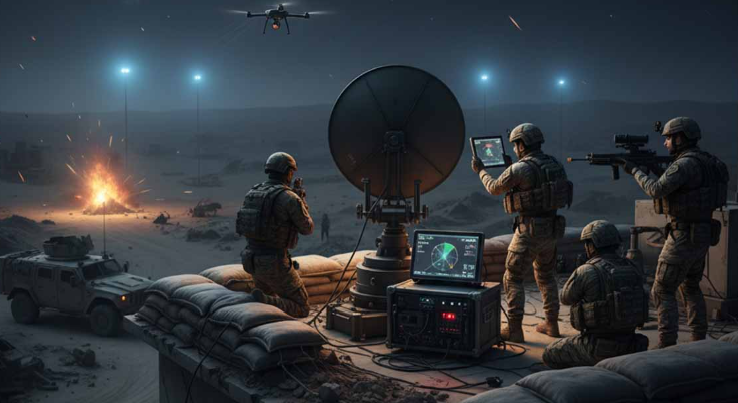
Yet commercial drones, FPV systems, electronic warfare, improvised solutions and rapidly evolving software allowed Ukrainian forces to generate effects disproportionate to their cost.
The important lesson was not that a cheap drone could defeat an expensive weapon.
That is too simple.
The deeper lesson was that a cheap system could become strategically relevant when it could be produced, deployed, replaced and adapted at scale.
Russia eventually adopted the same logic.
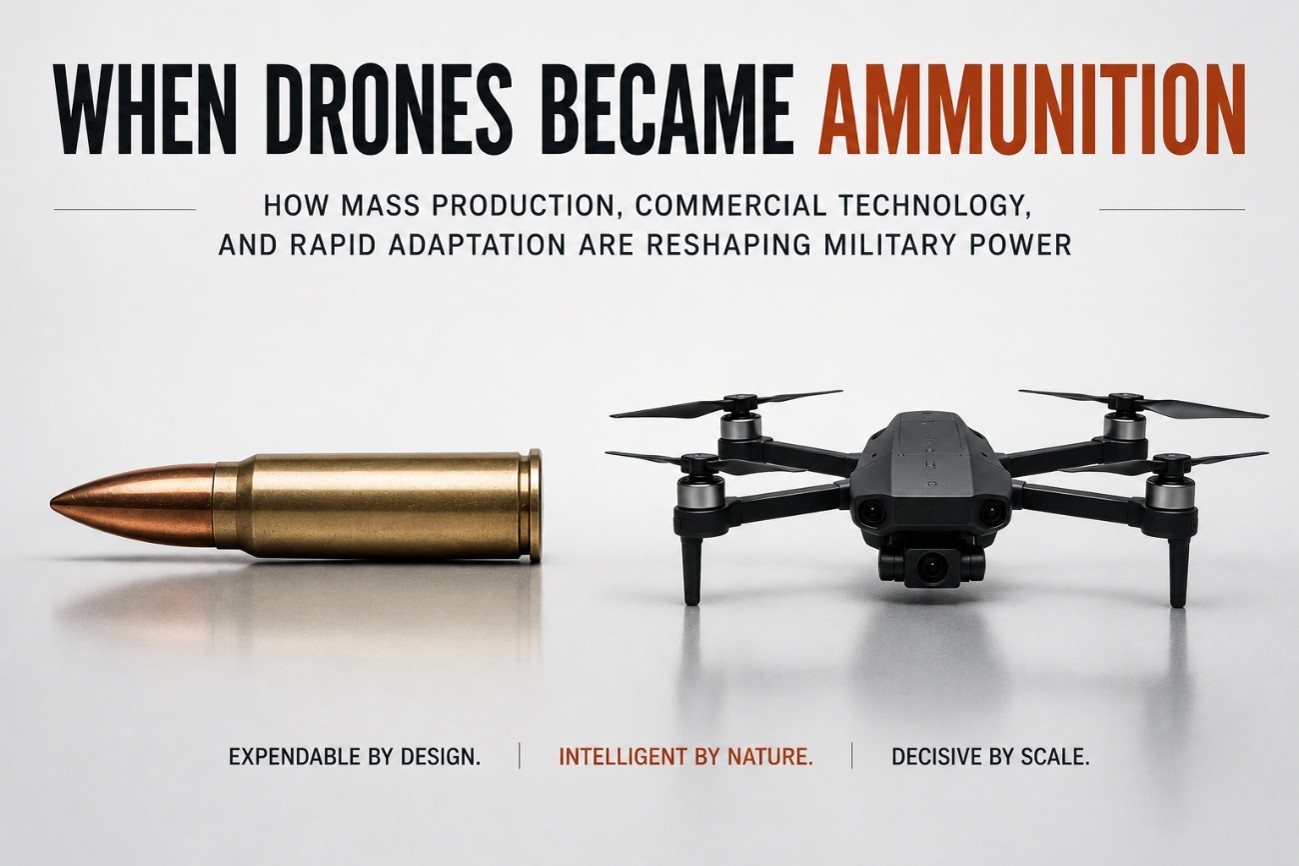
The drone stopped being merely a sensor or an auxiliary weapon and increasingly became an industrialized form of ammunition.
The objective was not always perfect precision.
Sometimes it was volume.
Enough systems to saturate defences.
Enough threats to force the adversary to consume expensive interceptors.
Enough repetition to expose weaknesses and generate new data.
The question therefore changed.
For decades, military planners asked How many targets can this system destroy?
Increasingly, they must also ask How much does it cost to defend against the number of threats the enemy can generate?
The Economics of Asymmetry
This is where the return of asymmetry becomes particularly important.
A $500 drone does not automatically defeat a $100,000 interceptor.
But if hundreds of drones can be produced and employed faster than the defender can manufacture or replenish interceptors, the problem is no longer simply technological.
It becomes economic, then operational and eventually strategic.
The defender may possess the superior weapon and still face an inferior strategic position if defending against the threat consumes resources faster than the attacker can generate it.
This is the paradox of technological superiority:
a system can be technically superior and strategically inefficient.
The equation becomes even more complicated when the attacker can continuously modify its systems.
A drone developed today may be obsolete in weeks.
But that does not necessarily make the investment worthless.
The next version may incorporate what the previous generation learned in combat.
The battlefield becomes a laboratory.
And the laboratory becomes an industrial process.
Iran and the Expansion of the Model
The recent confrontation between Israel and Iran offers another indication that the phenomenon is not limited to Ukraine.
The details of the two conflicts are different, as are the capabilities of the actors involved.
But the underlying problem is similar.
Sophisticated defensive architectures can face increasing difficulty when they must respond simultaneously to large numbers of relatively inexpensive and persistent threats.
The challenge is not simply whether the defender can intercept them.
It is whether the defender can continue intercepting them at the required scale and cost.
That distinction is crucial.
A defence system designed to defeat a limited number of high-value threats may perform extremely well in technical terms and still become strategically stressed when confronted with a much larger number of cheaper systems.
The problem is no longer simply:
Can we stop it?
It becomes:
Can we afford to keep stopping it?
Mass Is Back — But It Is Not the Mass of the Twentieth Century
The return of asymmetry does not mean the return of mass armies in their traditional form.
It is a different kind of mass.
Mass can now be created through relatively small systems produced by distributed industrial networks.
A startup can develop a component.
A factory can produce thousands of units.
Software can modify their behaviour.
Artificial intelligence can assist their employment.
And combat feedback can generate a new version within weeks.
This creates something that twentieth-century military theory was not designed to handle:
mass without necessarily requiring massive platforms.
A thousand relatively inexpensive systems can create a problem that a handful of exquisite systems cannot solve alone.
The decisive question therefore becomes increasingly connected to production, replacement and adaptation.
Who can produce more?
Who can replace losses faster?
Who can modify systems faster?
And, perhaps most importantly:
Who can learn faster?
From Cost Asymmetry to Learning Asymmetry
This may be the most important change.
The first generation of asymmetric warfare focused on finding inexpensive ways to attack expensive capabilities.
The next generation may focus on something broader:
creating an asymmetry in the speed of adaptation itself.
A system that costs $500 may not remain effective for long.
Its advantage comes from what happens next.
The operator identifies a weakness.
The developer modifies the system.
The new version returns to the battlefield.
The adversary adapts.
The cycle begins again.
This creates a competition not simply between weapons, but between learning cycles.
And this is where Military Learning Velocity becomes relevant.
The decisive advantage may belong not to the force possessing the most advanced technology, but to the force capable of transforming battlefield experience into new operational capability faster than its opponent.
Technology changes the battlefield.
Learning velocity determines how quickly an organization can change with it.
The Platform Problem
This also raises a difficult question for traditional defence planning.
Can a platform designed today remain relevant twenty or thirty years from now?
Modern fighter aircraft, warships and armoured vehicles are expected to remain in service for decades.
But the technological environment around them can change in months.
Artificial intelligence, autonomous systems, electronic warfare, distributed sensors and increasingly sophisticated drones are changing the battlefield at a speed that traditional procurement cycles were never designed to accommodate.
The problem is not that large platforms have suddenly become useless.
They have not.
The problem is that their value increasingly depends on their ability to adapt within an ecosystem that changes faster than the platform itself.
The future may therefore belong less to the “perfect platform” and more to the platform capable of being continuously upgraded, connected and reconfigured.
The New Measure of Military Superiority
For much of the twentieth century, military superiority was closely associated with the quality of weapons systems.
The twenty-first century may require a different measure.
Not simply: How advanced is the weapon?
But: How quickly can it be produced?, How cheaply can it be replaced?, How rapidly can it be modified?, How many can be deployed?
And: How quickly can the organization learn from using them?
This does not mean that exquisite systems have lost their value.
It means that exquisite systems now operate inside an environment increasingly shaped by mass, accessibility and rapid adaptation.
The most sophisticated weapon in the world may still be decisive.
But it may no longer be sufficient by itself.
The Return of Asymmetry
The most important lesson of Ukraine may therefore not be the success of any particular drone.
Nor is it that cheap weapons have somehow defeated expensive ones.
The deeper lesson is that asymmetry has returned to the centre of military competition — and this time it does not belong exclusively to the weak.
Any actor capable of combining accessible technology, industrial scale and rapid learning can create asymmetric effects.
That changes the meaning of military power.
The question is no longer simply who has the best weapon.
It is increasingly, Who can generate the right capability, at the required scale, at an acceptable cost — and adapt it faster than the adversary can respond?
If technology evolves in cycles of months while major defence programs require decades to materialize, perhaps the most important question is no longer which platform will dominate the battlefield of the future.
Perhaps the real question is How many times will that platform have to reinvent itself before it enters service?
And that may be the true return of asymmetry.
Not the return of the weak against the strong.
The return of the adaptable against the predictable.
------
Author Biography
Diego Bavio is an Argentine defense and security analyst specializing in military innovation, logistics, and transnational security in Latin America. He holds a Bachelor's degree in Security Sciences and developed the Military Learning Velocity (MLV)framework, which examines how the speed of organizational learning is becoming a decisive factor in modern warfare. His research also focuses on transnational criminal ecosystems, military adaptation, and regional security dynamics.