The Problem Was Never the Paper: Europe Already Had a Security Architecture. Russia Broke It.
Perhaps Europe’s problem is that nobody thought of another agreement.
Another consultation mechanism. Another communications channel. Another solemn declaration that borders must be respected and countries should not attack their neighbours.
Except, of course, Europe already had those things.
That is what makes Washington's latest discussion of a new European security architecture simultaneously interesting and uncomfortable.
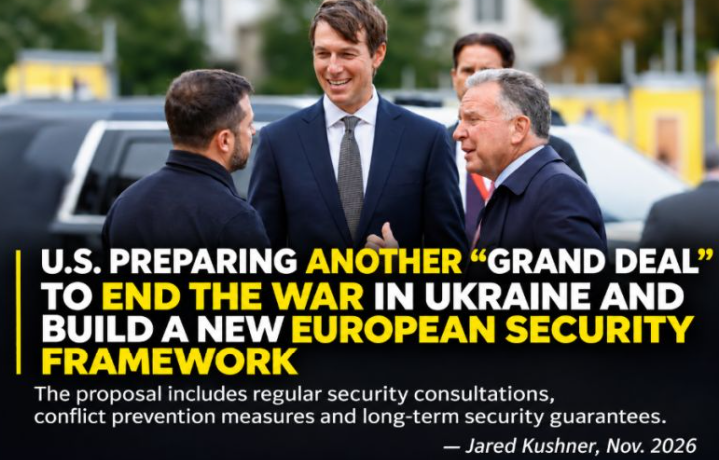
Jared Kushner says the United States is examining five objectives: permanent security consultations, reliable crisis communications, greater military transparency, reciprocal measures to reduce escalation risks and a durable framework for European security. Crucially, he also says countries must retain sovereignty over their security arrangements, while NATO remains central to Europe's collective defence.
All perfectly reasonable principles.
They also sound strangely familiar.
Because the fundamental crisis in European security was not created by Europe's inability to write such principles down.
It was created by the failure to obey them.
Ukraine has seen this movie before
Nowhere is that contradiction clearer than in Ukraine.
In the 1994 Budapest Memorandum, Russia, the United States and the United Kingdom reaffirmed commitments to respect Ukraine's independence, sovereignty and existing borders, and to refrain from the threat or use of force against its territorial integrity or political independence.
Ukraine, meanwhile, committed to eliminating the nuclear weapons on its territory as it joined the Nuclear Non-Proliferation Treaty as a non-nuclear-weapon state.
One distinction matters enormously: these were security assurances, not the equivalent of NATO Article 5 guarantees.
But that makes the diplomatic lesson no less uncomfortable.
A document existed. Sovereignty was affirmed. Borders were recognised. The use of force was explicitly addressed.
And yet Ukraine ultimately faced precisely the threat those diplomatic principles were supposed to constrain.
That history should hang over every conversation about Europe's next security architecture.
“Security concerns” and moral equivalence
Kushner has said the objective is to address “the security concerns of all sides” and create a more stable and predictable environment.
Diplomatically, that formulation is understandable. Successful negotiations frequently require understanding an adversary's perception of its own security.
But there is a dangerous line between understanding security concerns and legitimising demands over somebody else's sovereignty.
Ironically, Washington's proposal appears to recognise exactly that danger. Kushner says no country should have a veto over another nation's sovereign choices, including its security arrangements and alliances.
That principle should not be diplomatic decoration.
It should be the test.
If a future European settlement preserves Ukraine's ability to determine its own alliances and security policy, it reinforces sovereignty.
If “security architecture” instead becomes code for granting Moscow influence over what Ukraine may or may not do, then Europe has not constructed a new security order.
It has constructed a sphere of influence.
Paper needs consequences
None of this means diplomacy is pointless.
Wars generally do end through some combination of military realities and political agreements. Communication channels reduce the risk of accidental escalation. Transparency can matter. Verification can matter enormously.
The mistake would be believing that signatures themselves create security.
The serious question for any new arrangement is therefore not whether its language sounds convincing.
It is what happens when somebody violates it.
What will be verified?
What triggers a response?
Who guarantees Ukraine's security?
What happens automatically if aggression resumes?
And what costs would make breaking the next agreement strategically irrational?
Without credible answers, Europe's next grand security architecture risks becoming an elegantly drafted answer to the wrong problem.
The lesson of Ukraine is not that agreements have no value.
It is that agreements derive their value from the consequences attached to breaking them.
Vladimir Putin does not need another document explaining that national borders matter.
Moscow has signed documents saying that before.
The challenge for Washington and Europe is harder:
Make sure the next signature comes with consequences stronger than the temptation to violate it.