The Next Battlefield May Be Inside the Headquarters — Where Trust, Data and Decisions Become Targets
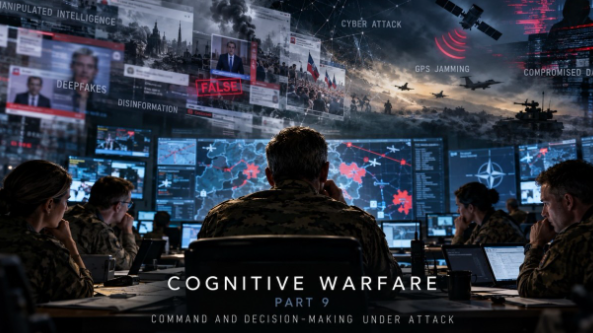
A military headquarters does not need to be physically destroyed to become ineffective.
It can still have functioning computers, staffed command posts, intact communications and established procedures — yet lose the ability to make timely decisions if the information environment around it becomes unreliable.
That is the central danger of cognitive warfare.
The real target is not simply what commanders see.
It is what they trust, how they interpret it, and whether they still feel confident enough to act.
Imagine a multinational headquarters during the opening hours of a crisis. Commercial satellite imagery suggests one thing. Classified intelligence suggests another. A subordinate unit reports unusual military movement. Open-source information gives a different picture. At the same time, communications are intermittent and a seemingly legitimate order must be authenticated.
None of these problems is new on its own.
What has changed is the ability to combine them.
Modern adversaries can manipulate information, disrupt communications, interfere with positioning systems and flood decision-makers with contradictory reports at the same time. The result may not be a false decision.
It may simply be a late one.
That distinction matters.
In high-tempo operations, delay can be as damaging as error.
A commander may postpone reinforcement. Surveillance assets may be redirected toward the wrong threat. Subordinate units may wait for clarification instead of acting. Political authorities may demand more certainty before approving a response.
Each step may be rational.
Together, they can paralyze the decision cycle.
Russia’s war against Ukraine offers the clearest real-world example of how electronic warfare, cyber operations and information manipulation can interact. GNSS jamming and spoofing, communications disruption and battlefield deception can complicate navigation, targeting and situational awareness.
Spoofing is especially dangerous because it does not simply remove information.
It can create information that looks credible but is wrong. A system may continue functioning while feeding false position or timing data into navigation, reporting or the common operating picture.
That creates a difficult problem for commanders:
Seeing is no longer the same as knowing.
Modern headquarters combine ISR feeds, commercial imagery, tactical reporting, OSINT, civilian infrastructure data and automated analytical tools. More data should improve awareness.
But more data can also create more uncertainty.
Several reports may appear to confirm one another while actually originating from the same manipulated source. A technically clean operating picture can therefore give commanders more confidence than the underlying evidence deserves.
Artificial intelligence introduces another layer.
AI can rapidly classify imagery, summarize reports and prioritize information. That can reduce staff workload.
But it can also amplify weaknesses already present in the data.
Manipulated inputs, poisoned datasets, prompt injection and automation bias can influence AI-supported workflows. A machine-generated summary may preserve the conclusion while removing the caveats that originally surrounded it.
The danger is not that AI is always wrong.
It is that it may sound extremely confident when it is wrong.
Information overload can become a weapon in itself.
Military headquarters have finite attention. Every additional warning, cyber incident, intelligence report and request for clarification consumes staff time.
The critical measure is therefore not how much information a headquarters receives.
It is decision latency: how long it takes to recognize a development, understand it, obtain authority and act.
An adversary does not need to overwhelm every system.
It only needs to make the organization slower than the situation it is trying to control.
The response is not simply better technology.
It is stronger command architecture.
That means preserving source provenance, communicating uncertainty, encouraging professional dissent, delegating authority and training units to continue operating when trusted systems fail.
Mission command becomes especially important here.
Subordinates must understand intent well enough to act without constant permission from higher headquarters. Communications alternatives must be genuinely independent. Authentication procedures must exist before contradictory orders appear.
And commanders must know which decisions truly require higher authority — and which can be made locally.
This leads to a broader conclusion.
Cognitive warfare is not just about propaganda or fake news.
It is about disrupting the relationship between information, trust, authority and action.
The headquarters itself has become part of the battlespace.
The next major command failure may not begin with a missile strike.
It may begin with a convincing map, a credible-looking order, a corrupted position — and a commander who waits too long to decide.