From Troop Taxi to Missile Boat: Saab’s CB90 CX Wants to Turn Every Littoral Craft Into a Combat Node
For decades, the logic of the combat boat was brutally straightforward: move soldiers fast, hit the beach, get out.
Saab now wants to rewrite that job description.
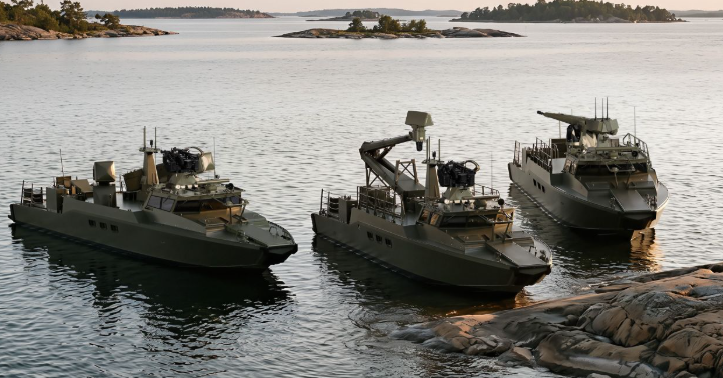
The Swedish defence group has unveiled three configurations of its new CB90 CX, pushing the famous Combat Boat 90 family beyond troop transport and into reconnaissance, anti-surface warfare and air defence.
And that shift may be more important than another new warship entering service.
Because the CB90 CX is built around a provocative idea: what if serious naval combat power no longer needs to live exclusively aboard serious-sized warships?
According to the article, Sweden is the launch customer for the new boat, which is intended to operate alongside the smaller CB90 NG.
Bigger boat, radically bigger ambition
The physical evolution is immediately visible.
The CB90 CX grows to around 18 metres, compared with 16.3 metres for the CB90 NG. Beam increases from 3.8 to four metres, while propulsion rises from two 900 hp engines to two 1,100 hp units.
Yet both are listed with maximum speeds above 40 knots.
More important is what that additional size allows the boat to carry.
Saab describes increased payload capacity, extensively modernised onboard systems and operation across a broader range of sea conditions. The CB90 CX is also designed for optionally crewed operations using Saab's Autonomous Ocean Core, while retaining troop-transport capability.
The stated crew range tells the story particularly well: zero to ten people.
This is no longer simply a landing craft with better electronics.
It is being pitched as a configurable combat platform.
Three boats, three different fights
The first three configurations show just how far Saab intends to push the concept.
The reconnaissance version uses Saab's Giraffe 1X radar, giving the small platform a role in building the wider tactical picture.
An anti-surface configuration goes further. Imagery released by the company shows two missile launchers, which the source assesses as probably being MARTE ER, potentially allowing a comparatively small and fast craft to threaten targets well beyond traditional combat-boat engagement ranges.
Then comes perhaps the most intriguing configuration: air defence.
The air-defence boat combines Rheinmetall's SeaSnake 30 weapon station with Hensoldt's SPEXER 2000 3D MkIII Naval radar. Sweden had previously ordered eight of the weapon systems, with options covering another 29.
The SeaSnake's 30 × 173 mm cannon has a stated maximum cyclic rate of 1,100 rounds per minute. Combined with airburst ammunition, electro-optical sensors and target-tracking capability, the system is intended to address threats including drones.
And that points toward the much bigger story.
Make the fleet harder to kill
Modern naval warfare presents commanders with an uncomfortable equation.
Concentrate sensors and weapons aboard a handful of exquisite warships and you gain enormous capability, but you also create extremely valuable targets.
Distribute those capabilities across many smaller platforms and the equation begins to change.
A CB90 carrying radar can see.
Another carrying missiles can strike.
Another carrying a 30 mm air-defence system can help protect the force.
Network them together and a flotilla of small boats stops looking like transport infrastructure and starts resembling a distributed combat system.
There are obvious limits. An 18-metre craft cannot reproduce the endurance, magazine depth, sensors, survivability or sea-keeping of a frigate. Adding sophisticated weapons to small boats also does not magically solve targeting, communications, electronic warfare or logistics.
But that may miss the point.
The CB90 CX does not need to replace a major surface combatant to matter.
It only needs to make an opponent's targeting problem harder, create more potential sensor and weapons nodes and force expensive threats to contend with numerous smaller ones.
And the combination of modular payloads with optional unmanned operation adds another dimension: commanders could eventually have greater freedom to decide where combat power requires sailors and where it only requires a platform.
The combat boat was once designed primarily to deliver troops into the fight.
The CB90 CX suggests something different:
The boat itself has joined the fight.