Germany Says “Enough”: Has Russia’s Hybrid War Finally Crossed a Red Line in Europe?

For years, European governments have spoken about hybrid warfare.
Cyberattacks.
Sabotage.
Disinformation campaigns.
Espionage.
Mysterious incidents around critical infrastructure.
The warnings became increasingly familiar.
But this week, Germany took a step that feels fundamentally different.
Berlin officially concluded that Russia was responsible for an attempted drone attack on German soil and announced a series of retaliatory measures that signal a significant escalation in Europe's response to Moscow's hybrid operations.
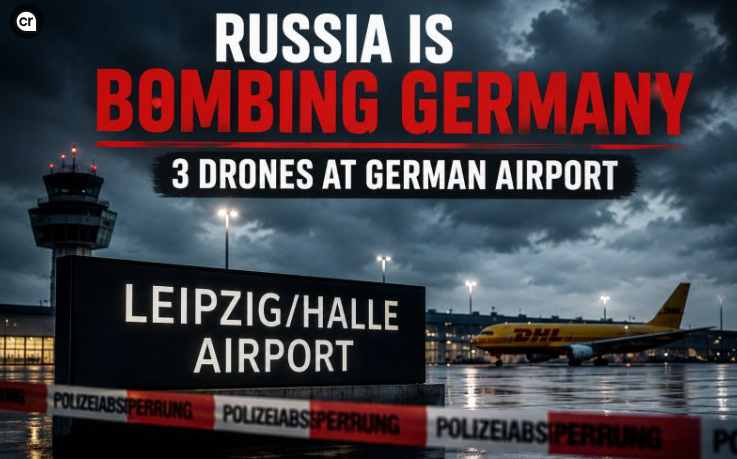
At the center of the controversy is Leipzig/Halle Airport, one of Germany's most important logistics hubs and a key location for Ukrainian cargo operations.
According to German authorities, an explosives-laden drone was discovered near a Ukrainian cargo aircraft on August 4. Investigators concluded that the operation fits a broader pattern of Russian hybrid activities across Europe and that individuals involved were acting on behalf of Russian state entities.
The accusation is remarkable not because Europe has never suspected Russian involvement in sabotage activities.
It is remarkable because Germany is now saying it publicly.
From Suspicion to Attribution
Hybrid warfare thrives in ambiguity.
Operations are designed to remain below the threshold of conventional military confrontation.
Deniability is a feature, not a flaw.
When sabotage occurs, governments often hesitate to assign responsibility publicly unless they possess overwhelming evidence.
That is why Germany's statement matters.
Interior Minister Alexander Dobrindt said that police investigations, intelligence findings, and operational patterns pointed to Russian responsibility for the attempted attack. The German government formally concluded that Russia was behind the incident.
Such direct attribution is among the strongest accusations made by a major European state since the beginning of Russia's full-scale invasion of Ukraine.
The message from Berlin appears straightforward:
This was not considered an isolated criminal event.
It was viewed as part of a broader security challenge.
Germany's Response Is More Than Symbolic
The reaction was immediate.
Germany announced the closure of Russia's Consulate General in Bonn and the termination of the arrangement under which the Russian House in Berlin operates. Officials also signaled tighter entry controls and support for additional sanctions measures.
Taken individually, these measures may not dramatically alter the strategic balance.
Taken together, however, they reveal a changing mindset.
For decades, many European governments treated hybrid threats as an uncomfortable gray zone between peace and war.
That gray zone appears to be shrinking.
The language used by German officials was unusually direct.
Foreign Minister Johann Wadephul stated that Germany is not at war but remains a daily target of hybrid warfare.
That statement reflects a broader realization emerging across Europe:
The battlefield may no longer begin at a country's borders.
The New Front Line Runs Through Airports, Data Centers, and Infrastructure
Modern confrontation rarely resembles the conflicts of the twentieth century.
Instead of tanks crossing borders, threats increasingly involve cyber networks, transportation hubs, communication systems, energy infrastructure, and logistics nodes.
Leipzig Airport is particularly significant because of its logistical role for NATO activities and Ukrainian air cargo operations.
If critical infrastructure becomes a target, the implications extend far beyond a single incident.
Every airport.
Every railway hub.
Every power facility.
Every communications network.
Potentially becomes part of the security landscape.
This is precisely why many European governments are now investing heavily in resilience, counter-sabotage capabilities, counter-drone technologies, and intelligence cooperation.
A European Turning Point?
What makes this episode especially important is timing.
Europe is already navigating a period of heightened geopolitical tension.
Defense spending is rising.
Counter-drone programs are accelerating.
Civil infrastructure protection has become a strategic priority.
And governments are increasingly viewing security through a whole-of-society lens.
Germany's move may therefore represent more than a response to one incident.
It may signal a broader shift from documenting hybrid pressure to actively responding to it.
Whether this produces meaningful deterrence remains uncertain.
But politically, Berlin appears determined to demonstrate that actions attributed to state actors will carry consequences.
The Bigger Question
The most important issue may not be the drone itself.
It is what happens next.
If European governments increasingly view sabotage, cyberattacks, infrastructure disruptions, and covert operations as elements of a coordinated campaign, the threshold for political and economic responses may continue to fall.
The challenge for Europe is no longer simply identifying hybrid warfare.
The challenge is deciding how to deter it.
And Germany's response suggests that debate may have entered a new phase.