The Drone We Invented, Then Ignored: How the Netherlands May Have Missed a Battlefield Revolution
History has a cruel sense of humor.
Sometimes a breakthrough technology appears too early. Engineers build it. Military officers test it. Innovators champion it. The concept works.
Then it gets shelved.
Years later, another country develops a similar solution, adapts it to a wartime necessity, and suddenly the world calls it revolutionary.
That appears to be the story unfolding around battlefield evacuation drones.
Recently, Ukrainian manufacturer Skyfall unveiled the StarGate, a heavy-lift drone capable of evacuating wounded soldiers directly from frontline positions. With a reported payload capacity of 150 kilograms and a range of roughly 15 kilometers one way, the platform addresses one of the most dangerous challenges in modern warfare: rescuing casualties under fire.
The innovation has attracted significant attention.
Yet for some observers in the Netherlands, the announcement triggered an uncomfortable realization.
The concept is not new.
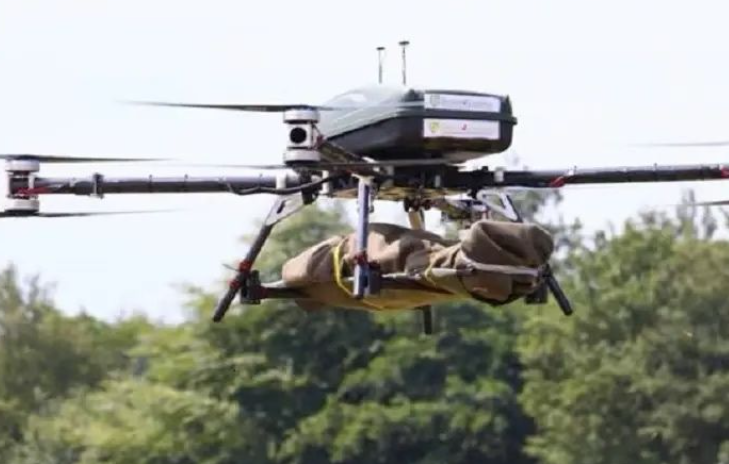
More than a decade ago, the Koninklijke Landmacht worked together with Machinefabriek Boessenkool B.V. and entrepreneur Eelco Osse on remarkably similar battlefield evacuation drone concepts. According to those involved, the project generated enthusiasm and international interest, presenting what appeared to be a genuinely pioneering capability.
But the technology never moved beyond experimentation.
The Innovation Trap
Defense organizations love innovation.
Innovation centers.
Innovation labs.
Innovation challenges.
Innovation conferences.
Few words appear more frequently in military strategy documents.
Yet genuine transformation requires something far more difficult than innovation.
It requires implementation.
This is where many promising ideas die.
The reasons are often familiar.
Existing systems already perform the function.
Budgets are constrained.
Doctrine is not ready.
Organizational structures cannot accommodate the capability.
Risk outweighs perceived benefits.
On paper, each objection appears reasonable.
Collectively, they can strangle innovation.
The evacuation drone reportedly encountered exactly these types of barriers. Existing vehicles already handled casualty transport. Medical procedures were designed around traditional systems. Operational concepts had not yet evolved to exploit unmanned evacuation platforms.
As a result, a potentially transformative capability remained largely unrealized.
Ukraine Changed the Equation
War has a way of exposing flawed assumptions.
The conflict in Ukraine has fundamentally altered how militaries think about casualty evacuation.
Traditional ambulance vehicles can be detected and targeted.
Road access may be impossible.
Drone surveillance is constant.
Artillery coverage is extensive.
Even approaching a wounded soldier can become a life-threatening mission.
In these conditions, unmanned evacuation systems are no longer experimental curiosities.
They become operational necessities.
A drone does not eliminate battlefield risk.
But it can reduce the number of personnel exposed to danger while preserving the critical objective of recovering wounded troops.
Suddenly, a concept once considered unnecessary begins to look essential.
The Cost of Moving Too Slowly
The strategic implication extends beyond military capability.
Innovation is also industrial policy.
Every breakthrough technology creates supply chains, expertise, intellectual property, export opportunities, and jobs.
When promising technologies fail to transition from prototype to production, countries often lose more than military advantages.
They lose market leadership.
While others commercialize and scale solutions, early innovators watch from the sidelines.
That reality sits at the heart of growing debates surrounding European defense innovation.
Governments increasingly emphasize strengthening domestic defense-industrial capabilities. The Netherlands itself has highlighted these goals through initiatives such as the Defensie Strategie voor Industrie en Innovatie (D-SII) 2025-2029, supported by both the defense establishment and the Ministerie van Economische Zaken en Klimaat.
But strategy documents alone do not create industrial champions.
Procurement decisions do.
From Talking About Innovation to Buying It
Perhaps the most important lesson of the evacuation drone story is not technological.
It is cultural.
Many organizations celebrate creativity.
Far fewer reward disruption.
The challenge is not generating ideas.
Engineers generate ideas every day.
The challenge is creating institutions willing to adopt them before a crisis proves their value.
Ukraine's wartime innovations demonstrate what happens when operational necessity accelerates implementation.
The Netherlands' experience highlights what can happen when implementation falls behind imagination.
The irony is striking.
Ten years ago, an evacuation drone looked like a solution searching for a problem.
Today, the problem has arrived.
And the solution is making headlines elsewhere.
Because in defense technology, the gap between invention and adoption can determine not only who innovates first, but who benefits when the rest of the world finally catches up.