The Boxer Effect. Why Germany and the Netherlands Are Betting on a New Generation of European Combat Power
Europe's defense industry is entering a new phase.
Not with a revolutionary announcement or a futuristic weapons program, but with something arguably more important: a growing commitment to common platforms, common capabilities and common strategic thinking.
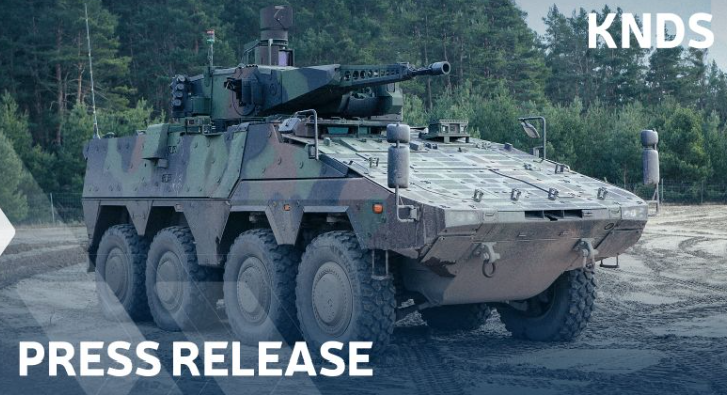
The latest signal came from Munich, where ARTEC, the joint venture formed by KNDS Deutschland and Rheinmetall, received an order from OCCAR for 69 additional BOXER RCT30 wheeled infantry fighting vehicles for Germany and the Netherlands. While the numbers themselves are significant, the broader message may be even more important.
Europe is increasingly choosing cooperation over fragmentation.
The additional procurement expands on the 2025 contract for 222 systems. Germany will receive 35 more vehicles, while the Netherlands adds 34, bringing the Dutch fleet to 106 BOXER RCT30 platforms. Beyond the statistics lies a deeper transformation taking place across European defense planning.
For decades, European armed forces often developed separate solutions for similar operational problems. Different equipment, different logistics chains, different training systems and different maintenance requirements created complexity and cost.
The BOXER story points in another direction.
As KNDS Deutschland CEO Florian Hohenwarter noted, Germany and the Netherlands have spent decades building defense partnerships through programs such as LEOPARD 2 and BOXER. The benefits extend far beyond procurement budgets. Shared platforms improve interoperability, simplify training, strengthen logistics and enable allied forces to operate more effectively together.
In an increasingly uncertain security environment, that interoperability has become a strategic asset.
The BOXER RCT30 itself represents one of the most capable wheeled combat vehicles currently entering service in Europe.
At its core is a combination of two proven combat systems. The highly adaptable BOXER platform is already used by multiple nations, while the remotely operated 30 mm turret is derived from the PUMA infantry fighting vehicle. The combination creates a highly mobile platform capable of engaging targets while moving, providing armored infantry with significant battlefield flexibility.
Mobility may be its most valuable feature.
Modern military planners are increasingly focused on speed, maneuverability and responsiveness. Heavy armored formations remain critical, but conflicts in recent years have demonstrated the growing importance of forces that can rapidly deploy, reposition and respond to changing battlefield conditions.
This is exactly where Germany's new "Medium Forces" concept comes into play.
The Bundeswehr has designated the BOXER RCT30 as "Schakal," and the vehicle is expected to become one of the defining platforms of this emerging force structure. Designed to bridge the gap between heavy armor and light mobile units, these formations seek to combine protection, firepower and operational agility.
The result is a combat vehicle built for a battlefield that looks very different from the one military planners envisioned twenty years ago.
The list of capabilities reflects these changing realities.
The "Schakal" is designed not only to engage traditional armored targets but also to confront newer threats. It incorporates anti-tank capabilities through the MELLS guided missile system and is described as capable of countering drones and aircraft, challenges that have become increasingly relevant in contemporary military operations.
Such versatility is becoming essential rather than exceptional.
Across Europe, armed forces are adapting to an environment where the battlefield includes armored vehicles, UAVs, precision-guided weapons, cyber effects and long-range surveillance systems operating simultaneously. Platforms that can address multiple threat types are increasingly viewed as critical investments.
Yet perhaps the most significant aspect of this procurement is not the technology itself.
It is the political message.
The additional order demonstrates growing confidence in European industrial cooperation at a time when governments are seeking greater resilience in defense supply chains. Every joint procurement increases production volumes, strengthens industrial capacity and reduces duplication of effort across allied nations.
That matters because security today is not measured solely by the number of vehicles delivered.
It is measured by the ability to sustain production, integrate allies and field capabilities quickly when required.
With Germany and the Netherlands joining as users of the BOXER RCT30, the system is now under contract with four nations. That growing user community creates a foundation for future cooperation, shared upgrades and long-term support structures.
The new order therefore represents more than an acquisition program.
It is evidence of a broader shift underway across Europe.
A shift toward common platforms.
A shift toward interoperability.
And a shift toward a defense model where collaboration is becoming as important as firepower itself.
In the age of multinational security challenges, the BOXER RCT30 is more than a vehicle.
It is becoming a symbol of how Europe intends to build its future combat power together.