The American Who Built a Town for Ukraine. Why One Man’s $140 Million Commitment Challenges the World
History often remembers presidents, generals, and billion-dollar government programs.
It remembers institutions.
It remembers states.
What history sometimes forgets is that extraordinary moments are often shaped by extraordinary individuals.
At a time when Ukraine is fighting for its survival, one American businessman has quietly demonstrated how much impact a single person can have.
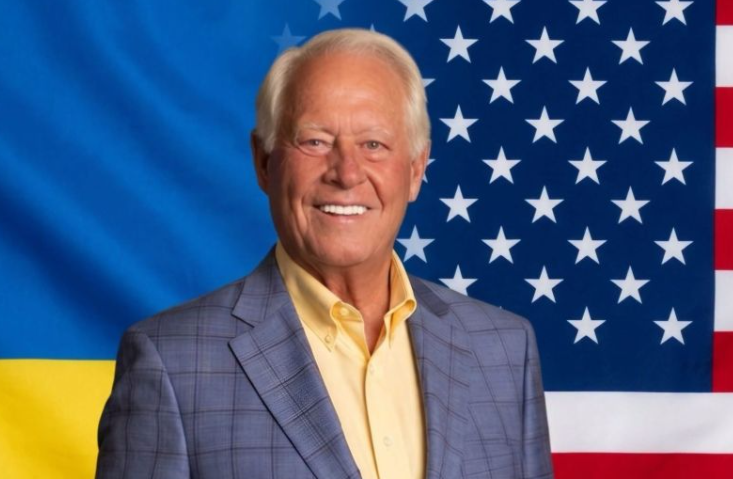
His name is Dell Loy Hansen.
And his story raises an uncomfortable question for the rest of the world:
What happens when one individual's commitment surpasses the imagination of entire institutions?
While headlines focus on military aid, diplomatic negotiations, and geopolitical strategy, Hansen has chosen a different battlefield.
The battlefield of human dignity.
The statistics alone are remarkable.
Using his own resources, Hansen has funded the construction of an entire community for Ukrainians displaced by Russia's war. Today, hundreds of families who lost everything now have a roof over their heads, a neighborhood to call home, and a chance to begin rebuilding their lives.
But the scale of the effort goes far beyond a housing project.
More than 250 apartments have been acquired for Ukrainians who were left without homes. Plans include additional communities, schools, and medical facilities. Reports place Hansen's personal commitment at more than $140 million.
Not government money.
Not corporate grants.
Not aid financed through taxpayers.
His own money.
The significance of this cannot be measured purely in dollars.
Because war destroys more than buildings.
It destroys predictability.
It destroys community.
It destroys the sense that tomorrow will be better than today.
Rebuilding therefore requires more than concrete and steel.
It requires hope.
That may be the most valuable asset Hansen has provided.
Millions of Ukrainians have been displaced since the full-scale invasion began. Entire cities have been damaged. Families have been separated. Children have grown up surrounded by uncertainty.
For many of them, the greatest fear is not what they lost.
It is whether they will ever be able to rebuild.
Projects like these answer that question with something powerful:
Yes.
Recovery is possible.
The effort also challenges a common assumption about philanthropy.
Large charitable donations often become exercises in visibility. Press conferences, naming rights, public campaigns, and carefully managed media strategies frequently accompany major contributions.
Yet some of the most transformative acts of support happen away from global headlines.
The families moving into safe homes rarely care whether the donor appears on television.
What matters is that the lights work.
The heating functions.
Children have bedrooms.
Life becomes normal again.
In wartime, normality becomes priceless.
The deeper significance of Hansen's work lies in what it represents.
His connection to Ukraine is not based on geography.
He was not born there.
He did not grow up there.
The war did not force him from his home.
Yet he chose to act as though the suffering of Ukrainians mattered personally.
That decision stands as a reminder of something that conflicts often reveal:
Human solidarity does not recognize borders.
The most effective support does not always come from those closest geographically.
Sometimes it comes from those who simply refuse to look away.
Throughout history, societies under attack have survived not only because of military victories but because ordinary people, companies, charities, volunteers, and philanthropists stepped forward when governments alone could not meet every need.
Ukraine's resilience has been powered by countless such acts.
Some involve delivering humanitarian aid.
Others involve supporting hospitals.
Others involve rebuilding schools.
Few, however, match the scale of creating entire communities for those who lost everything.
As the war continues, debates about weapons, sanctions, and diplomacy will remain essential.
But long after the fighting ends, another challenge will remain:
Rebuilding lives.
That process will require vision, investment, and compassion on a massive scale.
Dell Loy Hansen has already begun that work.
His contribution is not merely a donation.
It is a statement.
A statement that even in humanity's darkest moments, there are still people willing to invest not just in reconstruction, but in other human beings.
And perhaps that is why his story resonates so deeply.
Because in a world that often calculates value in profit and power, Hansen reminds us that the greatest measure of wealth may be how many lives you help rebuild.