(Un)Manned Warfare. NATO Is Buying Thousands of Drones, But Who Will Fly Them?

Western militaries have focused on acquiring advanced weapons systems. Now they are racing to acquire drones. From America's ambitious plan to field thousands of low-cost unmanned aircraft to Europe's proposed "Drone Wall" along its eastern border, NATO nations are investing billions into the technologies shaping modern warfare.
But Ukraine's battlefield experience reveals a critical reality that procurement announcements rarely mention:
A drone without a trained crew is little more than expensive hardware.
According to Ukrainian military operators, manufacturers, and instructors, between 80% and 90% of a drone mission's success depends on people, not technology. Pilots, navigators, engineers, mechanics, explosives specialists, and mission planners ultimately determine whether a drone becomes a force multiplier—or a wasted investment.
As NATO increasingly prepares for a future dominated by unmanned systems, it faces a challenge that Ukraine knows all too well: training tens of thousands of qualified drone specialists.
The Missing Piece in NATO's Drone Revolution
Russia's invasion of Ukraine transformed drones from niche military tools into one of the most decisive factors on the battlefield.
The United States recently unveiled its "Unleashing American Drone Dominance" initiative, aimed at rapidly fielding up to 10,000 low-cost air vehicles. The United Kingdom is restructuring significant portions of its military around unmanned capabilities. European Union members are discussing a multinational "Drone Wall" to monitor and defend borders against increasing Russian drone incursions.
Yet while governments discuss procurement targets and production capacity, comparatively little attention is being paid to the people required to operate these systems.
Dr. Paul Schwennesen, a U.S.-based military affairs analyst who recently returned from volunteer service in Ukraine, warns that practical drone training remains far behind operational needs.
Despite discussions about future programs, Schwennesen says he has yet to witness the kind of systematic adoption of tactical FPV drone training within NATO militaries that has become commonplace in Ukraine. He points out that even institutions such as the U.S. Air Force Academy do not currently field dedicated drone teams comparable to those operating in Ukraine's combat environment.
Ukraine's Most Important Lesson: People Matter More Than Machines
For Ukrainian operators, the lesson is straightforward.
According to Maria Berlinska, veteran of the Russo-Ukrainian War and head of the Victory Drones project, approximately 85–90% of success comes from people, while only 10–15% depends on equipment and other factors.
"A drone by itself delivers nothing," Berlinska argues. Success requires coordinated work from operators, mechanics, engineers, drivers, and support personnel.
The same view is echoed by Oleksandr Yakovenko, CEO of TAF Industries, one of Ukraine's leading FPV drone manufacturers.
Today, most Ukrainian FPV producers manufacture systems of broadly comparable quality. The difference increasingly lies in the operator's ability to exploit the platform's capabilities.
Even the most advanced drone will underperform in the hands of an inexperienced pilot.
Three Months to Create a Combat Operator
Ukraine's elite drone units have learned that producing effective crews cannot be rushed.
The 429th Unmanned Systems Regiment "Achilles", one of the country's most successful drone formations, has reportedly destroyed or damaged more than 43,000 Russian targets since 2022.
Its commander, Yuriy Fedorenko ("Achilles"), estimates that transforming a recruit into a soldier capable of conducting combat drone missions requires at least three months of intensive training.
Drone skills are highly specialized.
An FPV operator cannot automatically fly reconnaissance systems. A reconnaissance pilot cannot immediately transition to interceptor drones. Fiber-optic drones, strike drones, surveillance platforms, and counter-drone systems each require different competencies.
"It's like driving," Fedorenko explains. "The basic principles remain the same, but every vehicle demands different skills."
How Many Drone Troops Does NATO Need?
Ukraine's Unmanned Systems Forces currently comprise roughly 20,000 personnel, representing approximately 2.2% of Ukraine's 900,000-person armed forces.
Commander Robert Brovdi wants that number increased to around 45,000 personnel, equal to roughly 5% of Ukraine's military.
Applying even the lower Ukrainian benchmark to NATO militaries produces striking numbers.
Experts estimate that the United States would require approximately 26,000 unmanned systems specialists, while Germany and the United Kingdom would each require around 3,600 personnel. Poland would need more than 4,300 dedicated specialists.
According to Austin Gray, CEO and co-founder of Blue Water Autonomy, even these figures may be too conservative.
He argues that drone penetration across U.S. military formations remains relatively low and will likely need to increase significantly as unmanned systems become standard across combat units.
The Engineer Behind Every Successful Drone
Pilots receive most of the attention, but Ukrainian veterans repeatedly emphasize the importance of engineers.
Former Ukrainian parliamentarian and frontline servicemember Tetiana Chornovol argues that engineering support represents roughly half of a drone's success.
Engineers continuously adapt systems to combat conditions, test frequencies against electronic warfare threats, calibrate communications equipment, and prevent technical failures.
As battlefield conditions evolve daily, drone units often depend as much on technical expertise as flying skills.
This challenge is becoming increasingly complex.
More than 400 drone types are currently operating on Ukraine's battlefield.
The Interceptor Challenge
Ukraine's growing fleet of interceptor drones highlights why training is becoming even more important.
Costing approximately $5,000 each, interceptor drones have become an increasingly important component of air defense. During Russia's record attack involving 810 drones on September 7, interceptors reportedly accounted for roughly 20% of successful engagements.
Projects such as Britain's Project Octopus, developed jointly with Ukraine, aim to bring these capabilities to NATO countries.
However, interceptor systems require highly specialized operators.
Ukraine currently maintains more than 33 licensed drone schools, yet instructors remain in short supply.
According to Anton Melnyk of MITS Capital, volunteer training centers such as Victory Drones and Boryviter operate under enormous demand, while military units increasingly establish their own internal schools.
The problem is not producing drones.
The problem is producing enough people who know how to use them.
Autonomy Will Help—But Humans Remain Essential
Technology is gradually reducing manpower requirements.
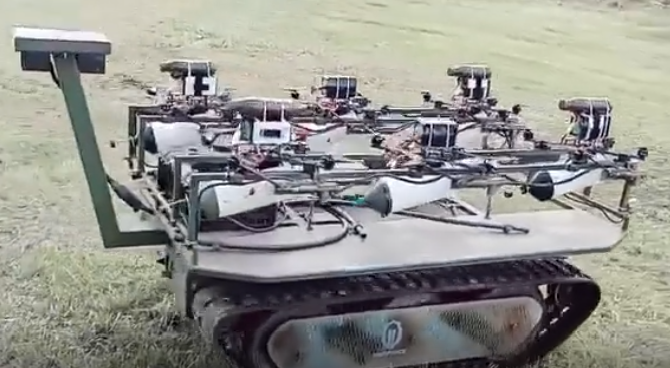
Ukraine is already deploying semi-autonomous systems capable of launching multiple interceptors and AI-enabled swarms that can reduce crew sizes from nine operators to three.
Yet even the most advanced systems still require human oversight.
NATO's "human-in-the-loop" doctrine ensures that people remain responsible for targeting decisions and legal use of force.
At the same time, Russia is investing aggressively in its future drone workforce. Specialized drone classes are appearing in schools, and drone competitions now include children as young as seven years old.
The lesson from Ukraine is impossible to ignore.
The future of warfare may be unmanned.
But victory will still depend on the people behind the controls.