Russian Zebra Truck on War. Why World War I Camouflage Is Colliding with AI on Today’s Battlefield
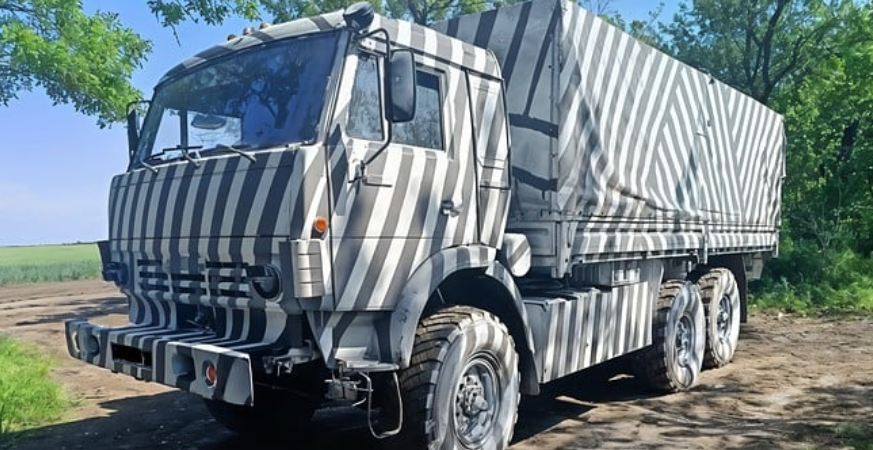
On the modern battlefield, where artificial intelligence hunts targets in milliseconds, Russia is reaching back more than a century—for paint.
Black-and-white stripes. Sharp angles. Vehicles that look more like abstract art than military assets.
At first glance, the idea seems almost surreal: Russian military trucks painted like zebras to evade AI-enabled drones. But beneath the spectacle lies a serious experiment—and a revealing clash between two eras of warfare.
Because this is not just camouflage.
It is a test of whether old deception can survive in a digital war.
A Century-Old Trick Returns
The concept behind the so-called “dazzle camouflage” dates back to World War I. Instead of hiding ships, designers painted them in high-contrast geometric patterns intended to confuse enemy observers about speed, direction, and distance.
The goal wasn’t invisibility—it was distortion.
Submarine commanders relying on visual estimation could miscalculate their shots. Even slight errors in perceived trajectory could mean a miss.
But hindsight has been less kind to the idea.
Recent scientific re-evaluations suggest that the effect of dazzle camouflage was far smaller than originally believed, producing only limited misjudgments in perception rather than decisive confusion.
In other words, even against human eyes, it was never a silver bullet.
From Human Vision to Machine Vision
Which raises a crucial question: what happens when the “observer” is no longer human?
Modern AI-powered drones don’t rely on perception in the same way. They analyze pixel patterns, textures, shapes, and thermal signatures, classifying objects in fractions of a second.
This is an entirely different game.
Unlike a submarine commander in 1917, an AI system is not trying to estimate a target’s trajectory visually. It is matching patterns against enormous training datasets—and improving continuously.
And that is where zebra camouflage runs into a fundamental problem.
Algorithms Don’t Stay Confused
Even if the patterns initially disrupt detection, the advantage may be fleeting.
AI systems can be retrained rapidly. Once enough examples of striped vehicles are collected, the algorithm adapts—and what was once confusing becomes just another recognizable pattern.
This dynamic is well understood in modern camouflage research: techniques must now be evaluated specifically against AI-based detection systems, not just human vision.
In practice, that means the battlefield advantage of visual tricks is temporary at best.
The machine learns. Fast.
Visibility vs Survivability
The irony of dazzle camouflage is that what may confuse machines can expose the target to humans.
High-contrast patterns—especially black and white—are extremely visible to the naked eye. A truck that might confuse an algorithm could stand out dramatically to a human pilot or observer.
And there’s another, more decisive limitation.
Modern warfare is multi-spectral.
Drones don’t rely solely on visible light. Infrared sensors detect heat signatures, identifying engines and moving vehicles regardless of paint schemes. Optical camouflage simply cannot hide thermal emissions.
In a battlefield dominated by multi-modal detection—optical, infrared, and beyond—paint alone is no longer enough.
The Real Battlefield: Logistics
The resurgence of such tactics reveals something deeper.
In Ukraine, AI-enabled drones are increasingly targeting not just front-line units, but logistics—supply trucks, fuel depots, and transport routes. These systems can autonomously identify and strike targets deep behind the lines, reshaping how wars are fought.
That makes every vehicle a potential target.
And it explains why simple, scalable solutions—like paint—are being tested. Electronic countermeasures are expensive. Advanced stealth technologies are limited.
But paint is cheap.
And in war, cheap experiments happen fast.
Desperation or Innovation?
So is zebra camouflage a desperate measure—or a clever adaptation?
The answer may be both.
It reflects a battlefield where the speed of technological change forces constant improvisation. Where even century-old ideas are revived and tested against entirely new threats.
But it also highlights a growing gap: between how humans think deception works—and how machines actually see.
The Future of Camouflage
The lesson is clear.
Camouflage is no longer just about hiding from human eyes. It is about deceiving algorithms trained on millions of images, operating across multiple sensor types, and evolving in real time.
To survive, future camouflage will need to be dynamic, multi-spectral, and software-aware.
Not just paint—but systems.
Because in a war increasingly fought by machines, the real question is no longer:
“Can you hide?”
It’s:
“Can you stay hidden long enough for the algorithm not to learn?”