The Future of Warfare in Russian Military Thinking

Russia is not fighting yesterday’s war.
It is failing through today’s war in order to imagine tomorrow’s.
That is the unsettling conclusion buried inside a new Swedish defense research report, The Future of Warfare in Russian Military Thinking, which frames the war in Ukraine as a “transitional war” - a massive live-fire experiment forcing Moscow to rethink nearly everything about how wars are fought.
From Moscow’s perspective, Ukraine is not merely a battlefield. It is a laboratory.
And what Russian military thinkers are extracting from that laboratory points toward a future that looks less like Hollywood’s mechanized warfare and more like a bleak ecosystem of drones, sensors, satellites, precision missiles, electronic warfare, and constant surveillance.
Welcome to the age of the transparent battlefield.
Russian analysts increasingly describe modern combat as taking place under permanent observation. Nothing hides for long. Tanks glow. Artillery reveals itself. Infantry formations light up across thermal sensors, drones, satellites, and electronic emissions.
The result?
Classic maneuver warfare is breaking down.
Russian military writers openly acknowledge that Ukraine has produced positional deadlock - not unlike World War I, but supercharged with 21st-century technology. Trench systems exist alongside quadcopters. Barbed wire meets artificial intelligence. Precision artillery replaces massed human waves - at least in theory.
This has triggered a civil war inside Russian military thought.
One faction clings to tradition. More mass. More artillery. More firepower. Bigger forces smashing forward through sheer violence.
The other faction sees something darker and more disruptive.
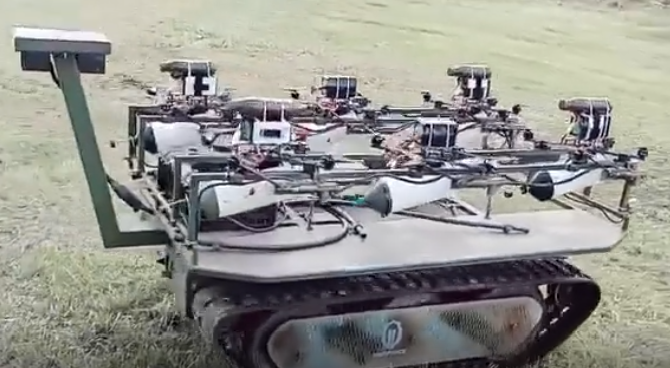
They argue that drones are having a “revolutionary impact” on military science. That the era of large battalions may be ending. That lighter, cheaper, distributed formations matter more than heavy armored spearheads. That survivability beats size.
That is not Western language.
That is Russian generals and analysts saying it.
Airpower, in Russian thinking, is no longer just about pilots and dogfights. The future belongs to non-contact warfare - long-range, high-precision strikes delivered from aircraft, ships, ground launchers, and space-enabled systems.
Russian theorists imagine wars opening with massive aerospace attacks before ground forces even move. Hypersonic missiles. Cruise missiles. Swarms of drones. Cyber and electronic attacks blinding command networks.
The opening minutes of future wars may decide everything.
Space, meanwhile, has quietly become central.
Russian writers now treat space not merely as support for navigation and communications, but as an active combat domain. Satellites guide missiles, locate targets, synchronize units, and enable near-instant kill chains. At the same time, destroying enemy ground stations, data-processing centers, and space infrastructure is viewed as one of the most effective ways to paralyze an opponent.
The future battlefield begins above the atmosphere.
Cyber warfare, interestingly, is not treated as a separate domain in Russian thinking. It is folded into something broader - “information confrontation.” Cyber attacks, electronic warfare, psychological operations, propaganda, and deception are seen as one continuous struggle.
In Russian theory, war does not start when tanks cross borders.
It starts when information space shifts.
Nuclear weapons remain the ultimate backstop.
Despite all the talk of drones and AI, Russian deterrence thinking still rests on nuclear forces. But modernization is focused on flexibility and survivability rather than sheer numbers. Moscow wants nuclear forces that can ride out a first strike and respond in unpredictable ways.
In short - escalation management matters more than apocalypse.
Perhaps the most revealing conclusion of the report is not about technology.
It is about mindset.
Russian military thinkers do not believe peace is stable or permanent. They view international politics as continuous competition across military, economic, informational, and technological dimensions. War is not an exception. It is a condition that periodically turns violent.
Ukraine did not shatter this worldview.
It confirmed it.
At the same time, Russia’s thinkers are painfully aware of constraints. Economic limits. Sanctions. Industrial bottlenecks. Dependence on partners like China. The future they imagine is ambitious, but uneven, improvised, and shaped by scarcity.
Which makes it more dangerous, not less.
Because scarcity pushes asymmetric solutions.
Cheap drones instead of expensive jets. Electronic warfare instead of aircraft carriers. Cyber sabotage instead of large invasions.
Russia is not trying to outbuild the West.
It is trying to outcomplicate it.
For Western planners, the warning is clear.
The next war Russia prepares for is not a repeat of Ukraine.
It is a faster, more automated, more opaque conflict where the opening blows may come from orbit, cyberspace, and unmanned systems long before soldiers see each other.
Ukraine is the classroom.
The real exam comes later.