Kasparov’s Warning. The Next Battlefield May Not Be Ukraine—It Could Be NATO
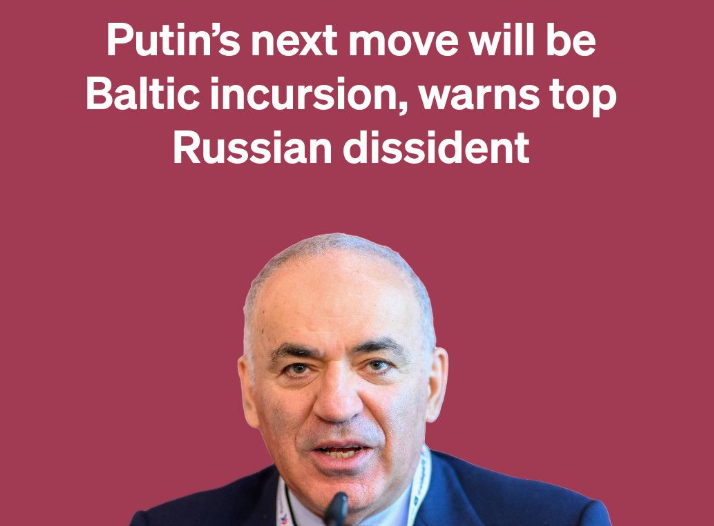
For nearly five years, the world has watched the war in Ukraine through a familiar lens: front lines, drone strikes, sanctions, and negotiations that never seem to go anywhere.
But according to one of Vladimir Putin's most outspoken critics, the next move may not happen inside Ukraine at all.
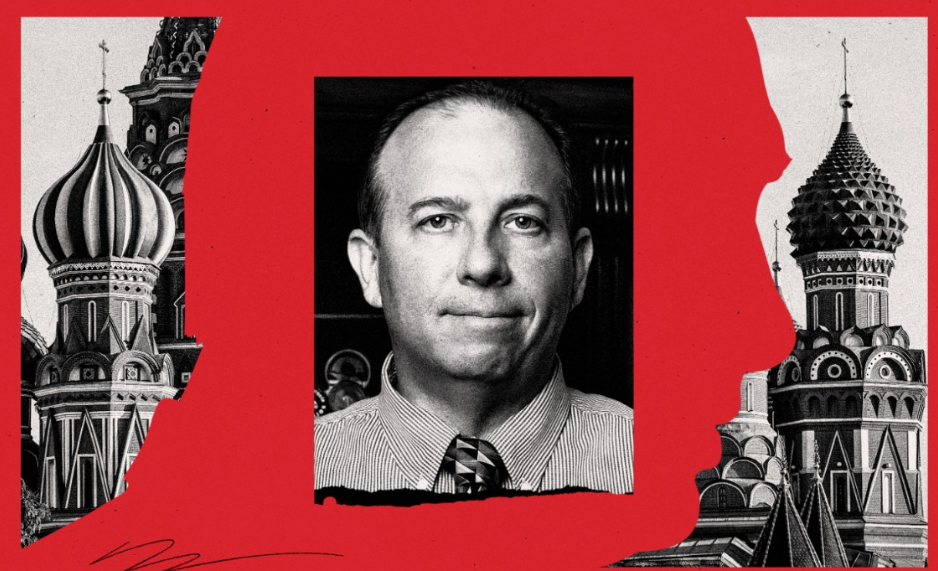
Former world chess champion and Russian opposition figure Garry Kasparov believes the Kremlin is not preparing for peace. Instead, he argues, Moscow could be preparing for a dangerous escalation that would directly challenge NATO itself.
His warning is simple—and unsettling.
If Putin feels cornered, history suggests he won't retreat. He will escalate.
The Logic of Escalation
Throughout his political career, Putin has displayed a consistent pattern.
When facing setbacks, he tends to raise the stakes.
Georgia in 2008.
Crimea in 2014.
The full-scale invasion of Ukraine in 2022.
Each crisis produced a larger gamble rather than a strategic retreat.
Kasparov argues this pattern remains unchanged.
Despite increasing Ukrainian strikes against Russian military infrastructure, oil facilities and logistics networks, he sees no indication that the Kremlin is preparing society for peace.
Russian state media continues to emphasize mobilization, military production and confrontation with the West.
Official rhetoric remains focused on victory rather than compromise.
The message reaching Russian audiences remains remarkably consistent:
The war is not ending. It is expanding.
The Baltic Scenario
Kasparov's most provocative prediction concerns NATO's eastern frontier.
He does not foresee a massive invasion involving hundreds of thousands of troops.
Instead, he envisions a smaller but strategically explosive scenario.
A limited incursion.
A border town.
A localized provocation.
Perhaps a region with a significant Russian-speaking population.
The objective would not be territorial conquest.
The objective would be political testing.
Would NATO respond immediately?
Would the United States honor its commitments?
Would Europe act as one?
Or would hesitation create political confusion?
According to Kasparov, that uncertainty itself could be viewed in Moscow as an opportunity.
In modern hybrid warfare, ambiguity is often more useful than outright aggression.
The Article 5 Question
At the heart of the warning lies NATO's most important principle: collective defense.
The alliance's credibility depends on every member believing that an attack against one will trigger a response from all.
For decades, this assumption has deterred direct confrontation.
But deterrence only works when it is believed.
A limited challenge to a Baltic state could become a test not of military power but of political will.
Would leaders interpret the incident as a local border dispute?
A hybrid operation?
A military attack?
A provocation?
The longer those questions remain unanswered, the greater the strategic advantage for the aggressor.
History repeatedly shows that alliances are strongest when their commitments are unquestioned.
Europe's New Reality
The broader significance of Kasparov's warning extends beyond military planning.
Europe has entered a fundamentally different security era.
For much of the post-Cold War period, major interstate conflict on the continent seemed increasingly unlikely.
Economic integration was expected to reduce geopolitical confrontation.
That assumption no longer holds.
Defense spending is rising across Europe.
Military industrial capacity is expanding.
NATO has reinforced its eastern flank.
Governments increasingly discuss resilience, mobilization and strategic autonomy.
The conversation has shifted from preventing conflict to preparing for it.
Ukraine's Growing Leverage
At the same time, Ukraine continues to reshape the battlefield.
Deep strikes against military targets, energy facilities and logistics networks are increasing costs for Moscow's political and economic elites.
Kasparov argues that these operations may be among Ukraine's most effective tools.
Every damaged facility creates new pressure.
Every disruption impacts revenue.
Every successful strike challenges perceptions of Kremlin control.
The strategy is not only military.
It is economic and psychological.
The goal is to widen divisions between Putin and the elite groups that underpin his power.
A Dangerous Strategic Moment
Whether Kasparov's prediction proves accurate remains uncertain.
No one outside the Kremlin truly knows Putin's next move.
But the warning deserves attention because it reflects a growing concern among many security analysts.
The greatest danger may not be a dramatic escalation on the Ukrainian battlefield.
It may be a calculated, limited action designed to probe Western resolve while avoiding full-scale confrontation.
Such operations are difficult to predict.
They are even harder to respond to.
The challenge for NATO is therefore not simply military preparedness.
It is political clarity.
Because in the coming years, deterrence may depend less on tanks and missiles than on one fundamental question:
Does Moscow believe the alliance will act?
If the answer is uncertain, the risk of testing that uncertainty increases.
And history shows that strategic ambiguity often becomes dangerous precisely when leaders think they can exploit it.