Peace for Ukraine, a Payday for Russia? Washington’s New Plan Redraws the Price of Ending the War
What if the price of peace is not simply ending a war, but rewriting the geopolitical order that emerged from it?
A new American framework for ending Russia’s war against Ukraine appears to be testing exactly that question.
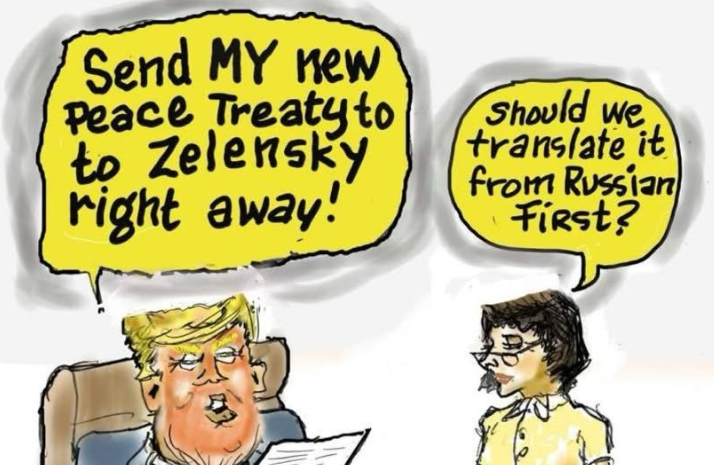
According to reports citing The Economist, Washington is discussing proposals built around a dramatic bargain: a demilitarized zone in Donbas and Ukraine giving up its aspiration to join NATO, in exchange for investment and a path toward European Union membership. Russia, meanwhile, could receive sanctions relief, renewed economic relations with the West and potentially a route back into Europe's energy market.
It is important to call this what it currently is: a reported framework, not a finalized peace agreement. Ukrainian officials reportedly know its broad parameters but have not received the complete proposal, while crucial details remain unresolved.
Still, those parameters are extraordinary.
For Kyiv, the proposed trade-off touches the heart of Ukraine's post-2014 strategic direction. Giving up NATO ambitions would mean surrendering a central security objective. In its place would come investment and the prospect of EU membership. Reports also describe a demilitarized zone in Donbas, although its precise borders, monitoring system and implications for territorial control remain unclear.
And then there is Moscow.
The package reportedly contemplates gradual sanctions relief, commercial opportunities involving American companies and wider normalization of Russia's relations with Western countries. Even more striking is the possible return of Russian pipeline gas to Europe, including discussion of restarting Nord Stream.
That transforms the proposal from a ceasefire formula into something much bigger.
It raises an uncomfortable question: Would Russia merely receive peace, or a pathway back into the economic system from which it was progressively isolated during the war?
Energy makes the issue especially explosive.
A Nord Stream revival would not simply switch gas flows back on. Europe has spent years reshaping its relationship with Russian energy. Moreover, Washington cannot simply decide that Russian gas will return to European markets. Reporting on the proposal notes that such a move would collide with European Union energy policy and legal constraints.
Ukraine, meanwhile, is drawing a red line around territory.
According to a source close to Ukraine's presidential office cited by Meduza, Kyiv is prepared for a ceasefire along the line of contact but rejects surrendering Ukrainian territory. Russia, by contrast, continues to articulate territorial claims that go far beyond the idea of simply freezing today's battlefield.
And therein lies the central contradiction.
A demilitarized zone can separate armies. Investment can rebuild cities. Sanctions can be lifted. Pipelines can, theoretically, be reopened.
But none of those mechanisms automatically answer the fundamental question that has haunted every attempt at diplomacy:
What prevents peace from becoming merely the interval before the next war?
The attraction of Washington's reported approach is obvious. After years of bloodshed, it tries to put something valuable on the table for everyone: economic reconstruction and Europe for Ukraine; sanctions relief and economic normalization for Russia; an end to war for everyone else.
Its weakness may be precisely the same thing.
When peace becomes a transaction, every concession acquires a price.
For Ukraine, that price could be NATO.
For Europe, it could be the return of Russian energy dependence.
For Russia, the reward could be readmission into Western economic life.
And for Washington, the gamble is enormous: proving that a grand bargain can finally stop Europe's bloodiest conflict in generations without turning military aggression into a profitable negotiating strategy.
That is why the real question is no longer simply“Can this plan stop the war?”
It is:
What kind of peace would it create, and who ultimately pays for it?