The Trump Paradox: Friend, Foe, or the Ultimate Transactionalist? / by Harshit Gaba
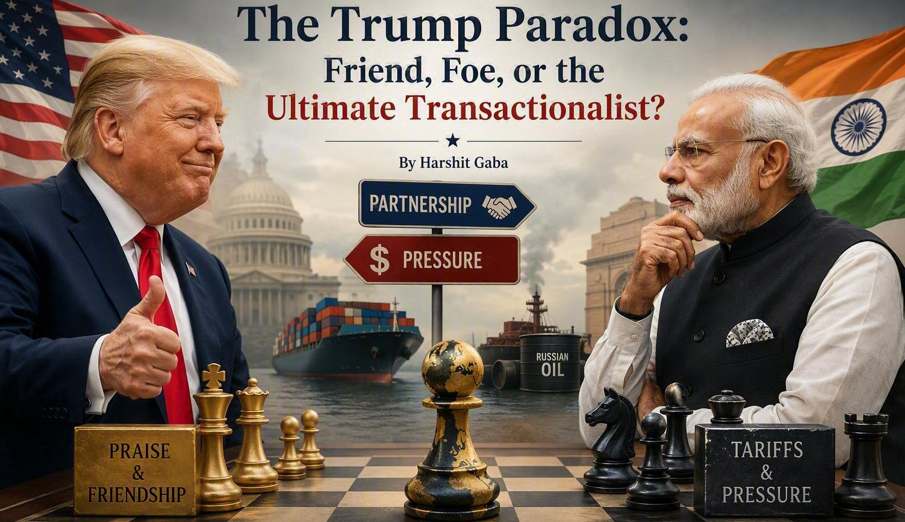
Geopolitics often operates under the illusion that history is merely repeating itself, right until an unprecedented surprise disrupts the chessboard. Today, the strategic relationship between India and the United States stands at exactly such a crossroads, navigating a profoundly complex era defined by one man's unpredictability.
When analyzing Donald Trump’s approach to New Delhi, foreign policy analysts are left grappling with a central question: Is he a friend or a foe? The answer is that he is neither. He is a pure transactionalist, and managing him requires navigating a relationship that often feels entirely delusional.
The Delusion of Grandeur
On the surface, the Trump-Modi dynamic is bathed in the warm glow of hyper-personalized diplomacy. Trump has consistently leveraged public adulation, leaning heavily into the optics of strongman camaraderie. He routinely showers Prime Minister Narendra Modi with praise, recently lauding him on the global stage as a "killer" and a "much tougher negotiator" than himself.
To the casual observer, this chemistry, complete with back-slapping and stadium-sized spectacles, suggests an unbreakable alliance between two leaders who respect each other's formidable political gravity. Trump respects power, and his characterization of Modi as a "hard-to-crack nut" who is strong, popular, and commanding plays perfectly into the narrative of a deep, personal friendship.
The Tariff Stick and the Russian Dilemma
However, this warmth is deeply paradoxical. The very same leader who extols Modi’s virtues routinely weaponizes trade against New Delhi. Over the past few years, Trump has aggressively used the threat of punishing tariffs, including slapping 25% duties on Indian goods, as a blunt instrument to strong-arm New Delhi into curbing its imports of discounted Russian crude.
This pressure campaign culminated in early 2026 with a coerced trade deal, where Trump agreed to lower US tariffs to 18% only after claiming India would halt its Russian oil purchases and buy more from the US and Venezuela.
This creates a severe geopolitical whiplash. Trump treats a vital, decades-long strategic partnership as a zero-sum financial transaction. Being labeled a "great friend" one day and a "tariff king" the next transforms what should be a mature bilateral tie into a volatile, hot-and-cold romance with no clear strategic endpoint.
Historical Amnesia
Washington's transactional pressure regarding Moscow ignores the deep, historical bedrock of Indo-Russian relations. To understand India's modern foreign policy, one must look at its history. When India fought its wars against its arch-rival Pakistan, most notably the defining conflict of 1971, it was the Soviet Union that stood steadfastly by New Delhi's side.
In stark contrast, the US historically tilted toward Pakistan, even deploying the Seventh Fleet to the Bay of Bengal to intimidate India. For Trump to demand that India abruptly sever its energy ties with a historically loyal partner demonstrates a profound misunderstanding of New Delhi's institutional memory and its unwavering commitment to strategic autonomy. India does not view its relationship with Russia through the lens of Western moral absolutism, but through the prism of its own survival and regional security.
The Democratic Contrast: Predictability over Pageantry
It is precisely this volatility that makes Democratic administrations, under figures like Barack Obama and Joe Biden, far more valued and predictable within New Delhi’s administrative and diplomatic circles.
While Democratic tenures may have lacked the flashy, personality-driven pageantry of the Trump era, they relied on institutional bandwidth rather than presidential whims. The Obama and Biden administrations fostered structural dialogues, advanced the Quad, facilitated deep defense-technology sharing (like the iCET initiative), and quietly accepted India's multi-aligned foreign policy. They understood that India is too large and too historically independent to be treated as a subordinate ally that can be bullied via tariffs.
In the corridors of South Block, the quiet predictability of Democrats is often viewed as vastly superior to the erratic surprises of Trump’s "America First" doctrine.
The Road Ahead
Geopolitics guarantees that we have never truly "seen it all." As the US-India relationship moves forward, New Delhi must separate the rhetoric from the reality. Trump’s personalized flattery is a diplomatic tool, but his tariffs are a strategic reality.
Ultimately, India cannot afford to view Washington through a sentimental lens. To manage a leader who views alliances as balance sheets, India must continue to play its own transactional game, securing its energy needs, fortifying its borders, and preparing for the inevitable surprises that come when dealing with a leader who is as likely to embrace you as he is to sanction you.
-------
Harshit Gaba - a staunch progressive strategist and geopolitical analyst dedicated to advancing global democratic solidarity and internationalist cooperation. Unapologetic advocate for realigning India's strategic posture with Western democratic alliances—specifically NATO and the European Union—while actively countering authoritarian hegemony. Proven track record in ideological mobilization, transnational policy advocacy, and championing a systemic shift toward left-wing governance to ensure a progressive, unified front alongside global allies, including the Democratic Party in the United States.