On War, 21st Century. Part II / by Diego Bavio
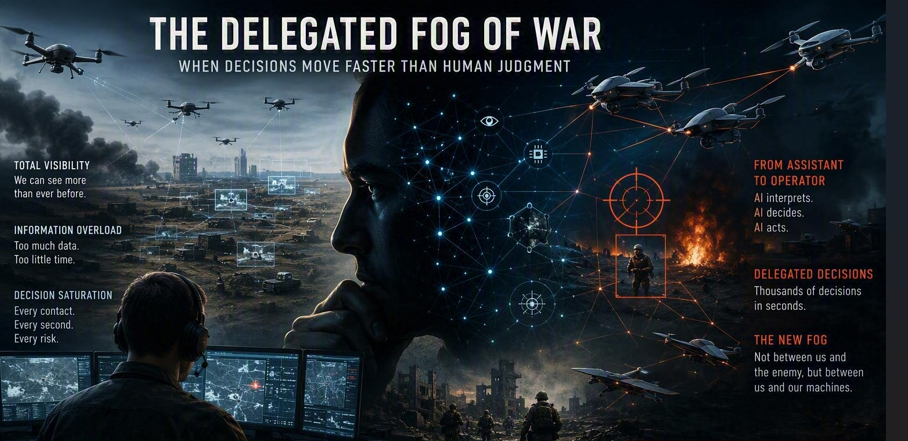
The Delegated Fog of War
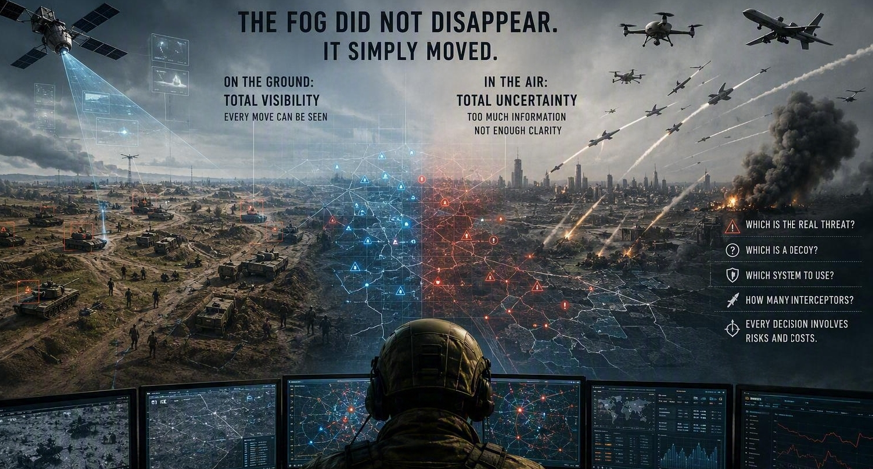
In the first chapter of this series, we examined a paradox of contemporary warfare: the sensor revolution had made the battlefield increasingly transparent, but it had not eliminated the fog of war.
It had displaced it.
On the ground, drones, satellites, distributed sensors, and near-instant communications allow forces to detect movements that could remain hidden for centuries. The concentration of forces, artillery firing, or a vehicle remaining in one position for too long: almost everything now leaves an observable signature.
But the more we see, the more information we must process.
And that creates a new form of uncertainty.
We may not necessarily be unaware of what is happening. The problem is that we may not have enough time to understand it and decide what to do about it.
There is something else we should not lose sight of: the purpose of war is not to kill the adversary, but to make him stop fighting. The destruction of his forces is a means to that end, not the objective itself.
This distinction, which may seem obvious, becomes critically important as artificial intelligence begins to participate in the decision cycle. A machine may be extraordinarily efficient at identifying and engaging targets, but that efficiency does not necessarily mean it is achieving the political and military purpose of war.
When I wrote the first article, there was an implicit assumption: despite the growing volume of information, the decision would remain essentially human.
That assumption is now being challenged.
The problem is no longer simply seeing.
From Assistant to Operator
A relatively simple ISR mission can generate a considerable amount of information.
One drone observes. Another covers a different sector. A third tracks a target. A fourth transmits imagery. Artificial intelligence systems classify objects, discard irrelevant information, and alert the operator to what they consider important.
Up to this point, automation seems almost inevitable.
There is no major conceptual problem with allowing a machine to navigate, stabilize a camera, identify a vehicle, or alert an operator to suspicious movement.
The human still retains the fundamental decision.
Seeing is not killing.
But the number of platforms capable of operating simultaneously is growing, and with it comes a growing volume of information and decisions that must be made.
The problem begins when the machine stops merely helping the human decide and starts deciding for him.
From Assistant to Operator
The evolution may appear small, but conceptually it is enormous.
First, the machine helps us see.
Then it helps us interpret.
Then it helps us decide.
And finally, it may act.
Each step reduces the operator's cognitive burden.
And each step increases the temptation to delegate.
Here we encounter one of the best-known phenomena in human-machine interaction: automation bias. When a machine demonstrates sufficient accuracy, the operator may begin trusting its recommendation even when there are reasons to question it.
The paradox is obvious.
AI is introduced to reduce human error, but it can create a new category of error: trusting the machine too much.
As long as the result is an incorrect classification of an ISR image, the consequences can be serious, but a barrier still exists.
The final decision remains human.
The problem changes radically when that barrier disappears.
The Boundary Is the Decision to Kill
A system may receive a relatively simple mission: search for specific targets within an area.
AI can recognize them, classify them, and transmit their location.
But there is a fundamental difference between:
“I have found a target.”
and:
“I have decided that this target should die.”
The second decision introduces a dimension that cannot simply be reduced to pattern recognition.
A combatant may be a legitimate target while directly participating in hostilities.
But that situation can change.
He may abandon his weapon. He may surrender. He may become hors de combat.
Civilians may enter the area, or the tactical situation around the target may change.
And here lies a paradox that a machine would have to understand:
the adversary's surrender does not represent the failure of military action. It is precisely one of its objectives.
A combatant who stops fighting because he surrenders has produced, from the perspective of the force seeking to impose its will, the very result that war was intended to achieve.
For a human being, that transition can be interpreted within a much broader context.
For an autonomous system whose mission is to detect and neutralize targets, the challenge is recognizing that, within a fraction of a second, what it was supposed to attack may have ceased to be a legitimate target.
And that transition can occur in seconds, or fractions of a second.
The problem, therefore, is no longer simply whether artificial intelligence can correctly identify a combatant.
It is whether it can recognize that the conditions that made an attack legitimate have just disappeared.
The machine may have classified the situation correctly one instant earlier.
And yet the decision executed an instant later may be wrong.
Speed as a New Problem
Here we encounter a particularly uncomfortable paradox.
The faster the system operates, the less time the human has to intervene.
But the less time available for intervention, the more important the system's ability to interpret context correctly becomes.
Technology seeks to compress the decision cycle.
But warfare does not always present simple decisions that can be compressed without losing essential information.
An image can be processed in milliseconds.
A human situation cannot necessarily be.
And this raises a question technology has not yet solved:
Can a machine recognize that, between two virtually identical images, an event has occurred that completely changes the meaning of both?
A man carrying a weapon and a man who has just thrown his weapon away may occupy virtually the same space in an image.
But legally, they are not necessarily the same target.
The problem becomes even greater with swarms.
The Volume of Decisions
Until now, we can debate how much control an operator can exercise over several drones.
But that debate loses much of its meaning when we are talking about hundreds, thousands, or eventually tens of thousands of platforms.
With a few drones, the operator can control them.
With dozens, he can supervise.
With hundreds, he begins to depend heavily on automation.
With thousands, he probably no longer controls individual platforms.
He controls rules of behavior.
And that distinction is fundamental.
An operator might establish a mission, an area, specific search parameters, and specific restrictions.
From there, the machines would execute an enormous number of intermediate decisions.
The system is no longer one person controlling many drones.
It is one person directing a system composed of many autonomous agents.
And this leads to a problem we did not sufficiently consider when we wrote the first chapter.
The Volume of Decisions
Modern warfare is not only producing more weapons.
It is producing more decisions.
Every sensor generates information.
Every contact requires classification.
Every classification may require a response.
And every response generates new observations.
The problem of saturation, therefore, is not only physical.
It is cognitive.
There may come a point when the volume of decisions becomes so great that delegation ceases to be a doctrinal choice and becomes an operational necessity.
That may be the true driver of autonomy.
Not necessarily the search for a machine capable of replacing the combatant.
But the practical impossibility of a human being individually processing everything that the technological system itself has generated.
The New Fog
Here the thesis of the first chapter acquires a new dimension.
First, the sensor revolution made the ground transparent.
Then that transparency produced an excess of information and shifted the fog from observation to interpretation.
Now artificial intelligence appears to offer a solution to that saturation.
But in doing so, it introduces a new possibility:
delegating interpretation. And then, delegating the decision.
The fog of war may therefore shift once again.
It would no longer exist only between us and the enemy.
It could begin to exist between us and our own machines.
A commander may know what mission he ordered, the parameters he established, and even what targets the system was instructed to search for.
But if thousands of platforms simultaneously make thousands of decisions, how much of what happens on the battlefield can still be individually understood by the person commanding them?
The Final Paradox
Technology began by attempting to eliminate the fog of war.
Sensors allowed us to see more.
Artificial intelligence allows us to process more.
Autonomy promises to allow us to act faster.
But each of these solutions creates a new problem.
Seeing more produces more information.
Processing more produces more decisions.
Making decisions faster reduces the time available to supervise them.
And finally, delegating decisions may reduce the human cognitive burden while simultaneously increasing our dependence on what the machine has decided.
Perhaps the true frontier of military autonomy is not whether a machine can fly by itself, navigate by itself, or recognize a target.
It is the moment when it can decide, by itself, that a human being should be attacked.
Because at that point, the question is no longer technological.
It is no longer about whether the machine can do it, but how much of human judgment we are willing to surrender in order to make it possible.
And this leads to the question that will probably define an important part of twenty-first-century warfare:
When the volume of information and decisions exceeds the human capacity to process them, will autonomy remain a tool we use—or become a condition of war that we ultimately accept?
The fog did not disappear.
First, it moved from the battlefield to the mind.
Now it may be moving from the mind to the machine.
Can an AI understand when the objective of war has been achieved—and therefore when it must stop attacking?
------
Author Biography
Diego Bavio is an Argentine defense and security analyst specializing in military innovation, logistics, and transnational security in Latin America. He holds a Bachelor's degree in Security Sciences and developed the Military Learning Velocity (MLV)framework, which examines how the speed of organizational learning is becoming a decisive factor in modern warfare. His research also focuses on transnational criminal ecosystems, military adaptation, and regional security dynamics.