On War, 21st Century. Part I / by Diego Bavio
Since the first months of Russia’s invasion of Ukraine, one idea began to take hold among military analysts and observers of the conflict: the battlefield had become transparent.
Commercial drones equipped with high-resolution cameras, private satellite constellations capable of updating imagery several times a day, distributed sensors, instant communications, and even interactive and collaborative maps appeared to have solved one of the oldest problems of war: finding the enemy.
The picture was convincing. A concentration of troops could be detected quickly. A vehicle that remained stationary for too long risked being located and destroyed. Artillery positions often survived only minutes after opening fire.
For many observers, this seemed to mark the end of the “fog of war” described by Clausewitz almost two centuries ago.
However, recent developments in Russia’s air campaign suggest a different conclusion.
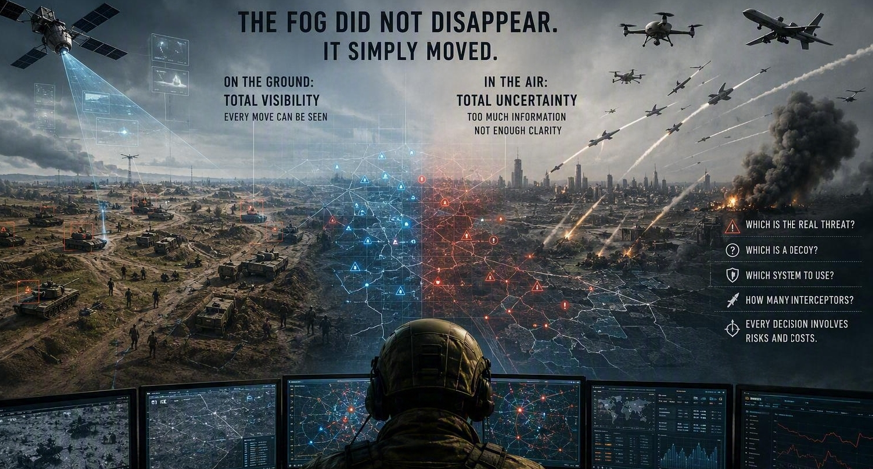
The fog did not disappear.
It simply moved.
The Triumph of Transparency
On the ground, transparency dominates.
Both sides know with relative precision the location of a large part of the enemy’s forces. The challenge is no longer primarily to discover targets, but to survive after being discovered.
Permanent observation has transformed the economics of ground combat. Moving troops, concentrating vehicles, or preparing an offensive has become much more difficult. Every movement generates observable signatures. Every signature can become a target.
Paradoxically, the better each side can see, the harder it becomes to maneuver.
The most visible consequence of this permanent transparency may not be technological, but operational.
For centuries, speed was one of the fundamental instruments of military maneuver. The ability to concentrate forces rapidly made it possible to create local superiority, break defensive lines, and exploit success before the adversary could react.
The war in Ukraine appears to partially challenge that logic.
Constant observation makes precisely what enabled maneuver for generations more difficult: assembling men, vehicles, and supplies without being detected. Offensive preparations are increasingly difficult to conceal and therefore more vulnerable to enemy intervention.
The paradox is striking. Speed remains valuable, but the concentration required to exploit it has become extraordinarily vulnerable.
Perhaps this is one of the reasons behind the extremely slow pace of territorial advances observed in Ukraine. It is not only a matter of the defensive power of modern weapons. It is also that transparency erodes the conditions that historically made large-scale maneuver possible.
After more than three years of war, neither side has managed to reproduce campaigns of rapid exploitation comparable to the great mechanized offensives of the twentieth century. Territorial gains exist, but they are usually measured in a few kilometers and require months of fighting.
Technology has not eliminated movement. But it appears to have reduced the ability to conceal it.
The Crisis of Maneuver
For much of modern military history, speed and surprise were closely associated. From Napoleon to the armored offensives of the twentieth century, successful maneuver depended on concentrating forces at a decisive point before the adversary could understand what was happening.
Basil Liddell Hart elevated this logic into a theory. His indirect approach sought to avoid the enemy’s strong points, disorient his decision-making process, and force him to react late and under unfavorable conditions.
The question raised by Ukraine is uncomfortable: what happens when the adversary can observe almost every relevant movement?
The indirect approach does not disappear. But its main problem ceases to be finding an unexpected route and becomes concealing the preparation for maneuver.
For two centuries, the ability to move grew faster than the ability to observe. Today, the opposite may be happening. Drones, satellites, and distributed sensors are expanding observation at a pace that makes the covert concentration of forces increasingly difficult.
If this trend continues, maneuver doctrines inherited from the twentieth century could face limitations their creators never imagined.
The Return of Uncertainty
But in the air, something different is happening.
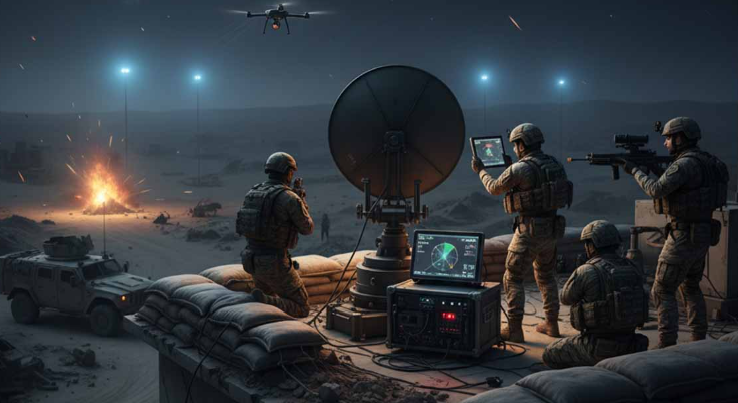
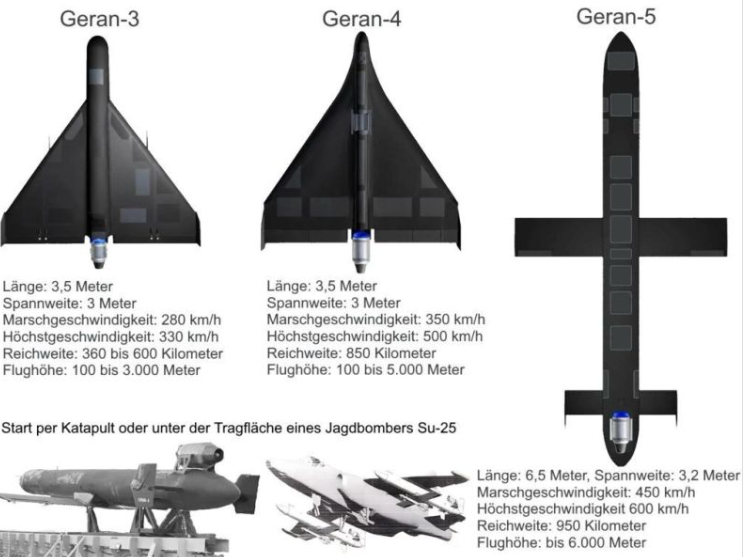
When Russia launches combined attacks using Shahed drones, faster drones, cruise missiles, and ballistic missiles, air-defense operators can usually see the contacts on their radars.
The problem is not detecting them. The problem is understanding them.
Which contact represents the primary threat?
Which one is a decoy?
Which defense system should be used?
How many interceptors is it worth expending?
Every decision involves risks and costs.
Uncertainty no longer lies in observation. It lies in interpretation.
The New Fog of War
Here one of the most interesting paradoxes of contemporary warfare appears.
While ground combat is experiencing unprecedented levels of visibility, air warfare is once again dominated by a different form of uncertainty.
It is not a fog produced by a lack of information, but a fog produced by an excess of information.
Operators have more data than ever before. What they do not have is enough time to process it, interpret it, and act correctly.
The question has ceased to be “what is happening?” and become “what is actually important?”
Saturation replaces surprise, and complexity replaces concealment.
And the fog returns through an unexpected route.
Clausewitz in the Age of Drones
Perhaps the main conceptual lesson of Ukraine is not that technology eliminated the fog of war, but that it moved it from the physical terrain to the cognitive terrain.
This observation is particularly interesting because, far from invalidating classical ideas about war, it appears to reinforce them.
The means have changed. The fundamental problems remain.
Artificial intelligence promises to accelerate decision cycles. Drones are changing the economics of combat. Military and commercial satellites provide levels of observation that were unimaginable just two decades ago.
But friction remains.
And so does uncertainty.
What Technology Still Cannot Do
There is a second lesson that is often lost amid discussions about drones, algorithms, and sensors.
None of these technologies occupies territory. Drones can observe and missiles can destroy.
Air campaigns can wear down infrastructure, the economy, and political will.
But sovereignty still depends on forces capable of physically occupying and defending a geographic space.
The war in Ukraine reveals a striking phenomenon. The more sophisticated observation and strike systems become, the more difficult the conquest of terrain appears to be.
Without a doubt, this dynamic contributes to the creation of relatively static fronts, even after years of combat.
Conclusion
The technological revolution has profoundly transformed the means of war.
However, the ends remain surprisingly intact.
Two centuries after Clausewitz, we are still discussing fog, friction, and maneuver.
The difference is that we are now trying to solve those same problems on a battlefield where almost everything can be observed.
Perhaps the decisive question of contemporary warfare is no longer how to find the enemy.
Nor how to destroy him.
The question is how to maneuver when both sides can see each other almost all the time.
------
Author Biography
Diego Bavio is an Argentine defense and security analyst specializing in military innovation, logistics, and transnational security in Latin America. He holds a Bachelor's degree in Security Sciences and developed the Military Learning Velocity (MLV)framework, which examines how the speed of organizational learning is becoming a decisive factor in modern warfare. His research also focuses on transnational criminal ecosystems, military adaptation, and regional security dynamics.