Latin America in the Age of Drones / by Diego Bavio
The war between Russia and Ukraine produced a new protagonist on the battlefield: the drone.
Drones are not new. Unmanned aerial systems have been part of military operations for decades. Modern UAV development began long before the war in Ukraine, and platforms such as the MQ-1 Predator and its successors demonstrated years ago that an aircraft could remain over an area of operations for hours, observe, gather intelligence and, eventually, strike.
But no war had placed drones so firmly at the center of public and military attention as Ukraine did. There, they ceased to be a relatively specialized capability and became one of the most ubiquitous elements of the battlefield.
Reconnaissance and attack drones, artillery-correction systems, intelligence platforms, electronic-warfare and communications systems, logistics drones and interceptors began operating in numbers that would have seemed difficult to imagine only a few years earlier. More importantly, small units, relatively small companies and even individuals demonstrated that they could develop and modify systems capable of producing real military effects.
The war therefore accelerated something that was already underway: the democratization of technology is lowering the barriers to entry into air power.
Today, it is no longer necessary to belong to the small group of countries capable of designing and manufacturing a fighter aircraft to develop an unmanned aerial capability. A group of engineers, a technology company, a university or even a small development team can integrate commercial components, sensors, navigation systems, communications and software into a platform designed for a specific mission.
The difference between a toy, a commercial tool and a military system is no longer necessarily found in their individual components. It increasingly lies in how those components are integrated, how the system is employed and, above all, how quickly its users can learn from its operational use.
That transformation has a major strategic consequence: the drone is changing the relationship between cost, technology and military effect.
A relatively inexpensive platform can force an adversary to employ much more expensive resources to detect, jam or destroy it. A system produced in large numbers can generate effects that once required far more sophisticated and expensive crewed platforms.
Air power is therefore becoming less exclusively a matter of large platforms. It is also a matter of mass, persistence, information, software, adaptation and production speed.
Ukraine made this transformation visible to the world. But it would be a mistake to reduce the lesson to the simple conclusion that armed forces need to buy drones. The deeper lesson is that whoever can rapidly develop, produce, employ and modify unmanned systems can generate military capabilities at a speed that traditional defense structures struggle to match.
And this raises a particularly relevant question for Latin America.
The region does not necessarily need to reproduce the Russian-Ukrainian model of warfare. It has its own threats, geography, budgets and industrial capabilities. But it is facing a technological transformation that it cannot ignore.
From border and coastal surveillance to the control of vast jungle areas, from counter-narcotics operations to the protection of critical infrastructure, Latin America has a set of problems in which unmanned systems can produce effects disproportionate to their cost.
At the same time, there is another side to the same revolution.
If technological democratization allows states to acquire or develop UAVs more easily, it also allows non-state actors to do the same. Criminal organizations no longer need state-level technological capabilities to incorporate drones into their operations. And this is no longer a future possibility. The problem is already present in the region.
According to ACLED, nearly 35,000 drone flights were detected in the vicinity of the Mexico-U.S. border during 2025. This figure requires an important qualification: it does not mean 35,000 drones, 35,000 criminal incursions, or that every flight was connected to drug trafficking. It refers to flights detected by the available surveillance systems.
But that qualification is precisely where the operational significance lies.
We are talking about what was detected, not necessarily everything that occurred.
No detection system provides perfect coverage. There are blind spots, range limitations, environmental conditions, classification errors and targets that may simply go undetected. And when more capable systems have been subjected to specific testing, significant increases in detection have been observed. That raises a much more uncomfortable question than simply counting the flights: how many unmanned systems are operating without being detected?
Moreover, all of this is occurring at what could be considered the first level of the threat: the adversary does not yet need to systematically contest the electromagnetic spectrum used to detect it.
If criminal groups begin incorporating electronic-warfare measures, more interference-resistant links, alternative navigation methods or techniques designed to reduce their signatures, the equation will change again. The challenge will no longer be simply to detect more drones, but to preserve detection capability when the other side begins adapting as well.
The nearly 35,000 detected flights should therefore not be read as the size of the problem.
They should be read as the part of the problem we are already capable of seeing.
The question, therefore, is no longer whether criminal actors will begin incorporating drones.
They already are.
The technological race does not begin when the first armed drone appears, either. It has already begun with the need to detect, identify, track and neutralize thousands of unmanned systems operating in the regional environment.
States need drones to see. They also need systems capable of preventing other drones from seeing, transporting, attacking or facilitating the operations of their adversaries.
This introduces a new technological race in the region.
The question for Latin America should therefore no longer be simply who is manufacturing drones. It should be much more uncomfortable: is Latin America developing the unmanned capabilities its own threats require? And, above all, does the region have the industrial capacity to develop them itself?
The Latin American Reality
For Latin America, the drone revolution arrives at a particularly interesting moment.
The region's enormous territories, thousands of kilometers of borders, the Amazon, mountainous areas, maritime spaces and remote rural regions make persistent surveillance extremely costly when it depends exclusively on crewed assets.
A UAV can change that equation—not necessarily because it can replace an aircraft, helicopter or maritime patrol aircraft, but because it can multiply the presence of sensors across the territory at considerably lower cost.
For many Latin American countries, this may be the principal value of unmanned systems. The objective is not necessarily to possess the most sophisticated drone. It is to have many eyes in the right place for a long time.
That leads directly to one of the capabilities that should probably receive priority in regional development: persistent ISR.
Intelligence, surveillance and reconnaissance may be the field in which Latin America can obtain one of the highest returns from UAV technology. A border should not be monitored only when there is a suspicion of illegal activity, nor should a route used by criminal organizations be observed only after an operation has taken place. The value of the UAV lies precisely in its ability to remain, persist, observe, transmit, compare, detect changes and enable another unit to act.
This transforms the UAV from simply an aircraft without a pilot into a node within a sensor network. A modern surveillance system can combine UAVs with ground radars, electro-optical and infrared sensors, radio-frequency detection systems, satellites, crewed aircraft and information from ground sources. The drone is therefore one component of a much larger architecture.
That distinction is fundamental. The objective should not simply be to buy UAVs. It should be to build ISR capability.
The Drug Trade as a Technology Accelerator
The region faces criminal organizations with financial resources, adaptive capacity and a growing willingness to incorporate technology.
Drug-trafficking organizations have already demonstrated their ability to adopt new tools when those tools reduce risk, increase territorial control or improve operational efficiency. Drones add another dimension: a modified commercial system can provide reconnaissance over an area without exposing a person, observe security-force movements, track vehicles, transport small payloads and, in certain contexts, even become a means of attack.
The critical issue is the speed at which new capabilities can be incorporated.
This creates a paradox for Latin American states: the same systems that can dramatically increase the state's surveillance capacity can also increase the surveillance and attack capabilities of criminal organizations.
That is why UAV development and counter-UAS development should not be treated as separate problems. They are part of the same equation.
The Other Half of the Revolution: C-UAS
If it becomes easier to put an object into the air, it also becomes increasingly important to determine what is flying, who controls it and what it is doing.
Counter-drone defense will therefore become an increasingly relevant capability for Latin American armed and security forces.
A small UAV can be difficult for some traditional systems to detect, may have a reduced signature and may cost a fraction of the system used to intercept it. This creates an economic as well as a technological question: how much should a state spend to defeat a target that may cost only hundreds or thousands of dollars?
The answer cannot simply be to deploy increasingly expensive systems. The solution requires a scalable architecture capable of detecting, identifying, tracking, deciding and neutralizing, using the appropriate means for each threat. In some cases electronic warfare may be sufficient; in others an interceptor or kinetic system may be required; in still others several layers may have to work together.
The challenge is to build a system in which the cost of defending against the threat is not permanently higher than the cost of attacking.
An Opportunity for Regional Industry
Latin America is not starting from zero. Argentina, Brazil, Colombia, Mexico and other countries have experience developing unmanned systems, coming from state organizations, universities and research centers, and private companies.
But there is an important difference between developing a UAV and building an industry capable of sustaining a capability.
A prototype demonstrates a technological possibility. A limited production run demonstrates manufacturing capacity. But a system employed by a force, modified through operational experience and subsequently produced in new versions demonstrates something more important: the existence of a learning cycle.
That cycle can become the real competitive advantage.
The company develops. The user employs the system, identifies problems and provides feedback. The company modifies it. The new version returns to the field, generates new data and produces further changes. The cycle starts again.
The faster this cycle operates, the greater an industry's ability to adapt to a threat that is changing as well.
This matters particularly in the UAV world because technology evolves much faster than traditional military acquisition cycles. A platform that is effective today can be partially overtaken within years—or even months—by a new generation of sensors, electronic-warfare systems, algorithms or methods of employment.
An industry that cannot learn quickly falls behind.
What Is Latin America Doing?
The region is highly heterogeneous. There is no single Latin American drone industry, but different national ecosystems at different stages of maturity.
Brazil has a relatively developed private industrial ecosystem, with companies that have introduced indigenous systems into military and security applications. Argentina has a long tradition of national development, including private companies that have brought their own UAVs to military users. Colombia has developed indigenous capabilities while simultaneously facing one of the regional environments in which armed groups are incorporating UAVs most significantly. Mexico also has important experience in private unmanned-system development. Other countries are beginning to develop national projects and capabilities linked to universities, companies and state organizations.
But the relevant question is not who has the longest catalogue.
It is which countries are succeeding in turning technological development into operational capability—and, beyond that, which are building the link between industry, user and learning that allows those capabilities to evolve quickly.
That is where the important differences emerge.
An Opportunity for Latin America
This question goes well beyond the ability to manufacture a particular UAV.
Why should Latin America limit itself to buying solutions developed for other environments when it has the opportunity to develop systems specifically adapted to its own needs?
Technological democratization has changed this equation. Developing an unmanned system no longer necessarily requires the industrial capabilities that for decades were needed to design a crewed aircraft. Commercially available components, advances in sensors, communications, navigation, data processing, artificial intelligence and manufacturing allow relatively small companies to enter areas once reserved for major corporations and states.
This does not mean that developing a military UAV is easy. It means that the barrier to entry is considerably lower than before.
And that lower barrier represents an important opportunity for Latin America because the region has sufficiently specific needs to justify its own solutions. A UAV designed to remain for hours monitoring an Amazonian border does not necessarily require the same characteristics as one designed for high-intensity conventional warfare. A system intended to detect vessels used for drug trafficking has different requirements from one designed to locate armored vehicles. A C-UAS system protecting critical infrastructure against modified commercial drones does not necessarily need the same architecture as one designed to confront military drone swarms on a conventional battlefield.
The threat determines the solution.
Latin America could therefore develop a new generation of unmanned systems designed from the outset for its own requirements: persistent border and coastal surveillance, counter-narcotics operations, territorial control, critical-infrastructure protection and defense against drones used by criminal organizations.
This does not necessarily mean developing every component domestically. Technological sovereignty does not mean manufacturing every screw. It means retaining the ability to integrate, adapt, modify and evolve a solution according to national needs, without becoming completely dependent on the will, timelines and priorities of external suppliers.
From Buyer to Developer
This point is particularly important for Latin American countries.
For decades, much of the region's defense procurement has followed a relatively simple logic: identify a required capability and buy it abroad. That model can solve an immediate requirement, but it rarely builds industrial capability.
UAVs offer the possibility of doing something different. The state can become a first user, allowing national companies to develop solutions, test them under real conditions, receive feedback from operators and evolve their products rapidly.
The benefit would not simply be a drone. It would be knowledge, engineers, software, sensors, communications systems, industrial processes, integration capacity and, above all, learning capacity.
A national industry that learns quickly can produce a second generation better than the first and a third better than the second. That has strategic value far beyond the characteristics of any individual platform.
Private Industry as Part of the Solution
The private sector therefore has a central role.
Recent international experience shows that innovation in unmanned systems can emerge from companies far smaller than the traditional giants of the defense industry. For Latin America, this represents a particularly interesting opportunity.
Not every country in the region can build a fighter aircraft, a modern tank or an integrated air-defense system. But many can develop sensors, software, UAVs, communications systems, electronic components or C-UAS solutions.
A company that begins by developing a solution for its domestic market can eventually find regional and international markets. This is particularly relevant in a continent that shares many of its security problems. Borders may separate states, but transnational threats do not respect them.
Drug trafficking, smuggling, illegal mining, illegal fishing and other illicit activities create similar requirements in different countries. That opens the possibility of developing regional solutions.
A UAV designed for border surveillance in Colombia may find applications in Brazil. A C-UAS solution developed to counter drones used by criminal organizations in Mexico may also be useful in Ecuador, Peru or Argentina. Regional scale may be precisely what allows an industry without a huge domestic market to achieve economically viable production.
It Is Not Just About Manufacturing Drones
The real opportunity, however, lies one level higher.
Latin America does not simply need a drone industry. It needs an unmanned-systems industry.
The distinction is fundamental. A UAV is a platform. ISR is an architecture. C-UAS is an architecture. Both require sensors, communications, information processing, software, operators, doctrine and command-and-control systems.
The challenge is therefore to build an ecosystem in which all these elements evolve together.
And again, one of the main lessons from Ukraine emerges: the advantage does not necessarily belong to whoever develops the most sophisticated system, but to whoever can learn and adapt it most rapidly.
For Latin America, that may be the real opportunity—not necessarily to compete with the United States, China, Israel or Turkey in the construction of large strategic systems, but to develop solutions that are good enough, affordable enough to be produced in quantity and, above all, adapted to the problems the region actually faces.
An Opportunity That Should Not Be Wasted
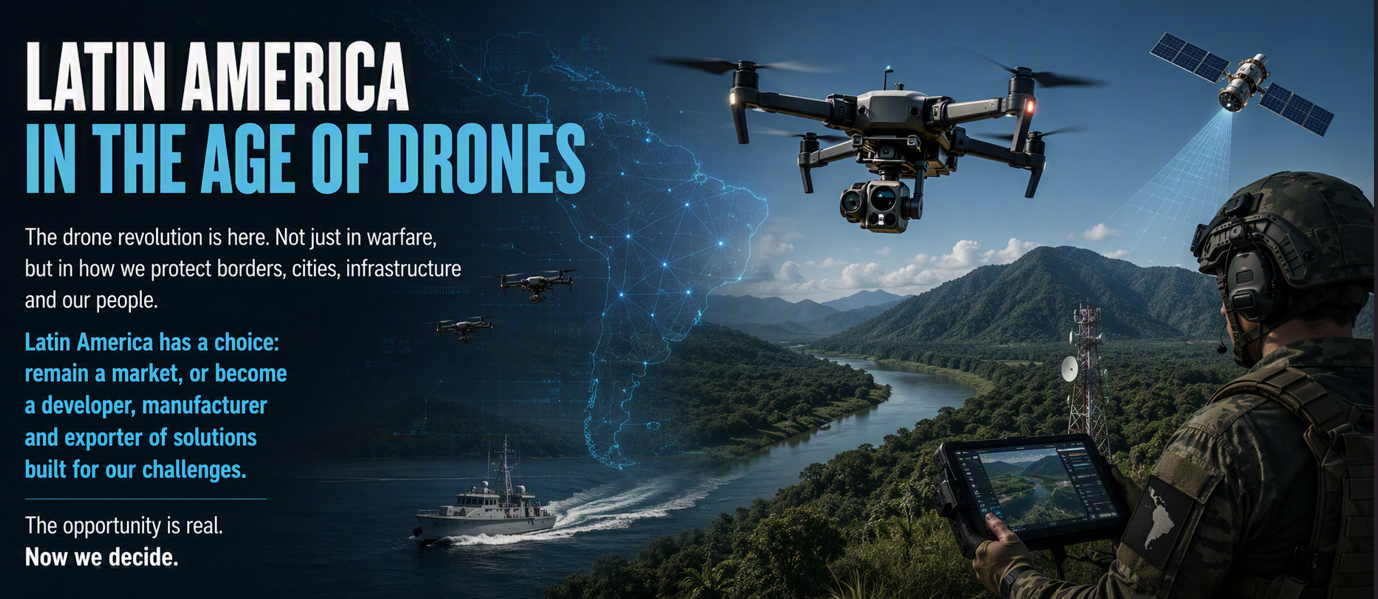
The drone revolution has reached Latin America.
The question is no longer whether the region will use them. Armed forces, security forces and increasingly criminal organizations will.
The question is who will learn faster to employ them, and who will have the capacity to develop them.
The region has companies, universities, engineers and accumulated experience. It also has something often missing in other markets: concrete operational problems that require concrete solutions.
Monitoring a border thousands of kilometers long, detecting a small aircraft in a jungle environment, identifying a suspicious vessel across an enormous maritime space, protecting critical infrastructure, or detecting and neutralizing a drone used by a criminal organization are not abstract scenarios. They are real problems—and each can also become an opportunity to develop indigenous technology.
The question, therefore, should not simply be how much money Latin America can spend buying foreign drones. It should be how much knowledge, industry and capability it can generate by developing the drones it actually needs.
Technological democratization has opened a window that barely existed a few decades ago.
Latin America can remain a market for the world's drone manufacturers. Or it can use its own needs to become a developer, manufacturer and exporter of solutions adapted to the challenges of the twenty-first century.
The opportunity is there.
Now the region has to decide whether it will take it.