When Drones Became Ammunition / by Diego Bavio
How Mass Production, Commercial Technology, and Rapid Adaptation Are Reshaping Military Power
The exact number is almost irrelevant.
Whether Russia actually intercepted 64,000 Ukrainian drones during the first half of 2026 matters less than what that claim reveals.
The figures cannot be independently verified and, like all wartime statistics released by one of the belligerents, they should be treated with caution.
Yet the real significance lies elsewhere.
For the first time in modern warfare, analysts are no longer discussing hundreds of drones.
They are discussing operations measured in the tens of thousands.
When a military system is produced, deployed, and replaced at that scale, it stops behaving like a traditional combat platform.
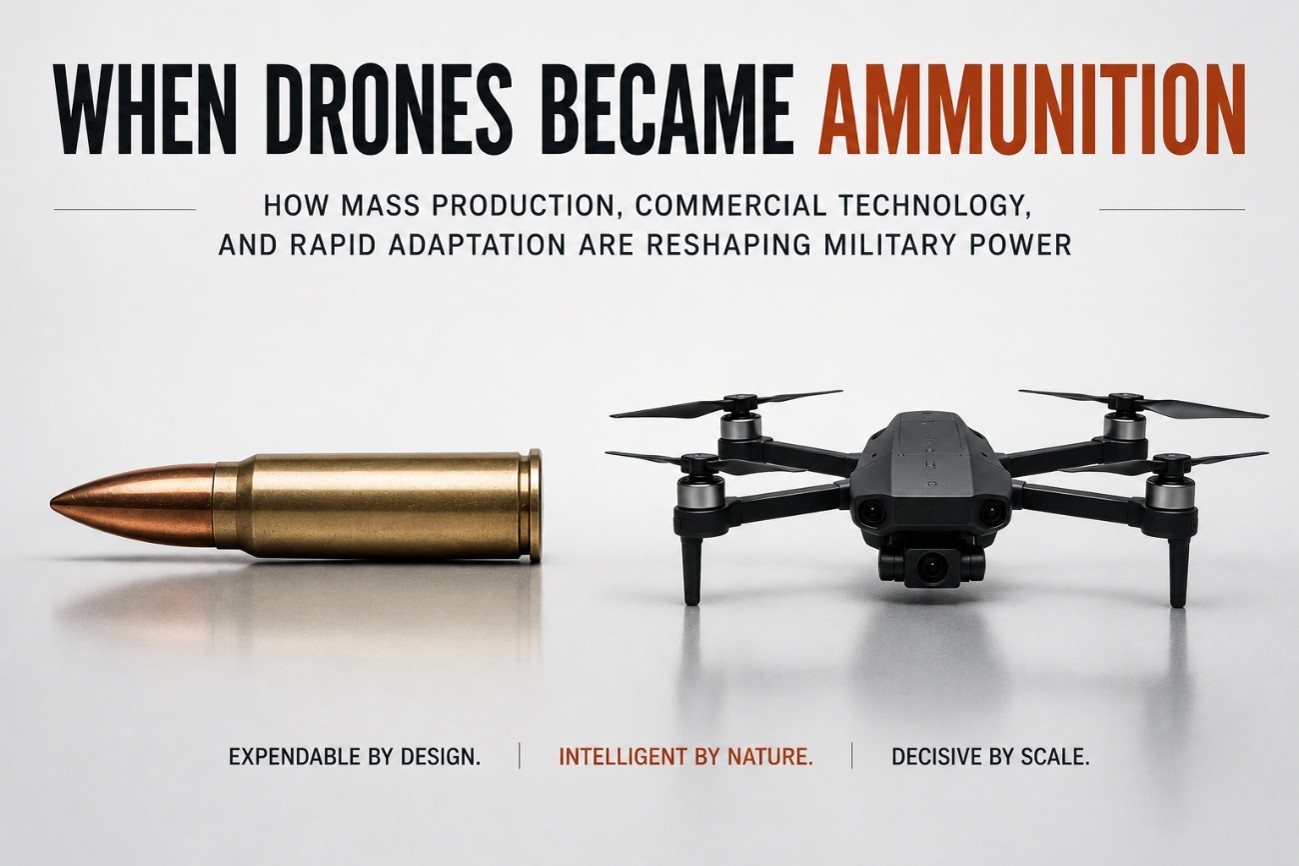
It begins to function as ammunition.
That distinction may fundamentally change how we understand military power in the twenty-first century.
From Platform to Ammunition
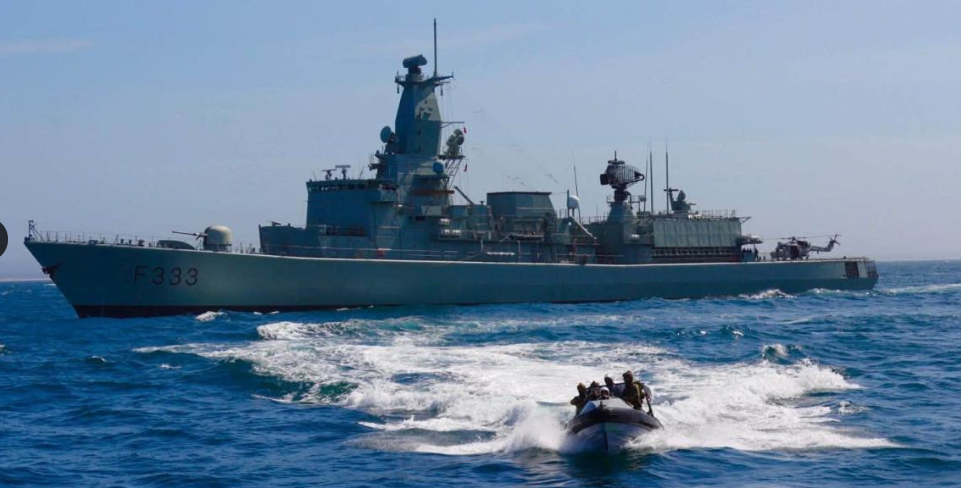
For more than a century, military capability was measured through major combat platforms: tanks, combat aircraft, warships, and helicopters.
These were expensive systems designed to remain in service for decades while employing different types of ammunition throughout their operational life.
Ammunition, by contrast, was expendable.
It was fired, produced an effect, and disappeared.
The war in Ukraine is blurring that distinction.
Thousands of drones now perform a single mission: identify a target, strike it, and be expended.
Operationally, their life cycle increasingly resembles that of a projectile rather than an aircraft.
When Quantity Changes the Nature of a System
The most revealing figure is not sixty-four thousand.
It is the fact that such numbers no longer seem extraordinary.
Only a few years ago, the use of several hundred drones in a military campaign represented a major innovation.
Today, both Russia and Ukraine measure drone operations in the tens of thousands.
At that point, quantity begins to change the very nature of the system.
A drone ceases to be a reusable platform and becomes an expendable military resource.
This is not simply a numerical difference; it represents a conceptual transformation.
A New Military Economy
If drones continue to be viewed primarily as platforms, the key industrial question remains:
How do we build the best drone?
If they are understood as intelligent expendable munitions, however, the question changes completely.
How do we manufacture hundreds of thousands of drones that are effective enough, and continuously improve them?
The competitive advantage no longer depends solely on superior engineering.
It increasingly depends on an organization's ability to rapidly iterate, produce, field, and replace systems before they become obsolete.
Military competition is gradually shifting from platform superiority toward adaptation advantage.
Democratizing Military Capability
This transformation extends well beyond drones themselves.
For decades, military superiority was closely linked to the ability to acquire increasingly sophisticated and expensive combat platforms.
Fifth-generation fighters, aircraft carriers, nuclear submarines, and integrated air defense systems became the defining symbols of military superiority.
That model naturally favored the world's largest industrial powers.
Today, commercial electronics, artificial intelligence, satellite navigation, distributed communications, and decentralized manufacturing are reducing the cost of generating meaningful military effects.
This does not produce military equality.
It produces something far more significant: the ability of middle powers and resource-constrained states to contest domains of warfare that were once dominated by major powers.
Ukraine provides the most visible example.
Iran has also demonstrated that large numbers of relatively inexpensive drones and missiles can impose operational challenges even on technologically superior opponents.
For the first time in decades, middle powers and resource-constrained states can generate strategic effects without competing platform-for-platform against major military powers.
The Real Weapon System
Perhaps the greatest conceptual mistake is to think that the drone itself is the weapon system.
It is not.
The real weapon system is the ecosystem that makes drones possible: industrial capacity, software, artificial intelligence, sensors, communications, electronic warfare, logistics, and continuous adaptation.
The drone is simply the expendable component of that larger system.
Just as a missile cannot exist without its launch platform, sensors, and logistics, the military value of drones depends on the ecosystem capable of producing, updating, and employing them at industrial scale.
The drone is therefore not the weapon system itself, but the visible expression of a much larger military ecosystem.
A Different Way of Measuring Military Power
For generations, military strength was measured by counting tanks, aircraft, and warships.
That metric is becoming incomplete.
Tomorrow's military effectiveness may instead be measured by different questions.
How rapidly can a nation manufacture drones?
How quickly can it modify software?
How efficiently can it replace battlefield losses?
How fast can combat lessons become new operational capabilities?
The decisive resource is no longer the drone itself.
It is the ability to produce the next version before the current one becomes ineffective.
The debate is therefore no longer about drones alone.
It is about a new model of military competition built on industrial scalability, rapid iteration, and continuous adaptation.
Beyond Ukraine
The most important lesson of the war in Ukraine may not be the emergence of drones.
It may be the emergence of a new model of military competition.
A model in which success depends less on possessing the most sophisticated platforms and more on continuously generating, adapting, and replacing intelligent expendable systems faster than an opponent.
If this transformation continues to unfold, drones will not simply represent another weapon.
They may represent the beginning of a different model of warfare.
Diego Bavio
Independent Researcher
Strategic Affairs | Defense Innovation | Military Adaptation
History repeatedly shows that prolonged wars reward scalable production over technical perfection.
The transition from the Thompson submachine gun to the M3 Grease Gun during the Second World War illustrates how industrial necessity reshapes military design.
Elegance, precision machining, and craftsmanship gave way to stamped steel, simplified manufacturing, and mass production.
Today's evolution of long-range drones and cruise missiles follows the same logic.
Modern conflicts increasingly favor systems that are sufficiently capable, rapidly adaptable, and industrially scalable over exquisite but scarce platforms.