#FrontlineStoriesUkraine/ Why Some Ukrainian Commanders View the Azov Coast as the War’s Strategic Center of Gravity
Military campaigns are often measured in kilometers gained, villages captured, and front lines advanced. Yet some military strategists argue that the most consequential objectives are not always visible on a map.
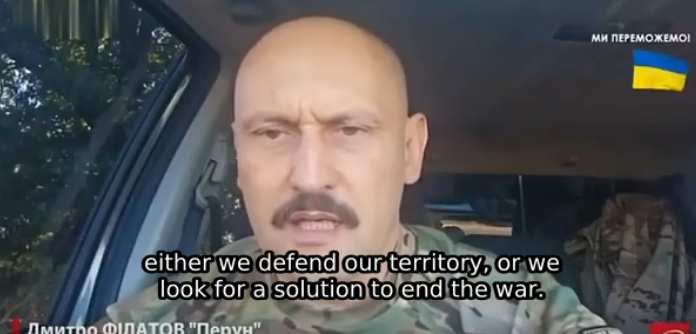
According to Major Dmytro "Perun" Filatov, commander of Ukraine's 1st Separate Assault Regiment named after Dmytro Kotsiubailo, the decisive geography of the war may not lie in the next contested settlement. Instead, he points toward a broader strategic objective: the Sea of Azov and the network of connections linking mainland Russia to occupied Crimea.
His assessment offers an alternative way of viewing the conflict.
Rather than asking how much territory can be captured, the question becomes which territory has the greatest effect on an opponent's ability to sustain military operations.
Filatov's remarks are not an announced campaign plan from Ukraine's General Staff. They represent the strategic thinking of a frontline commander analyzing the war's geography and logistics. Yet they highlight a concept that has shaped military planning for centuries: logistics often determine outcomes more than battlefield victories alone.
The southern corridor connecting Russia to Crimea occupies a central place in that calculation.
Since the beginning of the full-scale war, the occupied territories stretching through southern Ukraine have served as an important land connection between Russian-controlled areas and Crimea. The corridor supports the movement of personnel, equipment, ammunition, fuel, and military supplies across a broad operational theater.
From a military perspective, such routes are often as important as front-line positions themselves.
History repeatedly demonstrates that armies depend not only on combat power but also on the ability to move resources efficiently. Roads, railways, bridges, ports, and supply depots frequently become strategic targets because they enable everything happening further forward.
Filatov's argument suggests that reaching the Azov coastline at a critical point could significantly alter that logistical picture.
The objective would not necessarily be about isolating Crimea entirely. Alternative supply routes would remain available, including maritime connections, air transport, and the Kerch corridor. However, reducing the number of available supply paths would increase dependence on the routes that remain.
Military analysts often describe this as creating operational pressure.
When logistics are forced through a smaller number of corridors, those corridors become more valuable and potentially more vulnerable. Resources must be concentrated. Alternative options become limited. Flexibility decreases.
This helps explain the continuous attention placed on locations such as Melitopol, Berdiansk, Tokmak, and transport networks supporting southern operations.
From this perspective, geography becomes less important than connectivity.
A railway junction may be more strategically significant than a larger population center. A road network may hold greater military value than a heavily publicized tactical objective. The decisive issue is not always what occupies the territory, but what flows through it.
The concept is particularly relevant in a war increasingly shaped by technology.
Persistent drone surveillance, satellite imagery, precision strike systems, and long-range weapons have transformed the relationship between front lines and rear areas. Targets once considered relatively secure can now come under pressure from significant distances.
At the same time, these technologies make large offensive operations significantly more difficult.
Concentrating troops, vehicles, and equipment is increasingly visible to both sides. Any operation designed to alter the strategic geography of southern Ukraine would face enormous practical challenges under today's battlefield conditions.
That reality is important when evaluating ambitious military concepts.
Identifying a potentially decisive objective is one challenge. Generating the combat power needed to achieve it is another.
Nonetheless, Filatov's assessment provides insight into how some military planners think about victory.
Rather than focusing exclusively on territory, they focus on systems.
Rather than measuring success by individual settlements, they examine networks.
And rather than viewing logistics as a supporting function, they see it as the foundation upon which military operations depend.
Whether such a strategy could ultimately be implemented remains uncertain.
What is clear is that the discussion highlights a fundamental principle of warfare.
Sometimes the most important piece of land is not the ground itself.
It is the network of roads, railways, supply routes, and connections that pass through it.
In modern war, changing that network can change everything behind it.