Corruption, War, and the Truth. Why Criticizing Ukraine's Regime Requires More Than Headlines
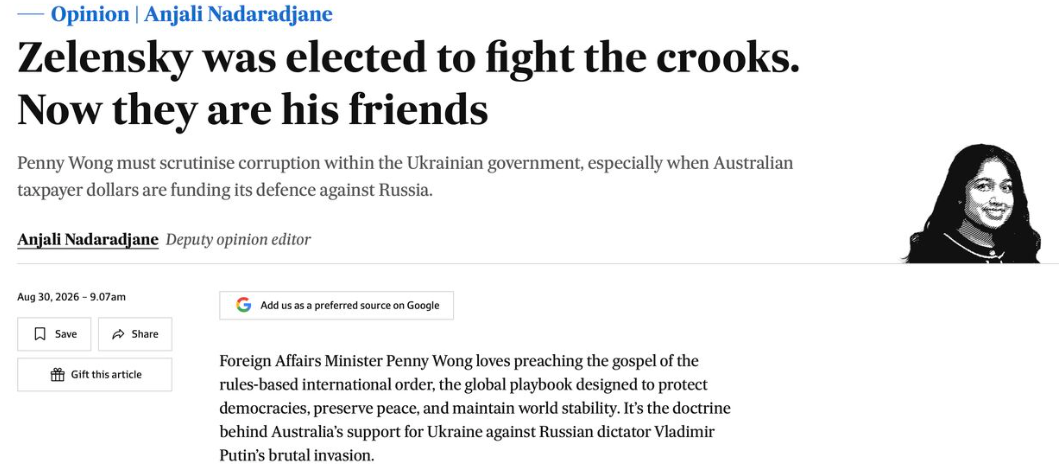
There are two very different stories that can be told about corruption in Ukraine.
One is complicated.
The other is convenient.
The convenient story is easy to write.
Ukraine is at war. Corruption scandals emerge. Officials resign. Investigations take place. Western aid continues flowing. Therefore, the system must be broken.
Simple.
Predictable.
And often misleading.
The complicated story requires context.
It requires understanding where Ukraine came from, what it inherited after the collapse of the Soviet Union, and what it has been trying to become ever since.
Most importantly, it requires distinguishing between corruption existing and corruption being exposed.
Those are not the same thing.
This distinction sits at the center of growing criticism directed at recent media coverage that takes genuine corruption scandals inside Ukraine and presents them as evidence of democratic collapse, failed governance, or compromised Western support.
The problem is not scrutiny.
The problem is interpretation.
Ukraine should be scrutinized.
Every dollar, euro, pound, and Australian dollar sent to Ukraine should be tracked and monitored. Politicians should be questioned. Procurement processes should be audited. Journalists should investigate wrongdoing.
That is how democracies function.
But serious journalism demands evidence, not implication.
If someone suggests that military aid provided by Western countries is reaching terrorist organizations, extraordinary evidence is required.
Not speculation.
Not recycled allegations.
Not claims repeated so often that they acquire the appearance of truth.
Evidence.
The burden of proof matters because accusations have consequences.
Military support programs are built on public trust. When media outlets suggest weapons may be ending up in the hands of terrorists, readers naturally assume supporting facts exist.
Without evidence, such claims do not strengthen accountability.
They weaken credibility.
The deeper issue, however, is historical context.
Ukraine did not emerge as a mature Western democracy.
It emerged from the wreckage of the Soviet Union.
It inherited institutions shaped by oligarchic influence, political patronage, entrenched corruption, weak rule of law, and decades of Moscow's political interference.
No country transforms a system like that overnight.
Not in five years.
Not in ten.
Possibly not even in a generation.
Yet Ukraine's trajectory over the last decade tells a story often ignored by critics.
Anti-corruption agencies have been established.
Investigative journalism has expanded dramatically.
Civil society groups have become more influential.
Public scrutiny of government decisions has intensified.
Senior officials have faced investigations that would have been unimaginable twenty years ago.
The existence of corruption scandals is frequently cited as proof of failure.
In reality, many scandals emerge because detection mechanisms work better than they did before.
This is an uncomfortable truth.
Healthy democracies often appear noisy.
Messy.
Confrontational.
Corruption investigations generate headlines.
Resignations generate headlines.
Public outrage generates headlines.
The absence of scandals does not necessarily indicate clean government.
Sometimes it indicates that nobody is looking.
That is why direction matters.
A snapshot can be deceptive.
Observers with little experience of Ukraine often see corruption stories and conclude that corruption defines the country.
They miss the larger movement beneath the surface.
The question is not whether corruption exists.
The question is whether institutions are becoming more capable of identifying, exposing, and confronting it.
Ukraine remains far from perfect.
There have been controversial decisions.
Attempts to weaken oversight mechanisms.
Political mistakes.
Institutional struggles.
Critics have legitimate points to raise.
But criticism becomes less useful when nuance disappears.
Especially during wartime.
Ukraine is simultaneously fighting one of the largest wars in Europe since 1945 while attempting to reform institutions inherited from a Soviet system.
Few nations have faced both challenges at once.
That reality does not excuse corruption.
It does provide context.
And context is journalism's first responsibility.
The strongest analysis does not praise Ukraine uncritically.
Nor does it condemn it reflexively.
Instead, it asks harder questions.
What reforms are succeeding?
Which institutions are failing?
What evidence exists?
What evidence does not?
What trends matter more than today's headlines?
Because democratic accountability depends on scrutiny.
But accountability also depends on accuracy.
Ukraine deserves criticism where criticism is warranted.
It deserves investigation where wrongdoing exists.
It deserves transparency where public money is involved.
What it does not deserve is a narrative built on implication rather than proof.
Good journalism holds governments accountable.
Great journalism holds itself to the same standard.