Burning the Network. Why Ukraine’s Real Target Isn’t Wildberries Warehouses - It’s Russia’s Logistics Nervous System
Wars have always been fought over territory.
But increasingly, they are decided by logistics.
The recent wave of strikes against Wildberries, Russia’s largest e-commerce and logistics network, reveals how modern warfare is evolving beyond traditional military targets and into the arteries of economic infrastructure.
At first glance, the attacks appear straightforward: warehouses burn, headlines spread, and social media fills with dramatic images of smoke towering over distribution centers.
But judging the campaign by flames alone misses the point.
The real target is not a warehouse.
It is a network.
From Warehouses to Warfare
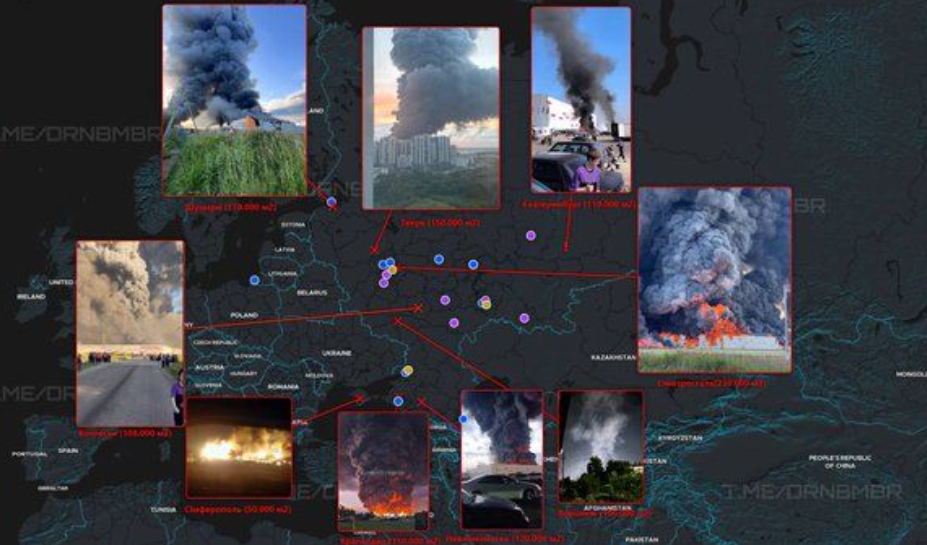
The attacks have stretched across multiple locations, including Elektrostal, Kotovsk, Krasnodar, Nevinnomyssk, Voronezh, facilities near St. Petersburg, and occupied Simferopol.
The map itself tells a story.
This is not a campaign focused on one facility or one city. It is a distributed effort aimed at nodes inside a sprawling logistics ecosystem responsible for moving millions of orders across Russia every day.
Much of the debate has focused on square meters damaged.
Some Ukrainian estimates suggest that more than 1.15 million square meters of logistics space have been damaged or disabled. Yet publicly available evidence does not currently confirm that figure.
Earlier Russian business reporting indicated that approximately 552,000 square meters had been affected, with roughly 444,000 square meters becoming temporarily unusable. That represented somewhere near 8–10 percent of available capacity.
Even those numbers remain fluid.
Several facilities resumed operations quickly, highlighting a central reality of modern logistics:
A building can survive while the network suffers.
The Hidden Cost of Disruption
Most observers instinctively think about physical destruction.
Logistics professionals think differently.
They think about throughput.
A logistics network does not fail only when warehouses disappear. It begins to degrade when inventory moves slower, routes become longer, scheduling becomes unpredictable, and operational costs steadily increase.
Wildberries operates a hub-and-spoke logistics system supporting hundreds of thousands of sellers and millions of customers.
When a major node goes offline, the consequences ripple outward:
- Inventory must be redistributed.
- Transport routes change.
- Neighboring hubs absorb excess volume.
- Delivery times increase.
- Storage costs rise.
- Insurance disputes grow.
- Safety procedures expand.
None of these developments generate dramatic satellite images.
But collectively, they impose a significant economic burden.
Network Warfare in the Digital Age
Ukraine's campaign reflects a broader shift taking place across modern warfare.
Historically, strategic bombing aimed to destroy factories, rail hubs, and industrial centers.
Today, the objective is increasingly to disrupt systems rather than eliminate them completely.
A logistics network does not need to collapse to become less effective.
It simply needs to become slower.
More expensive.
Less predictable.
This creates what economists call friction.
And friction is costly.
Every additional day of delay, every rerouted truck, every backup facility, every security upgrade, and every emergency stockpile consumes resources.
Over time, these costs compound.
The result is a gradual erosion of efficiency rather than a dramatic collapse.
An Economic Battlefield
The campaign also highlights the growing overlap between civilian infrastructure and strategic logistics.
Wildberries is primarily a commercial enterprise.
Millions of ordinary consumers use the platform.
Hundreds of thousands of small businesses depend on it.
At the same time, logistics networks often serve broader economic and national resilience functions.
Ukraine argues that parts of the logistics chain support supply movement and sanctioned-component distribution.
Russia rejects those claims.
Regardless of the competing narratives, the reality is that civilian and military logistics have become increasingly intertwined.
This creates difficult questions that do not disappear when the smoke clears.
Workers are affected.
Small businesses are affected.
Communities dependent on logistics employment are affected.
The human consequences become part of the strategic equation.
The Future of Deep Strike Operations
The most important lesson may be that future deep-strike campaigns will be measured differently.
Traditional assessments focus on destroyed assets.
Modern assessments may focus on degraded networks.
The key question is no longer:
"How many buildings burned?"
The more relevant question is:
"How much throughput was lost?"
If a logistics network maintains operations while requiring constant rebuilding, rerouting, redundancy, and protection, the attackers may still achieve their objective.
The network survives.
But it survives under pressure.
Making Russia Rebuild While Under Fire
The phrase "De-Wildberriesization" may sound like a social media slogan.
Yet behind the label lies a serious strategic idea.
The goal is not necessarily to destroy Russia's largest e-commerce platform.
The goal may be to force it into continuous adaptation.
Longer routes.
Additional warehousing.
Greater security costs.
More dispersed inventory.
Higher operational complexity.
In military terms, that means diverting resources.
In economic terms, that means lowering efficiency.
And in network warfare, efficiency is often the most valuable asset of all.
The warehouses may be rebuilt.
The distribution centers may reopen.
The trucks may continue moving.
But if Russia's logistics network must constantly redesign itself under pressure, the campaign has already achieved something significant.
Because in the twenty-first century, victory is not always about destroying the network.
Sometimes it is about forcing the network to rebuild itself while the war is still being fought.