The New Russian Exodus. When Citizens Run Before the Mobilization Order Arrives
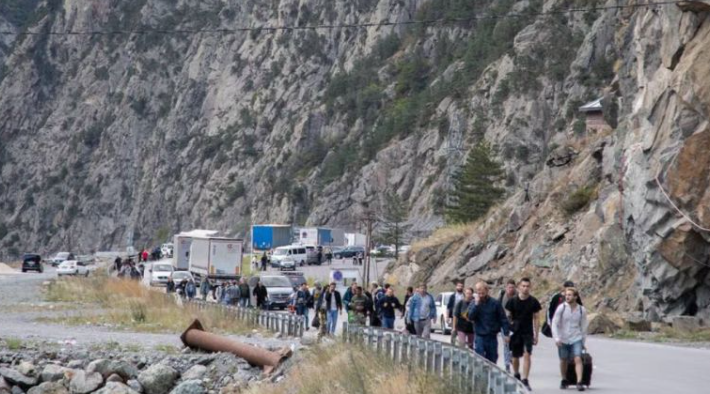
Something unusual is happening at Russia's southern border.
More than 113,000 Russian citizens have crossed into Georgia through the Verkhniy Lars checkpoint in just one week, a figure that immediately evokes memories of one of the most dramatic moments of the war in Ukraine.
In September 2022, following Vladimir Putin's announcement of a "partial mobilization," hundreds of thousands of Russians rushed to leave the country. Images of endless queues stretching for kilometers became symbols of a nation suddenly gripped by uncertainty. Georgia, Armenia, Kazakhstan, and other neighboring states became escape routes for those unwilling to risk being sent to the front.
Now, nearly four years later, history appears to be rhyming.
The Kremlin insists there are no plans for a new wave of mobilization. Officials dismiss rumors as speculation and argue that existing recruitment mechanisms are sufficient to sustain military operations. Publicly, Moscow projects confidence and stability.
Privately, many Russians appear unconvinced.
People rarely abandon their homes, jobs, families, and routines without reason.
The surge toward Georgia suggests that thousands of Russian citizens believe something may be changing behind the scenes.
Their concerns are not emerging from a vacuum.
Recent reports indicate that Russian authorities have intensified efforts to update databases of reservists, strengthen recruitment systems for contract soldiers, and expand the powers of the National Guard in scenarios connected to mobilization. Human-rights organizations have also reported a growing number of requests for assistance from men of conscription age, particularly those already registered in reserve pools.
Individually, these developments may appear administrative.
Taken together, they form a pattern.
And patterns matter.
The Kremlin learned a painful lesson in 2022. The mobilization announcement triggered not only military recruitment but also one of the largest waves of emigration in modern Russian history. Hundreds of thousands of educated professionals, entrepreneurs, engineers, software developers, academics, and skilled workers left the country.
Many never returned.
The economic consequences were significant.
The demographic consequences were even more profound.
The political consequences continue to shape Russia today.
That experience may explain why rumors alone now have the power to move people across borders.
The psychology of modern Russia has changed.
Citizens no longer wait for official confirmation.
They watch signals.
They observe bureaucratic changes.
They follow human-rights organizations.
They monitor recruitment efforts.
And increasingly, they make decisions before governments make announcements.
This creates a fascinating paradox.
Every denial issued by the Kremlin is intended to calm public concerns.
Yet every wave of departures suggests a growing trust gap between official messaging and public perception.
When citizens believe rumors more readily than official statements, governments face a challenge that statistics alone cannot solve.
Trust becomes a strategic resource.
And trust, once lost, is difficult to recover.
Georgia has become an important barometer of this phenomenon.
The Verkhniy Lars crossing is no longer simply a border checkpoint. It has become a geopolitical pressure gauge, measuring anxiety levels inside Russia in real time.
Each vehicle crossing south tells a story.
Some travelers may be acting out of caution.
Some may be responding to personal circumstances.
Others may genuinely believe that another mobilization, whether partial or broader, is approaching.
What unites them is uncertainty.
And uncertainty has consequences.
For Russia, a new exodus would represent more than a political embarrassment. It would risk another drain of human capital at a time when the country faces economic, demographic, and military challenges simultaneously.
For neighboring countries, it raises familiar questions about migration management, labor markets, security considerations, and long-term integration.
For Europe, it provides another glimpse into the internal pressures created by a prolonged conflict entering its fifth year.
Perhaps the most striking reality is this:
No mobilization has been announced.
No official order has been signed.
No mass conscription campaign has been publicly declared.
Yet more than 113,000 people have already voted with their feet.
In geopolitics, actions often reveal more than words.
And when thousands rush toward an exit before anyone officially tells them to leave, it suggests they have learned a lesson from history.
The lesson is simple.
In uncertain times, waiting for confirmation can be the most dangerous choice of all.