The Great Drone Manufacturing Delusion. Why the Industry Is 3D Printing What Sheet Metal Already Solved
The drone industry has a habit of falling in love with shiny technologies.
Today, that obsession is metal additive manufacturing. Across defense expos, aerospace conferences, and venture-backed drone startups, engineers proudly showcase intricate lattice structures, topology-optimized brackets, and fully 3D-printed airframes that look like they were designed by artificial intelligence after a caffeine overdose.
The message is always the same:
"This is the future."
But here's an uncomfortable question:
If mass-producing drones is the goal, why are so many companies trying to print entire metal airframes when inexpensive, scalable sheet metal has existed for over a century?
The answer reveals a growing disconnect between engineering theater and manufacturing reality.
The 3D-Printing Hype Machine
To be fair, metal additive manufacturing is a remarkable technology.
It enables design freedom impossible with conventional methods. Complex cooling channels, lightweight structures, part consolidation, and rapid prototyping all offer genuine advantages.
For aerospace components produced in low volumes, it can be transformative.
The problem starts when startups mistake a prototyping technology for a production technology.
A drone that takes dozens of hours to print, requires post-processing, heat treatment, machining, inspection, and extensive quality control may look revolutionary on LinkedIn.
It may also be commercially irrational.
Wars, logistics networks, agricultural fleets, and industrial inspection programs do not need beautiful prototypes.
They need thousands of reliable aircraft.
Fast.
Cheap.
Repeatable.
The Forgotten Superpower: Sheet Metal
Meanwhile, sitting quietly in factories around the world is one of humanity's most mature manufacturing technologies.
Sheet metal.
It lacks the glamour of additive manufacturing.
Nobody posts viral videos of robotic press brakes.
No investor presentation describes a laser-cut aluminum panel as "disruptive."
Yet sheet metal possesses one extraordinary advantage:
It scales.
The automotive industry learned this decades ago. So did aviation.
The reason aircraft manufacturers continue to use formed aluminum, titanium, and steel structures isn't because they are technologically backward.
It's because these materials are proven, economical, repairable, and manufacturable at scale.
Roboforming Changes the Equation
The conversation becomes even more interesting when robotic forming technologies enter the picture.
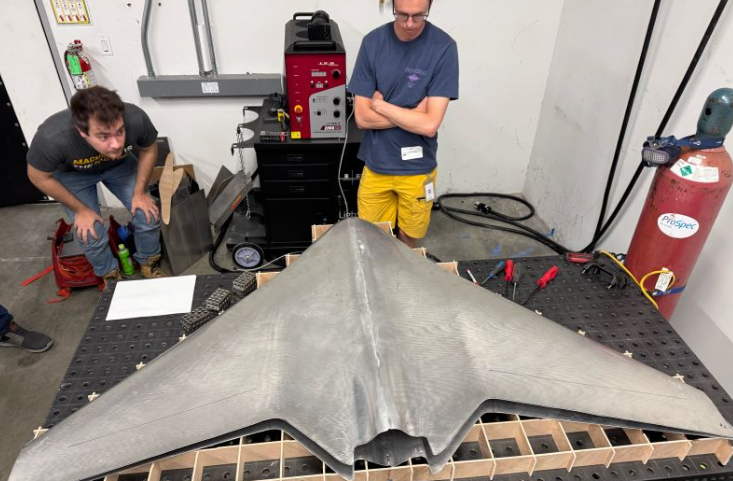
Modern robotic sheet-metal systems can produce increasingly complex three-dimensional geometries that were once difficult or expensive to manufacture.
Automated bending, forming, laser cutting, robot welding, and digital quality inspection are blurring the line between traditional fabrication and advanced manufacturing.
Suddenly, many structures previously considered ideal candidates for additive manufacturing can be produced faster and cheaper through automated sheet-metal workflows.
And unlike 3D printing, production rates can actually increase without requiring a warehouse full of expensive printers.
The Drone Industry's Real Problem Isn't Design
Most drone companies are solving the wrong challenge.
The bottleneck isn't usually engineering.
It's manufacturing.
Building ten drones is easy.
Building ten thousand is hard.
Building one hundred thousand is where most business plans encounter reality.
This challenge has become particularly visible in defense technology.
The war in Ukraine demonstrated that drone superiority is not determined solely by performance. It is increasingly determined by production capacity.
A drone that costs one-third as much and can be manufactured ten times faster often delivers more strategic value than a technologically superior platform built in small quantities.
Volume has become a weapon.
The Economics Nobody Wants to Discuss
Investors love technological breakthroughs.
Factories love economics.
Those incentives are not always aligned.
A beautifully optimized metal-printed airframe may reduce weight by five percent.
A sheet-metal design might reduce manufacturing costs by fifty percent.
Which improvement matters more?
The answer depends on whether you're building a demonstrator for a trade show or an industrial product for real-world deployment.
Increasingly, governments, militaries, and commercial operators are asking exactly that question.
The age of innovation theater is colliding with the age of production reality.
Lessons from History
This is not the first time manufacturing has gone through such a cycle.
The aerospace industry repeatedly discovers that elegant designs do not necessarily win.
Manufacturable designs win.
Reliable designs win.
Affordable designs win.
The products that dominate industries are rarely the most technologically exotic.
They are the ones that can be built consistently and economically at scale.
That lesson may now be arriving in the drone sector.
The Future Won't Be Printed. It Will Be Produced.
None of this means metal 3D printing is a dead end.
Far from it.
Additive manufacturing will remain critical for specialized parts, rapid prototyping, tooling, and complex components where conventional production makes little sense.
But building entire drone airframes through additive manufacturing may increasingly look like an answer searching for a problem.
The next generation of successful drone manufacturers may not be those chasing the most futuristic production methods.
They may be those combining intelligent design, robotic automation, and scalable fabrication technologies already proven by decades of industrial experience.
Because in the end, wars are not won by prototypes.
Markets are not dominated by prototypes.
And supply chains are not built on prototypes.
The future belongs to whoever can manufacture reality faster than everyone else.