The End of the Watchtower. Why Europe Needs Autonomous Drone Guardians for Critical Infrastructure

The appearance of multiple unidentified drones flying in formation above a Swiss military facility should alarm every European security planner.
Not because drones violated protected airspace.
But because they exposed a dangerous truth.
The model of infrastructure protection that Europe has relied on for decades is becoming obsolete.
For generations, security was built around a simple assumption: threats approached from the ground. Fences, cameras, patrols, checkpoints, barriers, guards, and access controls formed the backbone of critical infrastructure protection.
That world is disappearing.
As Swiss Army Chief Benedikt Roos bluntly noted after the latest incident, the idea that "a few guards" can protect a facility no longer reflects reality. Today's threat arrives from above, often silently, cheaply, and anonymously.
And increasingly in groups.
The reported sighting involved several drones operating in formation above a military installation. Whether the mission involved reconnaissance, intelligence collection, electronic testing, or simply probing defenses remains unknown.
The strategic lesson, however, is obvious.
Someone demonstrated the ability to enter protected airspace, conduct a coordinated operation, and leave without immediate identification.
That is precisely how modern hybrid warfare works.
Across Europe, similar incidents have appeared near airports, military bases, energy facilities, ports, logistics centers, and critical infrastructure. Security agencies increasingly view many of these activities as components of broader intelligence-gathering campaigns designed to test response capabilities, identify vulnerabilities, and create uncertainty.
The drone itself is often not the objective.
The information collected is.
This creates an uncomfortable challenge for European governments.
Traditional air-defense systems are often too expensive, too scarce, or simply inappropriate for protecting every power plant, data center, military facility, border crossing, transportation hub, or industrial site.
No nation can afford to deploy advanced missile systems around every critical asset.
Nor would it make sense.
The economics are wrong.
The threat may cost only a few hundred euros.
The response can cost millions.
That imbalance is precisely what hostile actors exploit.
The answer increasingly lies elsewhere.
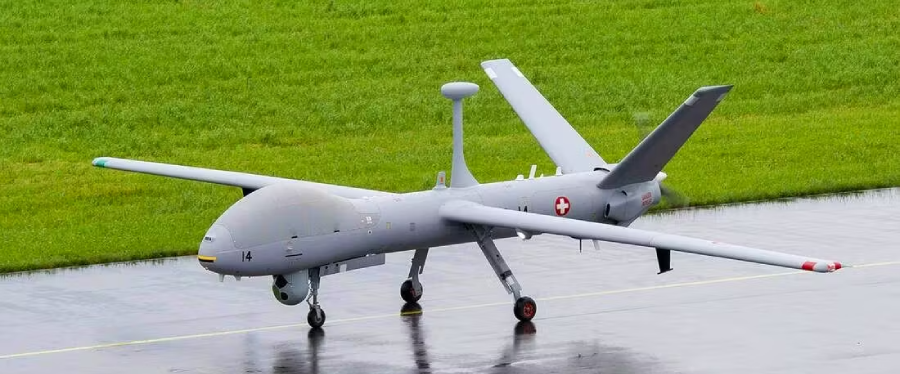
Instead of relying solely on static defenses, Europe needs persistent, autonomous, low-operating-cost aerial security systems capable of maintaining continuous situational awareness above critical infrastructure.
In simple terms:
Critical infrastructure needs its own airborne guardians.
This is where a new generation of unmanned systems enters the discussion.
Aircraft designed not for strike missions or military offensives, but for persistent monitoring, rapid response, and infrastructure protection.
Systems capable of remaining available around the clock.
Twenty-four hours a day.
Seven days a week.
In all weather conditions.
With sufficient redundancy to meet civil-aviation-level safety expectations.
That vision aligns closely with the concepts now emerging across the European aerospace sector.
Rather than treating drone defense as a purely military problem, innovators increasingly view it as an infrastructure-security challenge.
The mission is straightforward:
Detect unknown drones.
Track them.
Classify them.
Verify intent.
Provide immediate response options.
And maintain continuous coverage without exhausting personnel resources.
Artificial intelligence, onboard sensors, radar integration, automated patrol routes, and autonomous monitoring capabilities are transforming what was once impossible into a practical operational model.
The economic argument is equally compelling.
Human guards require shifts, infrastructure, training, transportation, supervision, and continuous staffing.
Aircraft do not eliminate humans from the loop, but they dramatically increase coverage per operator.
A single autonomous aerial surveillance system can monitor areas that would otherwise require significant manpower and resources.
This matters because the scale of the challenge is expanding rapidly.
Thousands of potential targets exist across Europe.
Power stations.
Military facilities.
Communication nodes.
Gas terminals.
Airports.
Ports.
Rail hubs.
Data centers.
Water infrastructure.
Protecting them all using twentieth-century security concepts will become increasingly difficult.
And adversaries know it.
The Swiss incident should therefore be viewed as more than an isolated security event.
It represents a warning.
Europe's threat environment has evolved faster than many protection strategies.
The uncomfortable reality is that the next generation of security architecture may not be defined by fences, cameras, or guard towers.
It may be defined by networks of intelligent airborne systems operating continuously above the assets societies depend upon most.
The logic is simple.
If the threat flies, the protection must fly too.
The era of passive infrastructure security is ending.
The era of autonomous aerial protection is just beginning.