The Drone General’s New War. Mykhailo Fedorov’s Billion-Dollar Bet on Ukraine’s Future
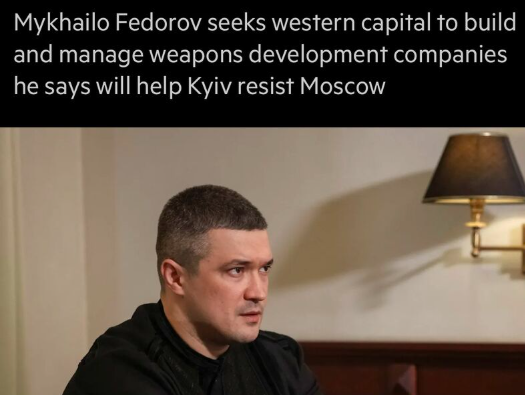
Washington has seen countless foreign delegations arrive seeking aid, investments, and political support. But Mykhailo Fedorov came with something different: a pitch deck for the future of warfare.
Just weeks after his dramatic dismissal as Ukraine's defence minister, the 35-year-old reformer landed in the US capital with an ambitious mission. He is not asking investors to back another startup. He wants them to back the next generation of war itself.
In an exclusive and remarkably candid interview with the Financial Times, Fedorov outlined plans for a new defense technology investment fund designed to transform battlefield innovation into a global business opportunity. His message was simple but provocative: Ukraine is no longer merely fighting a war. It is building the technologies that will define how future wars are fought.
"We're writing a new history of the war," he told the newspaper.
That statement is not merely rhetoric.
The proposed vehicle would not operate like a traditional venture capital fund. Instead of simply funding existing startups, it would actively create companies, assemble teams, identify technological gaps, and build products specifically designed for modern combat environments.
In Silicon Valley language, Fedorov wants to become both investor and founder.
In military language, he wants to become an architect of the battlefield of tomorrow.
Three Technologies That Could Change Everything
The fund's initial focus reveals how dramatically warfare is evolving.
First, battlefield robotics. Ukraine wants autonomous systems capable of replacing soldiers in the most dangerous front-line positions. The logic is brutally straightforward: machines do not bleed, and every robot deployed is potentially a life saved.
Second, jet-powered interceptor drones. Russia has increasingly deployed faster and more sophisticated aerial systems. Traditional drone warfare is entering an arms race where speed matters as much as cost. Ukraine wants affordable interceptors capable of hunting hostile drones before they strike critical targets.
Third, low-cost AI-enabled missiles. The combination of artificial intelligence and precision strike capability could dramatically lower the cost of modern missile systems while increasing effectiveness.
Taken together, these three priorities reveal a larger strategy.
Ukraine is trying to solve a fundamental problem. Russia has more people, more industrial capacity, and greater resources. Ukraine must compensate through technology.
What Silicon Valley calls disruption, Kyiv calls survival.
A Political Outsider Challenges the Establishment
The interview also highlighted the extraordinary transformation of Fedorov himself.
For years he was viewed as the face of Ukraine's digital revolution. His startup mentality helped modernize government services and accelerated Ukraine's drone development programs.
Yet that same entrepreneurial approach reportedly generated friction inside the military establishment.
His dismissal by President Volodymyr Zelenskyy triggered public protests and opened one of the most serious political debates Ukraine has experienced since the invasion.
Now Fedorov appears increasingly willing to challenge wartime orthodoxies.
He has publicly called for elections. He has argued that Ukraine is gradually losing the war if it fails to address emerging military threats. He has broken with the longstanding wartime tradition of avoiding public criticism of government decisions.
For supporters, this is courageous realism.
For critics, it is dangerous dissent.
Either way, Fedorov has become one of the most consequential and controversial figures in Ukrainian politics.
The Patriot-for-Drones Trade
Perhaps the most striking moment of the interview came when Fedorov proposed a new form of military partnership with Washington.
He said he would gladly help the United States "build an army of drones" in exchange for Patriot missile interceptors.
The proposal reflects Ukraine's immediate challenge.
Russia's increasingly sophisticated missile and drone campaigns are stretching Ukraine's air defenses to their limits. Patriot interceptors remain among the few systems capable of reliably defeating certain advanced threats. Yet global stockpiles are limited and demand is growing.
Fedorov's response is characteristic: don't just ask for help, offer technological expertise in return.
Ukraine, after all, has become the world's largest real-world laboratory for drone warfare.
A Startup Founder in a War Zone
Many political leaders think in election cycles.
Many generals think in military campaigns.
Fedorov appears to think in technological cycles.
His wager is that the side which innovates fastest will ultimately prevail.
The broader question is whether investors share that belief.
Because if Fedorov succeeds, Ukraine's defense sector could evolve into something never seen before: a wartime ecosystem where venture capital, artificial intelligence, robotics and military necessity merge into a permanent engine of innovation.
And if that happens, the former minister may end up shaping the future of warfare more profoundly outside government than he ever could inside it.