The Arsonists of the Information Age: How Russia Turns Real Crises Into Digital Weapons
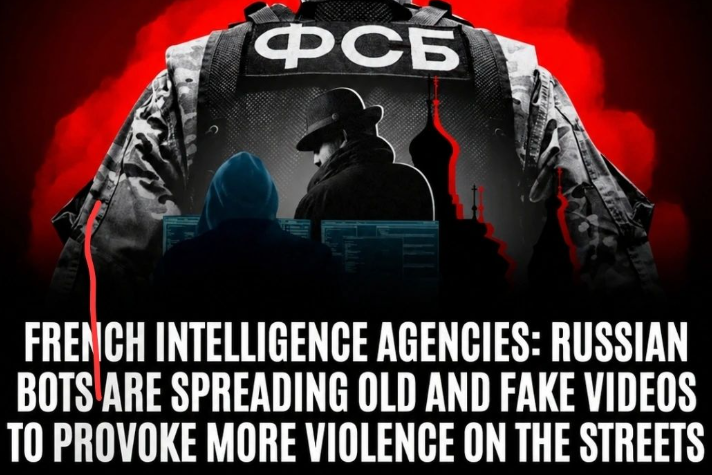
The most effective disinformation campaigns don't start crises.
They hijack them.
That distinction is critical because it explains why modern information warfare is so difficult to detect, confront, and defeat.
When protests erupted in France, the streets did not need foreign actors to create public anger, political disagreement, or social tension. Democracies naturally generate conflict. Citizens protest. Governments make controversial decisions. Social movements emerge.
But in the digital era, every genuine crisis presents an opportunity.
And according to French intelligence services and European investigators, Russia's disinformation ecosystem appears to have identified exactly such an opportunity.
Not to start the fire.
To pour gasoline on it.
The New Logic of Information Warfare
The popular image of propaganda still belongs to the twentieth century.
A government invents a lie.
A media outlet publishes it.
Citizens believe it.
Modern influence operations work differently.
Today's information warriors prefer to weaponize reality itself.
A protest does not need to be fabricated.
A demonstration does not need to be organized by Moscow.
Public frustration does not need to be manufactured.
All that is required is an existing fracture that can be amplified, exaggerated, distorted, and pushed to millions of people at machine speed.
This approach is both cheaper and more effective.
Why create a false narrative when reality already provides material that can be manipulated?
The Business Model of Chaos
Networks linked to Russian influence operations have developed a sophisticated operational model.
Researchers have documented tactics that include recycled video footage, manipulated content, AI-generated imagery, fake news reports, false expert commentary, and impersonation of trusted media organizations.
The objective is rarely persuasion.
The objective is confusion.
Disinformation campaigns no longer seek to convince everyone of one version of events.
Instead, they flood information spaces with so many conflicting narratives that citizens lose confidence in all narratives.
Truth becomes difficult to identify.
Trust becomes difficult to maintain.
Democratic discourse begins to fracture.
That outcome is often more valuable than convincing anyone of a specific geopolitical position.
The Rise of the Synthetic Battlefield
Artificial intelligence is accelerating this challenge dramatically.
A decade ago, influence campaigns required large teams of content creators.
Today, sophisticated AI systems can generate realistic video, voice recordings, images, and articles in multiple languages within minutes.
The barriers to scale have almost disappeared.
A single network can now produce the appearance of a massive information ecosystem.
Fake eyewitness accounts.
Fake journalists.
Fake experts.
Fake videos.
Fake evidence.
All distributed globally in real time.
The battlefield is no longer limited to land, sea, air, space, and cyberspace.
Information itself has become a contested operational domain.
Why Democracies Are Vulnerable
Open societies possess enormous strengths.
Freedom of expression.
Independent media.
Public debate.
Political pluralism.
These characteristics make democracies resilient.
They also make them attractive targets.
Authoritarian influence operations exploit openness because openness allows information to move freely.
Every social controversy becomes available for amplification.
Every political disagreement becomes an opportunity.
Every protest becomes potential content.
Democracies face a complicated dilemma.
They must defend themselves against manipulation while preserving the freedoms that define them.
Overreaction can be as damaging as inaction.
The Future Conflict Nobody Can See
The most dangerous aspect of modern disinformation is that it often remains invisible.
Citizens can easily identify tanks.
Missiles are visible.
Military deployments create obvious signals.
Information attacks operate differently.
People often encounter them disguised as ordinary content within their social media feeds.
The attack feels organic.
The manipulation feels authentic.
The emotional response feels personal.
That is precisely why it works.
The future of conflict will not only be fought through military force, economic power, or diplomatic influence.
It will increasingly be fought through perception.
The side capable of influencing what societies see, believe, share, and fear gains a strategic advantage without firing a shot.
Russia did not invent social unrest.
Nor did it invent political polarization.
But modern information warfare understands something profoundly powerful:
You don't need to create a crisis when you can weaponize an existing one.
And in the digital age, every protest, every controversy, and every moment of public anger can become ammunition.