Skynex and Rheinmetall. Latest Air-Defence Win Signals a New Era in Counter-Drone Warfare
Modern air defence was dominated by expensive missiles designed to intercept expensive targets.
That model is rapidly breaking down.
As drone warfare reshapes battlefields from Ukraine to the Middle East, militaries are rediscovering an old truth: sometimes the most effective air-defence solution isn't another missile—it's a gun.
Rheinmetall's latest export success demonstrates exactly how fast this shift is happening.
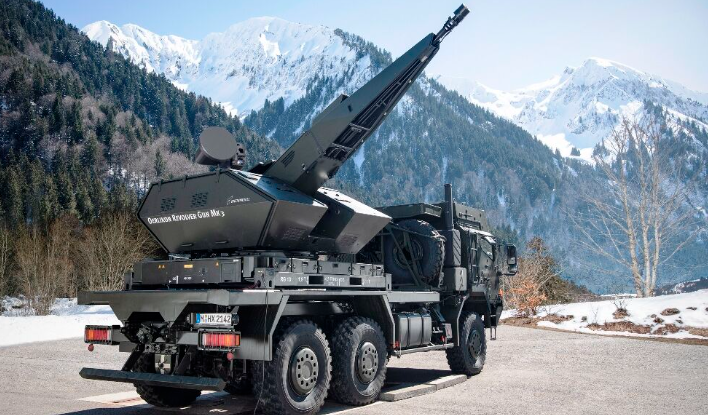
The German defence giant has secured a contract worth several hundred million euros for four complete Skynex very-short-range air-defence systems from an undisclosed international customer. Booked in the second quarter of 2026, the order marks the first Skynex acquisition by this customer and further expands the system's global footprint.
While Rheinmetall has not revealed the buyer, the strategic significance of the deal extends far beyond one procurement decision.
It reflects a growing realization among military planners worldwide:
The drone age demands a different kind of air defence.
More Than a Weapons Purchase
The Skynex order is not simply about delivering four batteries.
The package includes:
✅ Complete Skynex air-defence systems
✅ Military trucks and support vehicles
✅ Ammunition stocks
✅ Training packages
✅ Spare parts and tools
✅ Long-term logistics support
In other words, the customer is not buying equipment.
It is buying an operational capability.
Rheinmetall expects the programme to run for 39 months, with the first battery delivered 21 months after contract signature and the remaining systems following at six-month intervals.
Rheinmetall Italia will act as prime contractor, supported by multiple subsidiaries across the Rheinmetall Group.
That structure highlights another trend reshaping European defence: increasingly integrated multinational industrial cooperation.
Why Skynex Matters
The battlefield lessons emerging from Ukraine have exposed a painful reality for many air forces.
Using multi-million-euro missiles to destroy drones costing a few thousand dollars is economically unsustainable.
This is where systems like Skynex enter the conversation.
Skynex was specifically designed to counter:
- Drones and loitering munitions
- Cruise missiles
- Helicopters
- Short-range aerial threats
- Saturation attacks involving multiple targets
Unlike traditional missile-based systems, Skynex relies on advanced sensors, digital fire-control systems, and rapid-fire cannon technology.
Its approach is often described as "cost-effective interception."
The logic is straightforward.
If an adversary launches dozens or hundreds of low-cost drones, defenders need a method of engaging them without exhausting missile inventories.
Recent conflicts have made that requirement impossible to ignore.
The Rise of Gun-Based Air Defence
For decades, many armies viewed anti-aircraft guns as relics of an earlier era.
Precision-guided missiles appeared to have made them obsolete.
Drone warfare changed everything.
Small UAVs, one-way attack drones, and loitering munitions operate in a cost category that challenges traditional air-defence economics.
A missile worth hundreds of thousands—or even millions—of euros may successfully destroy the target.
But the exchange remains strategically unfavorable.
Gun-based systems offer a different equation.
The resurgence of systems such as Skynex reflects a broader transformation across NATO and allied countries.
The future air-defence architecture is increasingly layered:
🔹 Long-range missile systems
🔹 Medium-range interceptors
🔹 Electronic warfare solutions
🔹 Directed-energy weapons
🔹 Counter-drone systems
🔹 Gun-based air defence
No single technology provides the answer.
The challenge is building networks capable of handling threats across multiple domains simultaneously.
The Industrial Challenge
Perhaps the most important aspect of the Skynex order is what it says about defense-industrial priorities.
Countries are no longer buying isolated weapons systems.
They are acquiring complete ecosystems.
Training, maintenance, logistics support, spare parts, and ammunition reserves are now considered as strategically important as the weapon itself.
The inclusion of a comprehensive logistical support package suggests that customers increasingly recognize a simple fact:
A defence system is only as effective as its sustainment capability.
This reflects a lesson reinforced repeatedly by the war in Ukraine, where production capacity, ammunition availability, and maintenance infrastructure often determine combat effectiveness as much as technology.
A Glimpse of Future Air Defence
The identity of the Skynex customer remains unknown.
Yet the message behind the contract is unmistakable.
Military planners are preparing for an era in which low-cost aerial threats are everywhere.
The challenge is no longer defending against a handful of aircraft or missiles.
It is defending against swarms of drones, cruise missiles, and coordinated attacks designed to overwhelm traditional systems.
Rheinmetall's latest order suggests that governments increasingly believe systems like Skynex will become essential components of that defense.
The contract is more than a commercial success.
It is another indicator that the future of air defence may depend as much on affordability and scalability as on raw technological performance.
The missile age is not ending.
But the era of the intelligent gun has clearly returned.