Rheinmetall Skyranger - Much More Than a Gun
The name Oerlikon still carries weight in European air defence. For decades, it stood for precision cannons and rugged reliability. But a visit to Rheinmetall’s production site in Zurich‑Oerlikon makes one thing clear: the future of air defence has moved far beyond steel barrels and ammunition belts.
In a wide industrial hall filled with the layered sounds of welding arcs, hydraulic systems, and test rigs humming under load, the Skyranger comes to life — step by step, module by module. Overhead, a yellow heavy‑duty crane spans the length of the building. Below it, turret structures gradually evolve from raw steel into one of Europe’s most advanced mobile short‑range air‑defence systems.
At first sight, the Skyranger is defined by its centerpiece: a 30‑ or 35‑millimeter automatic cannon, fed with programmable AHEAD ammunition. This weapon alone has made the system famous — especially in an era dominated by drones, loitering munitions, and low‑flying cruise missiles. But focusing on the gun misses the point.
The Skyranger is not a weapon. It is an ecosystem.
One System, Multiple Armies
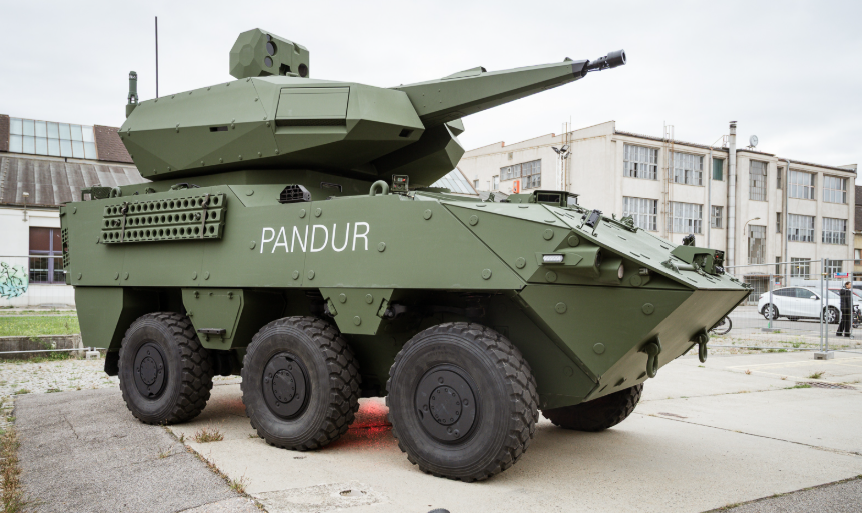
Austria, Germany, and Denmark may operate the same Rheinmetall technology — but they integrate it on entirely different platforms. Austria mounts the Skyranger turret on the Pandur Evolution, Germany chose the Boxer, and Denmark deploys it on Piranha vehicles. That modularity is not an afterthought; it is baked into the system’s DNA.
Inside the Oerlikon facility, technicians assemble turret structures in stages: base hulls, magazine carriers, drive units, sensor blocks, smoke grenade launchers, and finally the weapon and missile interfaces. The result is a mobile air‑defence effector capable of protecting maneuvering ground forces, critical infrastructure, and rear areas alike — even while constantly on the move.
The Software Is the Weapon
The real centre of gravity lies in software and sensor fusion. Rheinmetall’s Skymaster command‑and‑control system acts as the nervous system, stitching together radar inputs, electro‑optical sensors, infrared cameras, passive emitters, and external data sources into a real‑time air picture.
In Oerlikon, this capability is demonstrated by the Skyspotter system — containerized command and multisensor units designed for rapid deployment. Inside the control container, operators track, classify, and neutralize threats within seconds. The second container combines radar, EO/IR sensors, laser rangefinding, electronic jamming, and passive detection of non‑cooperative targets.
It is here that Rheinmetall’s philosophy becomes obvious: modern short‑range air defence is no longer about reaction speed alone. It is about networked decision‑making.
“Mobility no longer protects you,” one Rheinmetall product manager explains. “What used to be a concealed position is now a coordinate.” In an age where FPV drones cost less than a set of car tires yet deliver lethal precision, air defence must act faster than human perception allows.
Built for Evolution, Not Obsolescence
Even the most advanced system fails if sustainment collapses. That reality has reshaped Rheinmetall’s approach to logistics, training, and lifecycle management.
Long before a Skyranger is delivered, engineers run RAMS analyses, define mission profiles, and structure supply chains for decades of service. Customers receive simulators, test equipment, digital maintenance documentation, and upgrade paths — designed so that armies retain autonomy without sacrificing availability.
This forward‑thinking approach is tested brutally inside the Hexabot — a massive robotic rig resembling a mechanical spider. It simulates shock loads, off‑road vibration, extreme tilt angles, and structural stress. If a turret cannot survive here, it will never reach a Boxer, Pandur, or Piranha.
Beyond the Cannon of Yesterday
As the tour ends, the word Oerlikon looms large on the factory wall — not as nostalgia, but as a promise. While Europe debates air defence gaps and drone threats dominate modern battlefields, Rheinmetall is already producing answers.
The Skyranger is not yesterday’s flak gun reborn. It is a digitally connected effector, embedded in a layered, interoperable air‑defence architecture — designed for wars where the sky is no longer empty, silent, or forgiving.
And that is why demand for it is accelerating.

.jpg)