Quantum Systems Again Just Changed the Rules of European Warfare
Something extraordinary is happening in Germany.
For decades, Europe’s defense industry was dominated by established giants—companies that built tanks, fighter aircraft, warships, and artillery systems over generations. Innovation was often incremental, procurement cycles lasted years, and disruption rarely came from startups.
That paradigm is collapsing.
The latest proof arrived when Quantum Systems announced a $1.2 billion funding round, valuing the Munich-based drone company at $8 billion and making it one of the most valuable defense technology startups in Europe.
The timing could not have been more symbolic.
On the very same day, defense heavyweight KNDS postponed its planned IPO due to volatile capital market conditions.
A startup attracted billions.
A legacy defense giant paused its public market ambitions.
That contrast tells an important story about where investors believe the future of defense is heading.
The Rise of Germany’s Defense Unicorns
Quantum Systems is not alone.
Only weeks earlier, German robotics company NEURA Robotics secured a funding round worth approximately €1.4 billion.
Together, these transactions represent something previously unseen in Germany:
Multiple billion-dollar financing rounds for defense and deep-tech startups within a matter of weeks.
Investors are no longer searching only for traditional defense contractors.
They are looking for companies capable of shaping the next generation of warfare.
And increasingly, those companies are software-driven, AI-focused, autonomous-system builders rather than manufacturers of traditional military hardware.
From Startup to Neo-Prime Contractor
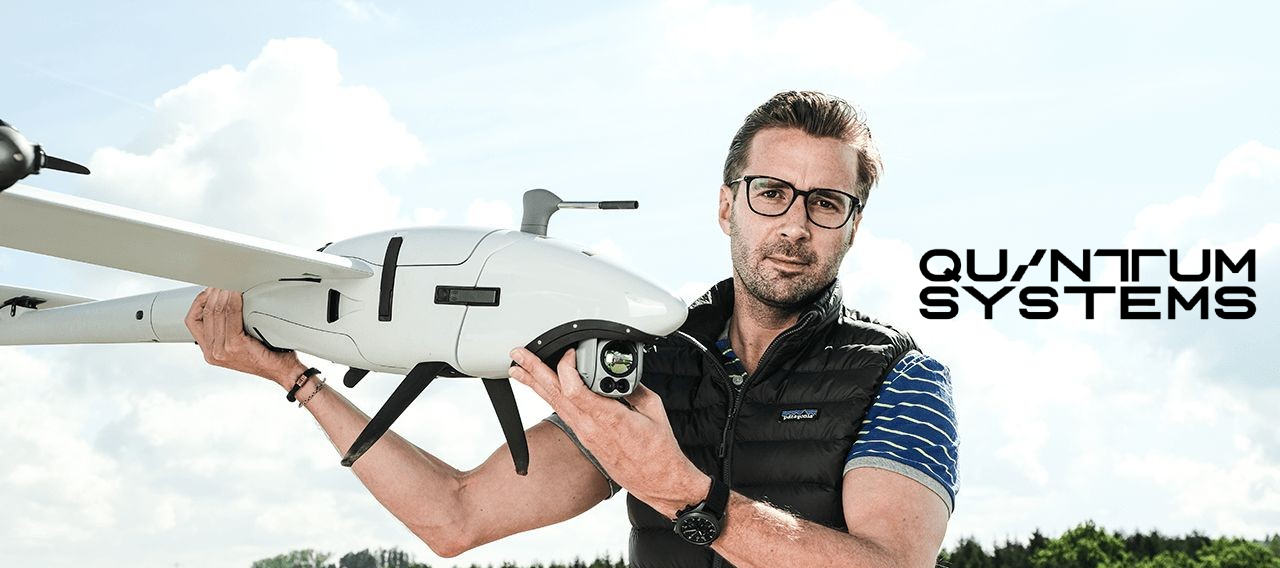
Founded in 2015 by former Bundeswehr officer Florian Seibel, Quantum Systems initially focused on reconnaissance drones for civilian markets.
The war in Ukraine changed everything.
Today, Quantum has transformed into one of Europe's most ambitious defense technology companies.
Revenue reportedly reached approximately €300 million in 2025, and management expects sales to double during 2026.
More remarkably, Quantum claims to be profitable.
In the notoriously challenging defense startup ecosystem, profitability is a rare achievement.
Seibel has repeatedly articulated a vision that extends far beyond drone manufacturing.
Quantum wants to become what he calls a "Neo-Prime."
Not merely another drone producer.
A full-spectrum defense technology company.
From Air to Land—and Soon Sea
The company is expanding aggressively across domains.
Its portfolio already includes:
✅ Reconnaissance drones
✅ Counter-drone systems
✅ Unmanned ground vehicles (UGVs)
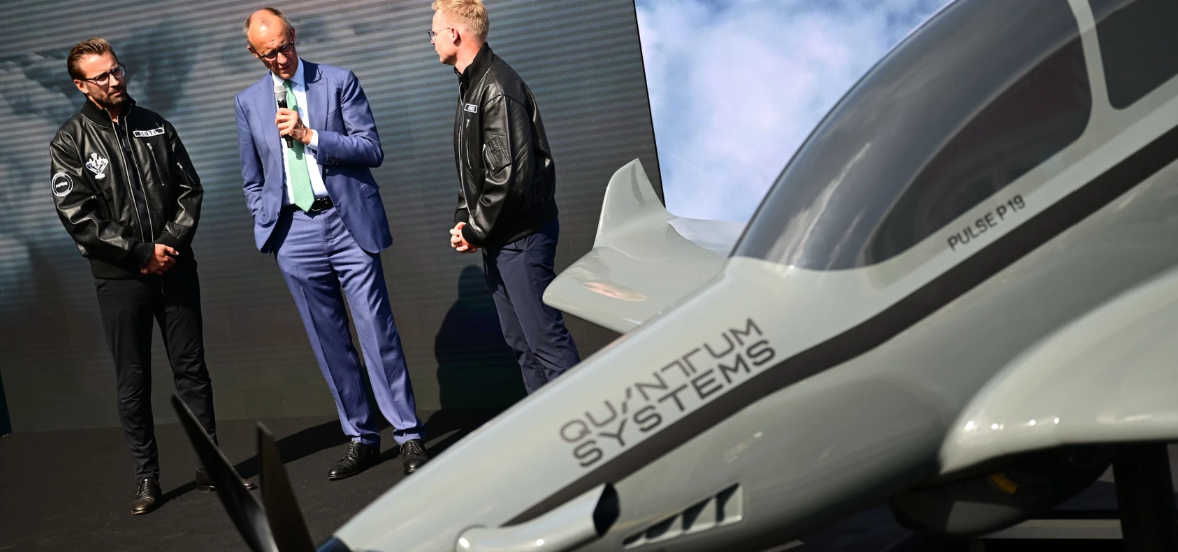
✅ The PULSE P19, a multipurpose aircraft capable of operating with or without a pilot
Now comes the next step.
According to Seibel, Quantum plans to unveil a maritime autonomous system in September.
Should that happen, Quantum would achieve something strategically important:
It would become a fully multi-domain autonomous systems provider.
Land.
Air.
Sea.
All linked through a common software architecture.
The future battlefield is increasingly defined not by individual platforms but by interconnected networks of autonomous systems operating simultaneously across multiple domains.
Quantum intends to be at the center of that transformation.
The Software Company Hidden Inside a Drone Company
Perhaps the most misunderstood aspect of Quantum Systems is that it is not primarily a drone manufacturer.
Like many successful defense-tech disruptors, its true value lies in software.
The company's operating system serves as the connective tissue linking autonomous aircraft, ground systems, future maritime platforms, and AI-enabled mission management.
The philosophy is simple:
Modern warfare is increasingly won by decision speed rather than platform size.
As Michael Schöllhorn, CEO of Airbus Defence and Space, recently noted:
"Modern battles are won through decision speed—the ability to collect, process and combine data faster than the opponent."
That statement may be the most important insight into the future of warfare.
Data is becoming as strategically important as firepower.
The Airbus Partnership
Another key element of Quantum's growth is its strategic relationship with Airbus.
Airbus participated in the latest financing round and recently announced cooperation with Quantum to integrate drone-interception capabilities into Airbus military helicopters.
The partnership reflects a wider trend.
Traditional aerospace and defense giants are increasingly seeking collaboration with fast-moving startups rather than attempting to replicate their innovation models internally.
Building everything from scratch may no longer be the winning strategy.
Partnering with companies that innovate faster may be.
Why Investors Are Changing Their Minds
The enthusiasm surrounding Quantum, NEURA Robotics, Helsing, Stark Defence, and other emerging European defense technology companies is not simply about drones.
It is about adaptability.
Large industrial conglomerates remain essential.
No startup will replace production of tanks, warships, or fighter jets overnight.
But investors increasingly recognize that the defining technologies of future warfare are evolving at startup speed.
Artificial intelligence.
Autonomy.
Sensor fusion.
Swarming systems.
Mission software.
Counter-drone architectures.
Traditional corporations often struggle with the pace of change required in these fields.
Startups thrive on it.
The Real Revolution
The most significant takeaway from Quantum's $1.2 billion financing round is not the valuation.
It is what the valuation represents.
Investors are betting that military advantage in the coming decades will increasingly belong to companies capable of:
- Building autonomous systems
- Integrating AI at scale
- Connecting multiple domains
- Accelerating decision cycles
- Adapting faster than competitors
In short, they are betting that software-enabled autonomy will become as important to defense as tanks, aircraft, and missiles were in the twentieth century.
Germany's defense startup ecosystem is no longer a niche experiment.
It is becoming a strategic industry.
And if Quantum Systems succeeds in its ambition to become a true multi-domain operator, Europe may be witnessing the emergence of an entirely new category of defense prime contractor.