Skydio F10 Lightrunner: The Drone That Wants to Make “Launch, Fly, Land” Feel Almost Automatic
For weeks, Skydio teased its next product with three deliberately cryptic lines:
Go far. Go fast. Go F10.
You won’t believe your SideEye.
Perfectly asymmetrical.
Now the teasing is over.
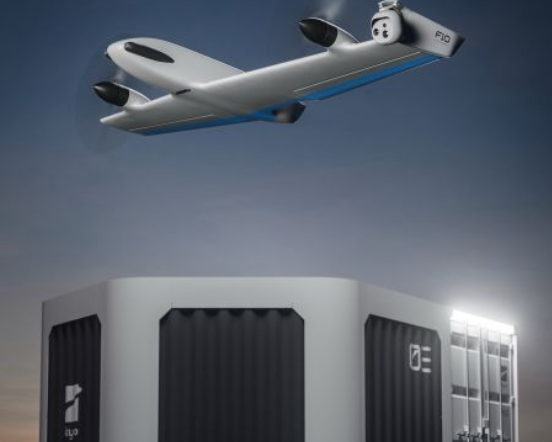
Skydio has launched the F10 Lightrunner, and the product pitch is not subtle: this is a drone built to move fast, stay in the air for a long time, operate remotely and reduce the amount of human effort required to launch, fly and recover it.
On paper, the numbers immediately stand out.
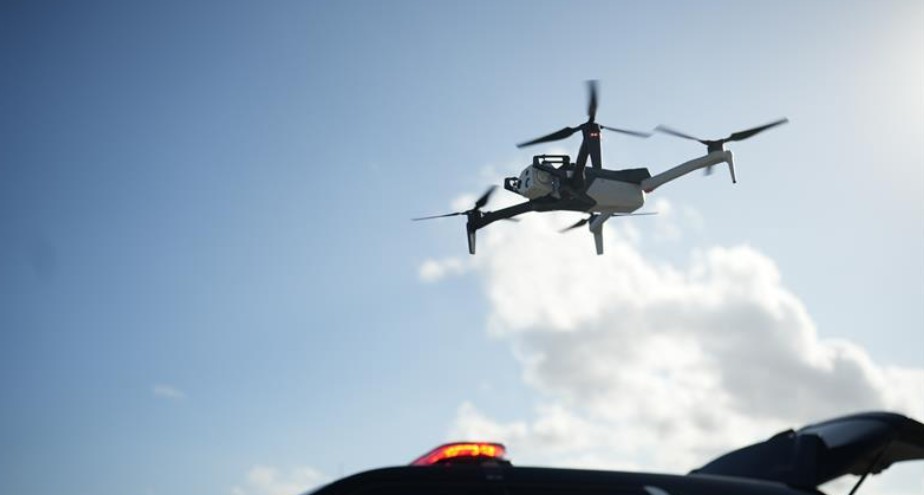
The F10 Lightrunner is designed for speeds ranging from 40 to 100 mph, with up to 120 minutes of flight time. That combination puts the emphasis on reach and persistence — two capabilities that matter enormously for inspection, security, public safety and other missions where a drone has to cover large areas without constant repositioning.
But the more interesting story is not just speed or endurance.
It is automation.
Robotic launch and landing
Skydio describes the F10 as supporting RTOL — Robotic Launch and Land.
That phrase captures an important direction in the drone market.
For years, unmanned aircraft have often still depended on people for the most basic parts of the mission: preparing the vehicle, launching it, recovering it and resetting it for the next flight.
The more those steps can be automated, the more drones begin to behave like persistent infrastructure rather than individual aircraft.
That matters because the value of a drone system increases dramatically when it can operate repeatedly with minimal human intervention.
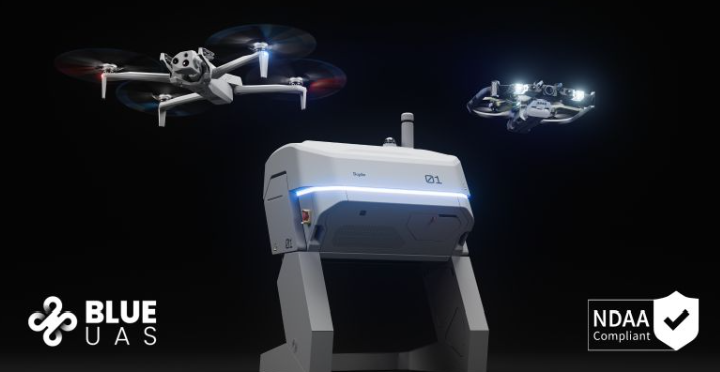
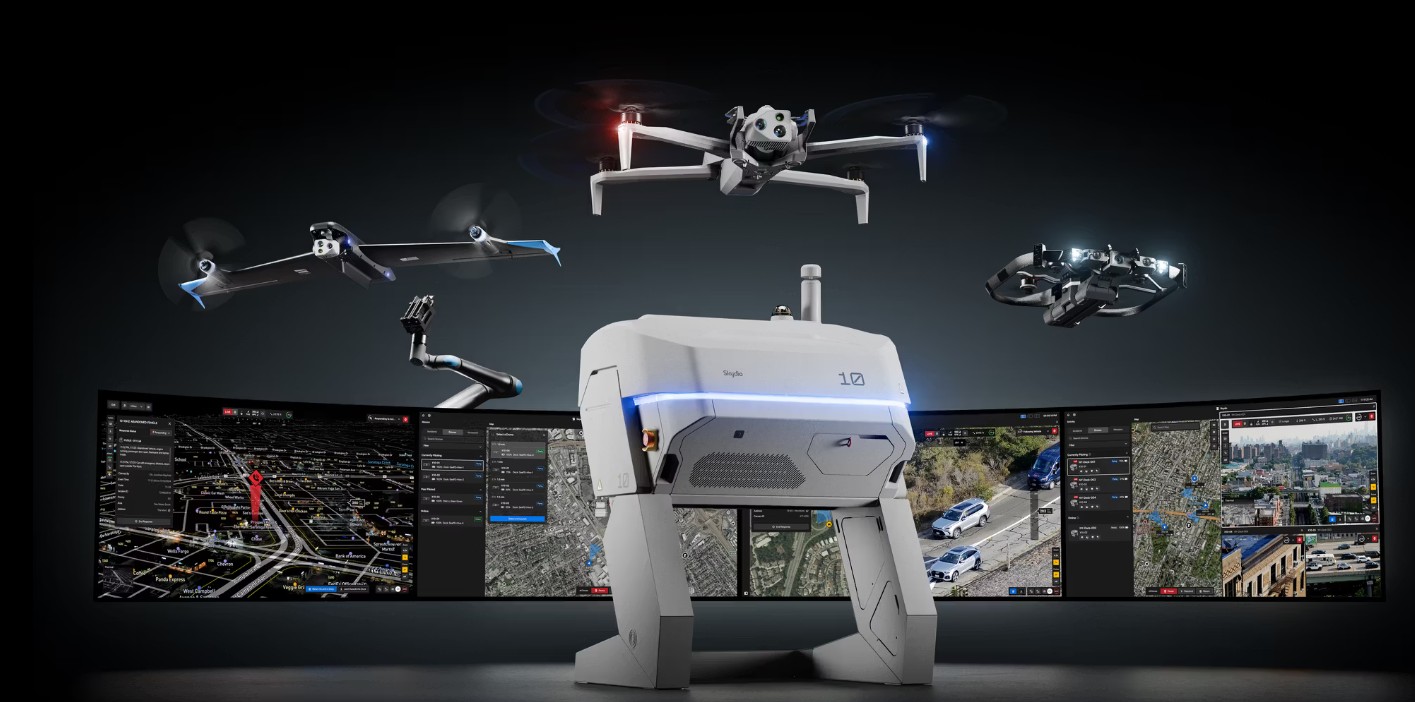
Skydio pushes that concept further with its MegaDock, which can house up to five F10 Lightrunners.
That suggests a model built not around one drone and one pilot, but around multiple vehicles managed as a coordinated operational system.
From piloting to mission management
Another clue comes from the new Foresight UI.
Skydio describes it as enabling single-click camera operation, which points toward a broader shift in drone usability.
The goal is no longer to make the operator better at manually controlling every movement.
The goal is to remove complexity.
Instead of thinking constantly about aircraft attitude, camera positioning and flight mechanics, the operator can focus more directly on the mission itself.
That becomes even more important when paired with Skydio Remote Flight Deck, which allows the aircraft to be flown remotely from anywhere.
Remote operation changes the economics of drone deployment.
An organization no longer necessarily needs a highly trained pilot physically present at every location. A centralized operations team could potentially supervise multiple sites, launch aircraft as needed and respond to events from far away.
That is a much more scalable model.
The strange-looking feature with a serious purpose
Then there is SideEye.
The teaser line — “You won’t believe your SideEye” — was playful, but the product purpose is practical.
Skydio says the SideEye camera provides unobstructed views.
That explains the “perfectly asymmetrical” teaser as well.
In aerospace, symmetry often feels natural. But if asymmetry gives the sensor a better field of view, then form follows function.
That is a useful reminder that autonomous systems are increasingly being designed around perception, not aesthetics.
A drone is only as useful as what it can see.
Why F10 matters
The F10 Lightrunner looks like more than another aircraft launch.
It reflects a broader evolution in the drone industry from individual flying machines toward robotic fleets.
Speed matters.
Flight time matters.
Camera quality matters.
But the real shift comes from the combination of:
long endurance + automated launch and landing + docking + remote operation + simplified control.
Put those together, and the drone starts to become part of an always-available operational network.
That is the bigger idea behind F10.
Skydio is not simply asking operators to fly farther.
It is trying to make drone operations easier to scale.
And if that works, the most important feature of the F10 may not be that it can fly at 100 mph.
It may be that fewer people need to think about flying it at all.