€30 Million for a Gearbox — Why RENK’s Patria Deal Is Really About the Future of Autonomous Tracked Vehicles
A €30 million transmission order may not sound like the most dramatic defense story of the year.
But this one is more important than it looks.
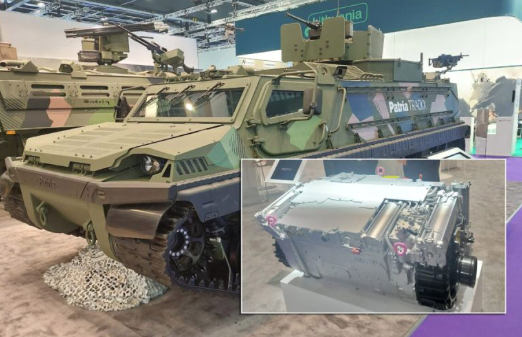
Germany’s RENK Group has received an order from Finnish defense company Patria for HSWL 076 transmissions for the TRACKX vehicle family. Deliveries are expected to begin in 2027, following an earlier pre-series order placed by Patria.
At first glance, this is a supplier contract.
At a deeper level, it is a signal about where European ground mobility is heading.
The HSWL 076 is not just a mechanical component. It combines steering, braking and drive functions within a digitally controlled powertrain architecture. According to RENK, that architecture is intended to support capabilities such as remote control, platooning and future autonomous functions.
That changes the strategic significance of the deal.
From drivetrain supplier to autonomy enabler
Modern military vehicle programs are increasingly defined by software, sensors and automation.
But all of those technologies ultimately depend on one thing: the vehicle must be able to move precisely, reliably and controllably in difficult terrain.
That makes the powertrain a critical layer of autonomy.
For a tracked vehicle to operate remotely or eventually autonomously, the drive system must respond accurately to digital commands. Steering, braking and propulsion can no longer exist as separate mechanical functions only. They need to become part of an integrated control architecture.
That is exactly where RENK’s HSWL 076 fits.
The transmission was designed for light tracked vehicles in the 10-to-20-ton class and weighs around 700 kilograms. Its compact design and high power density make it suitable for platforms where mobility, payload and system integration must all be balanced carefully.
For TRACKX, this matters because the vehicle family is clearly being positioned for more than conventional crewed operation.
TRACKX is moving closer to series production
The timing of the order is also significant.
Finland and Sweden recently initiated procurement of the first TRACKX vehicles, with deliveries expected to start next year.
That means the platform is moving from development and testing toward operational procurement.
RENK has already supported TRACKX through development, testing and pre-series phases. The new order therefore represents continuity rather than a one-off supplier relationship.
Michael Masur, CEO Vehicle Mobility Solutions at RENK Group, described the procurement decisions by Finland and Sweden as an important step toward series production.
More importantly, he emphasized continued development with Patria, especially around crewed and uncrewed vehicle concepts.
That is where the story becomes much bigger than a €30 million contract.
Europe is building for mixed manned-unmanned fleets
Ground warfare is increasingly moving toward combinations of crewed and uncrewed systems.
Unmanned ground vehicles can be used for reconnaissance, logistics, surveillance, resupply and operations in high-risk areas. Platooning can allow multiple vehicles to follow coordinated movement patterns. Remote control can keep personnel away from dangerous terrain.
But these concepts require highly integrated mobility systems.
Autonomy is not just about artificial intelligence.
It is about sensors, computing, communications, actuation and mechanical control working together as one system.
RENK’s role in TRACKX highlights that reality.
The future of military robotics will not be built only by software companies. It will also depend on companies that can digitize traditionally mechanical systems and make them compatible with autonomous architectures.
Why the deal matters
The €30 million order is meaningful on its own, but the strategic signal is more important.
Patria is expanding TRACKX.
Finland and Sweden are moving into procurement.
RENK is embedded in the platform’s mobility architecture.
And the technology roadmap already includes remote operation, platooning and future autonomous capabilities.
That creates the possibility that the HSWL 076 becomes more than a transmission for one vehicle family.
It could become part of a broader European ecosystem for lightweight tracked platforms designed from the beginning for both crewed and uncrewed missions.
The defense industry often focuses attention on weapons, sensors and AI.
But sometimes the technologies that make autonomy possible are hidden deeper inside the machine.
In this case, the future of robotic ground warfare may start with something far less glamorous:
the gearbox.