When Missiles Cross Borders: Moldova’s Warning That Europe’s Security Buffer Is Disappearing
Europe’s eastern frontier is becoming increasingly difficult to treat as a distant security problem.
On October 5, a projectile fell near the Palanca–Maiaky–Udobne border crossing between Moldova and Ukraine during Russian attacks on Ukrainian infrastructure. After striking the ground, it ricocheted into a passenger bus parked near the barrier and damaged a border-control booth. A Moldovan border guard suffered minor injuries, and the crossing was temporarily suspended. Moldovan authorities later reopened it.
The incident would be concerning on its own.
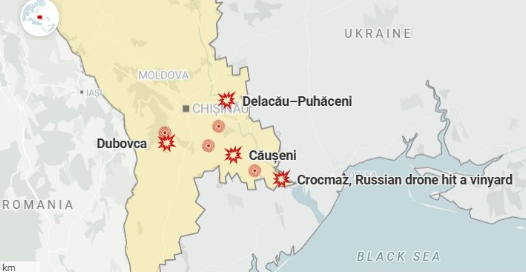
But it came shortly after Moldova reported another series of airspace violations involving Russian missiles and military drones. Moldovan officials said three missiles and two drones entered national airspace within roughly 15 minutes, with debris and explosions reported across several districts.
Taken together, these events point to a bigger European security problem:
The war is geographically contained on maps far more neatly than it is in reality.
Borders do not stop missiles
Modern long-range weapons do not respect the political boundaries that define NATO, the European Union or neutral states.
A drone can deviate from its planned route.
A missile can malfunction.
Debris from an interception can fall across a frontier.
Navigation errors, electronic warfare, damaged guidance systems or deliberate flight paths can all create situations in which weapons launched during one country’s war suddenly appear over another.
For Moldova, this is not theoretical.
The country shares a long border with Ukraine but is not a NATO member. That makes repeated incursions especially sensitive: every incident raises questions about air-defense coverage, warning systems and the ability to protect civilians from a conflict taking place just kilometers away.
The meaning goes beyond Moldova
Other European countries are watching the same trend.
Romania, Poland and other states bordering Ukraine have repeatedly had to respond to drones, debris or possible airspace violations since Russia’s full-scale invasion began. EU foreign-policy chief Kaja Kallas recently pointed to airspace incidents and other security threats as evidence that the consequences of the war are increasingly affecting Europe beyond Ukraine itself.
This changes the strategic calculation.
For years, much of the European defense debate focused on conventional deterrence: tanks, aircraft, artillery and large formations.
The current war is demonstrating that low-cost drones, cruise missiles and long-range strike systems can create pressure hundreds of kilometers away from the frontline.
Air defense therefore becomes not merely a military capability but civil infrastructure.
Protecting borders increasingly means detecting small drones, tracking low-flying missiles, integrating radar networks and being able to intercept threats quickly enough to protect cities, transport networks and critical infrastructure.
The political debate is getting harder
The original commentary surrounding the Moldova incidents also argues that uncertainty over U.S. policy toward Russia should push Europe to accelerate its own military preparedness.
That is a political interpretation rather than an established fact, and views differ sharply over Washington’s Russia policy.
But the underlying strategic question is real:
How much of Europe’s security can depend on assumptions about future U.S. support?
Even without agreeing on the political diagnosis, European governments increasingly face pressure to strengthen their own air-defense capacity, ammunition production, drone defenses and military readiness.
Russia’s large-scale attacks against Ukraine continue to involve substantial numbers of missiles and drones; on October 7, Reuters reported another major strike involving dozens of missiles and jet-powered drones. Reuters
That scale matters.
A defense system built to intercept occasional threats may look very different from one designed to withstand sustained waves of inexpensive drones mixed with sophisticated missiles.
Moldova is the warning
The Palanca incident was not a major military engagement.
One border guard was lightly injured. A bus and checkpoint infrastructure were damaged.
But strategically, that is precisely why it deserves attention.
It demonstrates how easily a large-scale missile and drone war can produce consequences outside the intended battlespace.
Europe does not need to assume that every cross-border incident is deliberate to recognize the danger.
Accidents, debris and miscalculation are dangerous enough.
The security lesson is simple:
geography no longer guarantees distance from the war.
For Europe, preparedness increasingly means being able to detect, intercept and respond before the next projectile reaches the wrong side of a border.