Russia Is Paying More for Less on the Battlefield. So Why Are Ukrainian Cities Being Hit Harder?
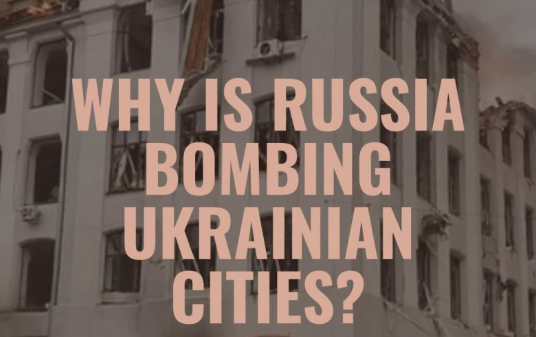
Hundreds of drones. Dozens of missiles. Apartment buildings, universities, warehouses and infrastructure damaged.
For millions of Ukrainians, nights increasingly begin with the same question:
How much is coming tonight?
Russia's expanding aerial campaign against Ukrainian cities raises another question: why devote so many weapons to attacks far from the immediate frontline?
There is no single explanation. But four factors increasingly overlap: coercion, political calculations, technological opportunity and the grinding economics of the ground war.
1. Make Civilian Life Exhausting
Air attacks do not need to produce a battlefield breakthrough to have strategic value.
Repeated strikes force millions of people into shelters, interrupt sleep, damage electricity and heating networks, disrupt businesses and impose enormous reconstruction costs.
The potential political objective is straightforward: make the war sufficiently exhausting that Ukrainian society becomes more willing to accept unfavorable terms simply to make it stop.
History, however, offers reasons to question whether this works.
Strategic bombing has repeatedly demonstrated an uncomfortable paradox: attacking civilians can sometimes strengthen rather than destroy social resistance.
Ukraine has already endured years of missile and drone attacks without the political collapse Moscow may have expected.
2. Deterrence Depends on Expected Consequences
The second explanation concerns international politics.
An aggressor's behavior is influenced not simply by what opponents say but by what it expects them to do.
If Moscow concludes that escalating attacks will trigger additional sanctions, weapons deliveries or other serious costs, escalation becomes less attractive.
If it concludes the consequences will be limited, the calculation changes.
This is where arguments over Washington's Ukraine policy become important.
Critics of President Donald Trump's approach contend that pressure on Kyiv, interruptions to American support and warmer rhetoric toward Moscow weakened deterrence. Supporters argue that engagement with Russia is necessary to create a diplomatic route toward ending the war.
Whatever interpretation one accepts, the underlying principle remains:
Deterrence works only when consequences are credible.
3. Russia Found Another Technological Window
The war in Ukraine has become an extraordinarily fast cycle of technological adaptation.
Russia deploys a weapon.
Ukraine develops a countermeasure.
Russia modifies the weapon.
Ukraine adapts again.
Shahed-type attack drones illustrate the process.
Ukraine became increasingly effective at countering conventional propeller-driven Shaheds using mobile fire groups, electronic warfare and interceptor drones.
Russia responded with new tactics and faster variants, including jet-powered designs.
That creates a temporary window in which existing defenses can become less effective.
Ukraine is already developing the next response: faster interceptor drones, improved sensors, greater radar coverage and more integrated air-defense networks.
But developing a solution and producing thousands of copies are different problems.
Russia has an incentive to exploit that gap before it closes.
4. The Ground War Is Brutally Expensive
Then there is the frontline.
Russia can still advance in some sectors, and describing the entire front simply as a stalemate risks oversimplifying a dynamic battlefield.
But territorial gains have come at enormous human and material cost.
That creates an asymmetry.
Moving a defended frontline by kilometers can require weeks of combat, large numbers of troops and enormous quantities of equipment.
Launching drones toward Kyiv, Kharkiv, Dnipro or Odesa is comparatively easier.
Air attacks therefore allow Moscow to impose costs on Ukraine even when decisive operational breakthroughs on the ground remain difficult.
The Real Contest Is Adaptation
Calling these attacks evidence of either Russian “strength” or “desperation” alone misses something important.
Russia has demonstrated an ability to manufacture and launch large numbers of long-range weapons.
Ukraine has demonstrated an extraordinary ability to develop counters.
The question is which side can adapt and scale faster.
And that means the answer to Russia's expanding drone campaign will not come only from Patriot batteries and expensive surface-to-air missiles.
It will increasingly come from cheap interceptors, distributed radar, electronic warfare, automated targeting and mass production.
Russia is trying to make Ukrainian cities increasingly expensive to defend.
Ukraine's challenge is to reverse that equation:
make attacking them increasingly expensive instead.