The Nuclear Brake. Why Finland Believes China Holds One of the Most Important Levers Over Putin
For more than four years, one question has haunted every discussion about the war in Ukraine.
Could Russia resort to nuclear weapons?
The possibility has shaped military planning, influenced Western aid decisions, affected financial markets, and dominated geopolitical debate. Every Russian nuclear threat has generated headlines. Every escalation has revived fears of a broader catastrophe.
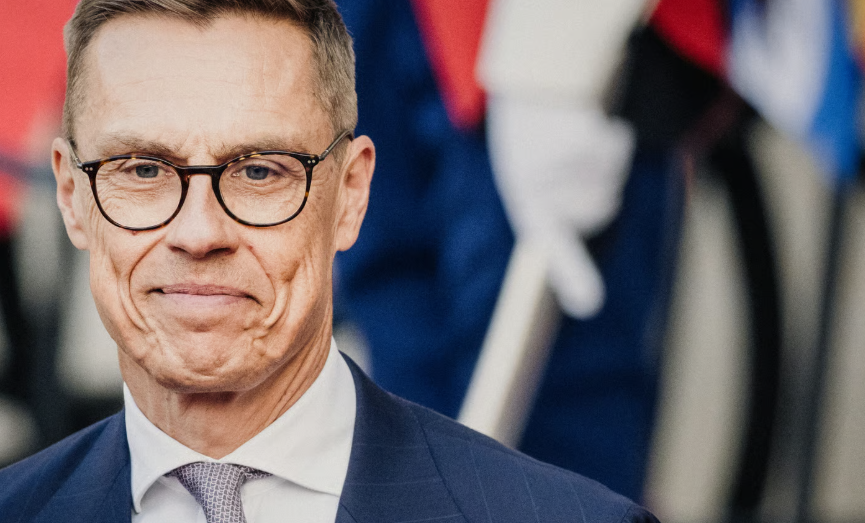
Now, Finnish President Alexander Stubb has offered an unusually revealing insight into what may be one of the most important deterrents against such a scenario.
And it is not NATO.
It is not the United States.
It is not Europe.
According to Stubb, it is China.
Speaking about a recent meeting with Chinese Foreign Minister Wang Yi, the Finnish president revealed that he directly raised the issue of Russian nuclear escalation. The answer he received was strikingly blunt.
"We will never allow it to happen."
If accurate, the statement provides a rare glimpse into one of the least discussed dimensions of the war: China's role as Moscow's most influential partner and perhaps its most important restraint.
The significance cannot be overstated.
Since the beginning of Russia's full-scale invasion, Beijing has walked a careful diplomatic line. China has deepened economic cooperation with Russia, criticized Western sanctions, and opposed efforts to isolate Moscow internationally. Yet at the same time, Chinese officials have repeatedly signaled opposition to the use of nuclear weapons in the conflict.
Stubb's comments suggest those concerns may be even stronger in private.
The logic is straightforward.
Few countries have benefited more from geopolitical stability than China. A Russian nuclear strike would trigger consequences extending far beyond Ukraine. Global markets would convulse. Supply chains would be disrupted. International pressure on Beijing would become intense. The carefully constructed image of China as a stabilizing global power would face unprecedented scrutiny.
In short, nuclear escalation would create strategic chaos.
And chaos is bad for business.
This may explain why Stubb describes China's position as a "pretty good deterrence."
The message is simple: Moscow is not operating in isolation.
Every major strategic decision must account for Russian interests, Western reactions, and increasingly the views of Beijing.
Yet perhaps even more interesting than what Stubb said about China is what he said about fear.
For much of the war, Russia has successfully forced Western audiences into an endless cycle of speculation.
Will Russia escalate?
Will Russia strike NATO?
Will Russia use nuclear weapons?
Will Europe become the next battlefield?
Stubb believes this dynamic benefits Moscow.
Every hour spent discussing hypothetical catastrophes is an hour spent reacting to Russian narratives rather than shaping events proactively.
His response is refreshingly simple.
Stay calm.
Stay vigilant.
Prepare for the worst.
Avoid panic.
It is the kind of advice that comes from a nation that understands Russia perhaps better than most.
Finland shares a 1,340-kilometer border with Russia. Unlike many Western European countries that analyzed Moscow from a distance, Finland's understanding has been forged by geography, history, and necessity.
That experience appears to shape Stubb's broader assessment.
Despite alarming headlines, he does not view a direct Russian attack on NATO as imminent. Russian forces remain heavily engaged in Ukraine. NATO's collective deterrence remains intact. Moscow's military resources are stretched.
The result is a more nuanced perspective than the often dramatic narratives dominating public debate.
But Stubb's most provocative observation concerns the future.
While supporting Ukraine remains the immediate priority, he argues that Europe is approaching a point where direct political dialogue with Russia may once again become necessary.
That statement is remarkable coming from the leader of one of NATO's newest members.
Not because it reflects weakness.
But because it reflects realism.
History shows that even bitter adversaries eventually talk.
The Cold War never prevented communication between Washington and Moscow. At moments of highest tension, diplomatic channels often became even more important.
The purpose is not trust.
The purpose is avoiding mistakes.
Avoiding miscalculations.
Avoiding escalation driven by misunderstanding rather than intent.
That may ultimately be the most important takeaway from Stubb's remarks.
The future of European security will not be determined solely by tanks, missiles, sanctions, or military alliances.
It will also be shaped by conversations happening behind closed doors.
Between Helsinki and Beijing.
Between Washington and Moscow.
Between allies and adversaries.
And if Stubb is correct, one of the strongest safeguards against nuclear escalation may not come from public threats or military deployments.
It may come from China's quiet message to the Kremlin:
There are limits that cannot be crossed.