One Vehicle, One Decision. Diehl’s IRIS‑T SLS MK4 Signals the End of Layered Complexity
For decades, air defense has been defined by complexity.
Separate radars. Separate command units. Separate launch systems. Layered architecture, distributed across multiple platforms, requiring coordination, manpower, and time. It worked—but it was never simple, never fast, and increasingly, never sufficient.
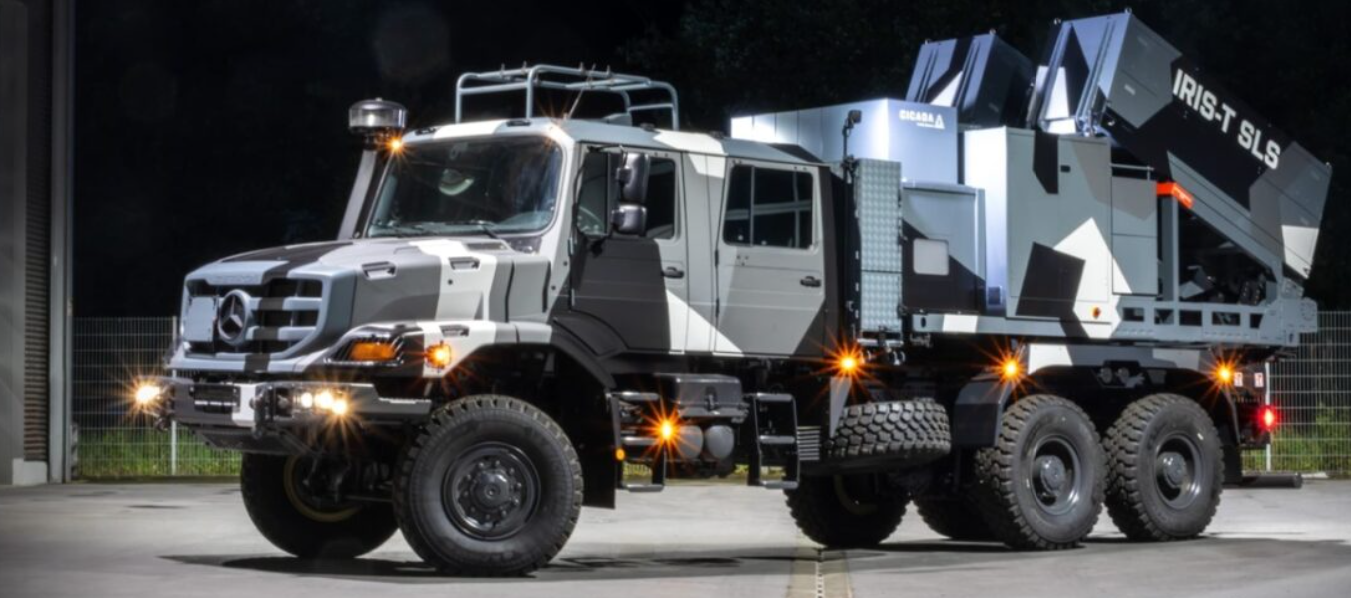
At ILA Berlin 2026, Diehl Defence unveiled something that quietly challenges that entire philosophy: the IRIS‑T SLS MK4 “all‑in‑one” system.
And “all‑in‑one” is not a marketing phrase. It’s a statement.
Radar, command-and-control, and launcher—combined onto a single, highly mobile platform, designed to move with troops and react in seconds. In an era increasingly defined by swarm drones, low-altitude threats, and compressed decision cycles, this level of integration is not just convenient—it is necessary.
Because the threat has changed.
Modern air defense is no longer about high-altitude jets alone. It is about small, fast, unpredictable targets—drones, loitering munitions, cruise missiles—often arriving in numbers, often at low altitude, often with minimal warning. In that environment, the traditional distributed model starts to struggle.
Too slow. Too dependent. Too fragmented.
The IRIS‑T SLS MK4 tackles that problem head-on.
With an effective range of 12 kilometers and an altitude coverage of up to 6 kilometers, it sits squarely in the short-range air defense (SHORAD) segment. But its real advantage is not range—it is reaction time. By combining detection, decision, and engagement into one vehicle, the system eliminates the delays inherent in multi-platform coordination.
It sees, decides, and fires—almost instantly.
And it can do so while moving.
The introduction of “fire-on-the-move” capability marks another decisive step. Traditionally, air defense systems require stabilization before firing, limiting their effectiveness in dynamic combat scenarios. The MK4 changes that, allowing missiles to be launched while the platform remains in motion—keeping pace with maneuvering forces and maintaining protection even during rapid advances.
This is not just evolution. It is acceleration.
The system uses the proven IRIS‑T missile—originally designed as an air-to-air weapon—repurposed and refined for ground-based operations. This continuity is strategic. It reduces development risk, leverages existing combat-proven technology, and ensures compatibility with broader NATO standards.
But Diehl is not stopping at a single effector.
The modular architecture allows integration of additional capabilities—including counter‑UAS effectors like the CICADA eMissile or even weapon stations. In practical terms, this opens the door to hybrid defense systems capable of engaging both traditional aerial threats and emerging drone swarms within the same platform.
Flexibility becomes firepower.
And yet, the most disruptive element may be something less visible: automation.
The MK4 is designed with a high level of automation, reducing personnel requirements and enabling faster, more consistent responses. In an environment where skilled operators are limited and reaction windows are shrinking, automation is no longer a luxury—it is a necessity.
Fewer people. Faster decisions. Greater impact.
Of course, this raises deeper questions.
As air defense systems become more automated and self-contained, where does human control sit? How much decision-making is delegated to the system? And how do operators maintain situational awareness when complexity is abstracted into software?
These are not technical questions. They are doctrinal ones—and they will define how systems like the MK4 are ultimately used.
Because what Diehl Defence is demonstrating is part of a broader shift in military thinking.
From distributed to integrated.
From coordination to autonomy.
From layered systems to self-contained combat nodes.
The implications go beyond a single platform.
If successful, this approach could redefine how short-range air defense is deployed—enabling smaller, more agile units to operate independently, with their own protection embedded and always active.
Battlefields are becoming faster. Denser. Less predictable.
The IRIS‑T SLS MK4 is built for exactly that environment.
Not as part of a system—but as a system itself.