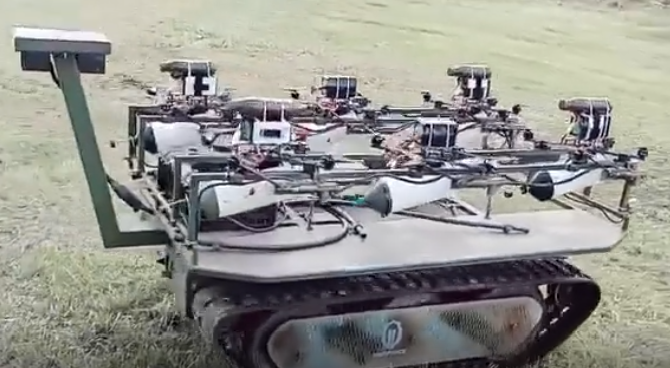
Quantum Systems Launches MANDRILL -The First Unmanned Ground Vehicle

At Enforce Tac 2026 in Nuremberg, Quantum Systems didn’t just unveil a new vehicle.
They unveiled a strategic statement.
After more than a decade dominating the unmanned air domain, the German defense tech company has officially entered the ground robotics arena with MANDRILL, its first Unmanned Ground Vehicle (UGV). But this is not just another robotic platform on wheels or tracks.
It’s a signal.
“The future is unmanned,” said Hendrik Kramer. Bold words — but perhaps not bold enough.
Because what Quantum Systems is really saying is this: The future is integrated.
MANDRILL is not designed as a standalone ground robot. It is conceived as part of a fully networked, multi-domain ecosystem powered by the company’s open software suite, MOSAIC UXS. Air, land — and soon maritime — systems linked into a shared digital architecture.
In other words: one battlefield, one network, many machines.
And that changes the equation.

Beyond Hardware: The Ecosystem Play
Defense innovation is no longer about individual platforms. It’s about interoperability.
MANDRILL’s modular architecture allows it to morph into multiple roles: ISR reconnaissance with EO/IR payloads, logistics transport, medevac, engineering support, towing and recovery, electronic warfare, even robotic drone launch and landing integration.
But its real strength isn’t its payload.
It’s its connectivity.
Through native integration into MOSAIC UXS, MANDRILL is designed to communicate seamlessly with unmanned aerial systems — the very domain where Quantum Systems already claims leadership. A drone spots a target. A ground robot moves to investigate. Logistics follow autonomously. Data flows in real time across domains.
This is not incremental innovation. This is systems thinking.
And it positions Quantum Systems differently from many competitors who still focus on hardware-first approaches.
Europe’s Autonomous Moment?
Europe has long trailed behind the United States and China in defense tech ecosystems. Fragmentation, national silos, and procurement complexity have slowed unified innovation.
But MANDRILL signals something different.
It represents a vertically integrated, software-defined robotics approach emerging from Germany — one that emphasizes scalability, industrial manufacturing, and interoperability from day one.
If MOSAIC UXS truly delivers on its promise of manufacturer-independent networking, this could be one of the first serious European plays toward an open multi-domain robotics architecture.
And that’s where things get interesting.
Because modern warfare is increasingly defined not by individual vehicles — but by sensor networks, data fusion, and autonomous coordination.
The winners will not be those with the most hardware.
They will be those with the smartest ecosystems.
The Strategic Subtext
Quantum Systems frames this launch as a logical next step after 11 years in the air domain. But strategically, it’s much bigger.
By expanding into ground robotics, the company is:
- Diversifying operational domains
- Deepening customer dependency on integrated solutions
- Strengthening its position as a multi-domain system provider
- Future-proofing against market saturation in UAV platforms
In short: they’re building a robotics stack.
Air. Land. Soon maritime.
All under one software architecture.
That’s not just product expansion.
That’s platform strategy.
The Bigger Question
What does this mean beyond one company?
It reflects a broader shift in defense technology:
- From manned to unmanned
- From isolated systems to networks
- From hardware-driven procurement to software-defined warfare
The battlefield is becoming digital infrastructure.
Autonomy is no longer experimental. It is operational.
And the integration layer — the software backbone connecting machines — may become the most valuable strategic asset of all.
MANDRILL may look like a ground vehicle.
But it represents something much larger:
The acceleration of autonomous multi-domain operations in Europe.
The future might not just be unmanned.
It might be networked, modular — and relentlessly interoperable.
And that future has just rolled onto the stage.
.jpg)