The Internet’s New Owners. Why Meta’s Undersea Cable Empire Should Worry Europe

When most people think about Meta, they think about Instagram, WhatsApp, and Facebook.
They don't think about submarine cables.
Maybe they should.
Because while Europe debates AI regulation, data privacy, and digital sovereignty, a far bigger transformation is taking place beneath the ocean surface.
Thousands of kilometers below the waves, Big Tech is quietly building the physical foundations of the digital world.
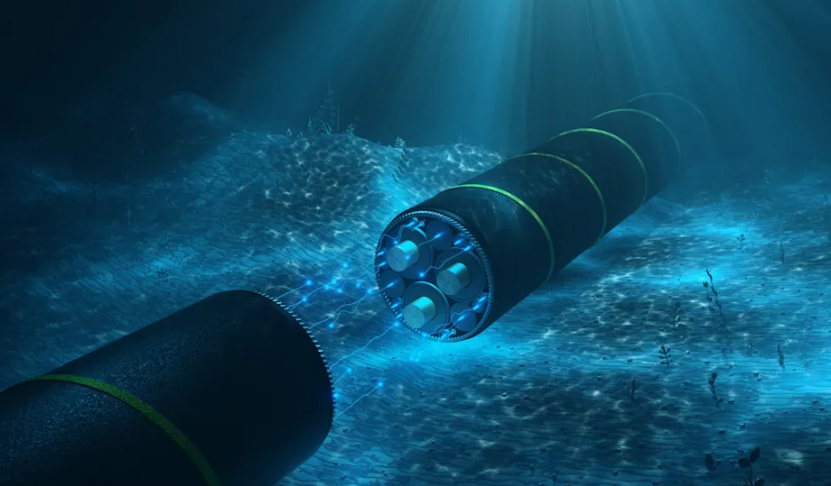
Meta's latest project, Candle, will lay approximately 8,000 kilometers of undersea fiber-optic cable connecting key Asian markets, including Japan, Taiwan, the Philippines, Indonesia, Malaysia, and Singapore. Even more ambitious is Project Waterworth, a planned global network exceeding 50,000 kilometers of subsea infrastructure spanning five continents.
That is longer than the Earth's circumference.
And it raises a provocative question:
What happens when the companies running our apps also own the roads that carry our data?
From Internet Customer to Internet Landlord
For decades, the relationship was straightforward.
Telecom operators built infrastructure.
Technology companies rented capacity.
Content providers consumed bandwidth.
Everyone played a distinct role.
That separation is disappearing.
Today, cloud hyperscalers and digital platforms are becoming infrastructure providers in their own right. Google, Meta, Microsoft, and Amazon are investing billions into subsea cables, hyperscale data centers, private backbone networks, satellite systems, cloud platforms, and AI infrastructure.
They are no longer merely customers of the internet.
Increasingly, they are the internet.
This is not necessarily a problem in itself.
More cables mean more bandwidth.
More bandwidth means lower latency, greater resilience, and stronger global connectivity.
The concern lies elsewhere.
It lies in concentration.
The Vertical Integration Nobody Talks About
Most discussions about Big Tech focus on social media, data collection, or artificial intelligence.
But infrastructure ownership may be the bigger story.
Consider the modern enterprise stack.
A company communicates through Microsoft Teams or Google Workspace.
Stores data in a hyperscale cloud environment.
Uses US-built operating systems.
Runs customer relationships through cloud-based CRM software.
Processes transactions through international digital platforms.
And increasingly, the data moving between these services travels through infrastructure owned by the same small group of corporations.
The boundaries are blurring.
What once looked like a competitive ecosystem increasingly resembles a vertically integrated digital supply chain.
And that creates dependency.
Not necessarily dependence on technology itself.
Dependence on specific providers.
The Sovereignty Question Europe Keeps Avoiding
Europe often frames digital strategy through a regulatory lens.
GDPR.
AI regulation.
Competition law.
Data protection frameworks.
All important.
But regulation alone does not create capability.
A continent can regulate technology without controlling any of it.
That distinction matters.
While Europe debates compliance requirements, American hyperscalers continue building the platforms, infrastructure, and AI systems that power a growing share of the global economy.
The result is an uncomfortable reality:
Many European businesses have become digitally sovereign in theory but operationally dependent in practice.
That dependency becomes even more complex when legal jurisdictions enter the picture.
The US CLOUD Act demonstrates how digital sovereignty extends beyond physical server locations. Data stored in Europe may still be subject to legal obligations affecting US-based providers.
The popular argument that "our servers are in Frankfurt" does not automatically solve every jurisdictional concern.
Physical location and legal control are not always the same thing.
The Cable War Is Probably Already Over
Could Europe build competing global cable networks?
Certainly.
Will it happen fast enough to change the current balance of power?
Probably not.
Submarine infrastructure requires extraordinary capital, long planning cycles, specialized vessels, international agreements, and decades-long investment horizons.
By the time new competitors emerge, current hyperscalers may already have extended their lead even further.
The infrastructure race is difficult.
The software race remains open.
Europe's Last Strategic Window
This is where the conversation becomes interesting.
Businesses make purchasing decisions every day.
Scheduling software.
CRM platforms.
Document management.
Digital signatures.
Workflow automation.
Collaboration tools.
Communication systems.
These are markets where European providers can still compete, innovate, and win.
Not through anti-American sentiment.
Not through protectionism.
But through resilience, transparency, compliance advantages, and customer trust.
Digital sovereignty is not about rejecting global technology.
It is about avoiding single points of failure.
The most resilient economies rarely depend entirely on one supplier.
The digital economy should be no different.
The Real Question
Meta's giant subsea cable projects are impressive engineering achievements.
But they also symbolize something larger.
A transfer of power.
The internet was once a distributed network connecting independent actors.
Now, parts of it increasingly resemble an ecosystem owned by a handful of infrastructure giants.
Europe cannot easily change what has already been built beneath the oceans.
But it can still decide what runs on top of it.
And that decision may determine whether Europe remains merely a customer of the digital future or becomes a meaningful builder of it.