Latvia Is Digging for War Before War Arrives: Inside NATO’s New Baltic Defense Line
Europe's military buildup is usually measured in tanks, missiles, drones and defense budgets.
Latvia is measuring part of it in kilometers of excavated earth.
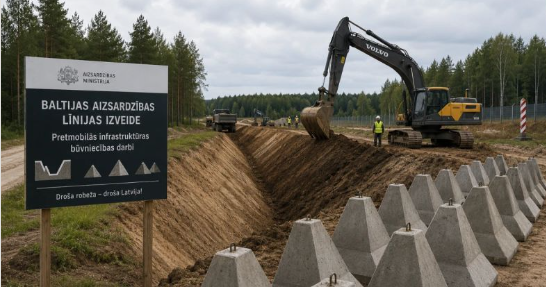
The country has entered the first-priority construction phase of its Baltic Defence Line, transforming preparations along its eastern frontier from individual military-engineering projects into a structured, multi-year civil-construction program.
The immediate plan includes roughly 27 kilometers of anti-tank ditches, dragon's teeth, engineering-material positions and supporting infrastructure across Balvi, Alūksne, Ludza, Krāslava and Augšdaugava.
Initial investment: €12.98 million.
Construction is expected to proceed in phases through autumn 2027.
But the real significance isn't the ditch.
It's everything being built around it.
From Soldiers Digging to Contractors Building
Latvia didn't suddenly discover fortifications.
Military engineers were already excavating anti-tank ditches and deploying obstacles along the eastern border in 2024, with additional defensive barriers appearing on acquired land afterward.
What is changing now is the scale—and the bureaucracy behind it.
Latvia's state property manager VNĪ has contracted five companies for the first-priority construction package.
The program reportedly includes six work packages covering anti-tank ditches and obstacle deployment, nine areas for positioning or storing engineering resources and two communications towers.
That sounds less dramatic than a new missile system.
Strategically, however, it may be just as important.
Latvia is moving from having military engineers prepare selected positions to making counter-mobility part of permanent national infrastructure.
Why Dig Ditches in the Age of Drones?
At first glance, anti-tank ditches and concrete dragon's teeth can look almost archaic.
Europe is preparing for a battlefield filled with autonomous drones, precision missiles, electronic warfare and artificial intelligence—and simultaneously digging giant holes in the ground.
There is no contradiction.
A tank still cannot ignore terrain.
A defensive line does not need to stop an attacking army permanently. It needs to slow it, channel it and make its movements predictable.
That creates opportunities for artillery, drones, anti-tank weapons and other fires.
A column forced toward a limited crossing point is easier to target than one maneuvering freely across open terrain.
The ditch isn't supposed to win the battle.
It's supposed to shape it.
€303 Million to Change the Battlefield Before It Exists
Latvia's wider eastern-border fortification plan allocates approximately €303 million over five years.
It forms part of the Baltic Defence Line developed jointly with Estonia and Lithuania as the three NATO states rethink their physical defenses along the alliance's eastern frontier.
This is not intended to become an impenetrable wall from the Baltic Sea southward.
Modern armies can breach obstacles.
Bridges can be laid.
Minefields can be cleared.
Defensive positions can be attacked.
The objective is to make all of those actions slower, harder and more visible.
And time may be the Baltics' most valuable defensive resource.
NATO Reinforcement Needs Minutes and Hours
The Baltic states possess relatively small territories and sit directly on NATO's eastern edge.
In a crisis, slowing an attacking force isn't simply tactical.
Every hour gained provides more time to mobilize reserves, move ammunition, deploy allied aircraft and bring additional NATO forces into the region.
That is why defensive preparation extends far beyond concrete obstacles.
Roads matter.
Bridges matter.
Drainage matters.
Communications matter.
Storage locations matter.
Land ownership matters.
Even construction contracts matter.
A government trying to solve those problems after fighting begins has already lost valuable time.
Deterrence You Can See From Space
Perhaps the most interesting aspect of the Baltic Defence Line is how physical it is.
Europe's renewed defense posture is often discussed through abstract figures: 3% of GDP, ammunition-production targets, brigade readiness and procurement budgets.
Latvia is turning those percentages into geography.
Fields are being reshaped.
Obstacles are being positioned.
Engineering supplies are being pre-positioned.
Communications infrastructure is being prepared.
The message is straightforward.
If an attacking force ever crosses Latvia's eastern frontier, NATO does not want to begin designing the battlefield that morning.
It wants the battlefield waiting for them.
Deterrence isn't only what sits inside an arsenal.
Sometimes it is the ditch that was already dug before the first tank arrived.
.jpg)