Latin America and the New Rearmament: From Weapons Buyers to Builders of National Power / by Diego Bavio
The world is building weapons again.
After decades of shrinking stocks, declining production capabilities, and fragmented defense industries, the war in Ukraine has brought back to the center of the discussion an issue that once seemed to belong to the past: military capability requires an industrial capability behind it capable of sustaining it.
It is not enough to buy an advanced system.
A country must be able to maintain it, modify it, replace it and, when the adversary finds a response, develop the next generation.
Europe is facing that challenge today. Its problem is not simply increasing production, but recovering time and building a system capable of transforming information, experience and technology into new military capabilities at a speed compatible with warfare.
This is the logic underlying the concept of Military Learning Velocity: advantage does not depend solely on the technology available, but on the speed at which an organization can learn, adapt and reproduce capability.
But while Europe is trying to recover capabilities it has lost, Latin America faces a different opportunity.
Can the region use this new rearmament cycle to develop national capabilities that have remained incomplete for decades?
The question is not simply how much it can sell. Nor even how much it can save by replacing imports.
The deeper question is:
Can defense industry once again become a tool of National Development?
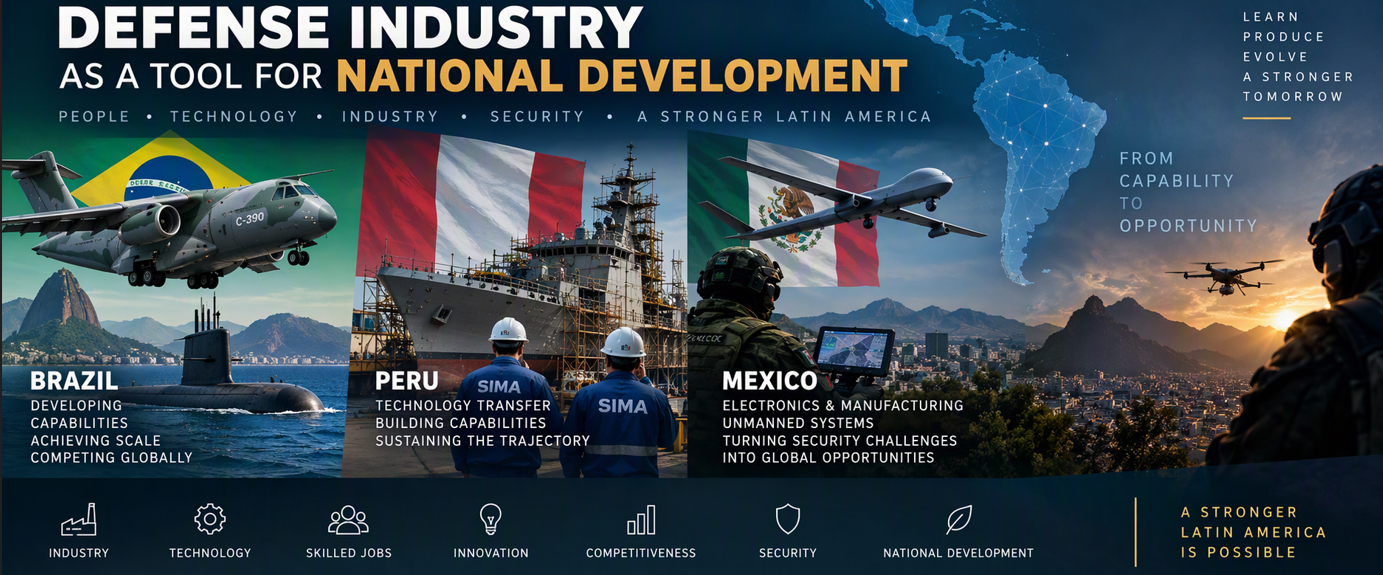
Brazil: When State Policy Begins to Generate Scale
Brazil is the first case that should be examined.
Not simply because it possesses Latin America's largest defense industry, but because for decades it has maintained a policy aimed at developing national capabilities.
The result is now beginning to go beyond strictly domestic requirements.
The C-390 Millennium is probably the most visible example. Brazil moved from developing an aircraft for its own Air Force to having a product capable of competing on the international market.
The same principle can be seen in the Gripen program, where Brazil moved from being a buyer to participating in production and incorporating industrial and technological capabilities.
But the Brazilian case does not end with the aerospace industry.
The PROSUB program may be an even more important example from the perspective of capability development.
Brazil incorporated French Scorpène technology through a technology-transfer program that enabled it to build four conventional submarines on Brazilian soil. The transfer included the training of engineers and technicians, the development of the shipyard workforce and the progressive incorporation of local suppliers.
The importance of the program does not lie solely in the four submarines.
It lies in having developed the capability to build submarines.
And that difference is fundamental.
One nation can acquire four submarines.
Another can acquire four submarines while simultaneously acquiring the industrial knowledge required to build the next ones.
The second country has not merely increased its military inventory.
It has increased its national power.
The result is a trajectory that is beginning to acquire a characteristic that, until recently, seemed reserved for the major industrial powers: the ability to transform a national military requirement into a product with international potential.
Brazil therefore represents the first model.
Not simply buying. Developing. Not simply developing. Producing. And not simply producing: achieving enough scale to compete.
Peru: Building Capabilities, but Sustaining the Trajectory
The Peruvian case illustrates another dimension of the problem.
Building industrial capabilities does not depend solely on acquiring technology. It also requires sustaining a learning trajectory for long enough for that learning to accumulate.
Peru already possesses an industrial base on which to build. SIMA is not starting from zero, and cooperation with South Korea is progressively transforming that existing capability.
The naval program developed with Hyundai Heavy Industries began with the local construction of new surface vessels and the modernization of infrastructure, incorporating technology transfer, personnel training and the participation of domestic suppliers. The first steel plate for the future multirole frigate was cut in November 2025, while SIMA was simultaneously modernizing its workshops to undertake increasingly complex naval projects.
The next step is considerably more ambitious: submarines.
In December 2025, SIMA and Hyundai signed a co-development agreement that includes the transfer of capabilities in design, construction, quality control and maintenance, personnel training and future co-production in Peru.
The objective is no longer simply to build under foreign supervision.
It is to use cooperation to progressively expand Peru's own technological and industrial capabilities.
The sequence is particularly interesting.
First, build surface vessels while incorporating technology and industrial processes.
Then use that experience to move toward a much more complex platform such as a submarine.
In other words, turn each program into the starting point for the next one.
But the Peruvian experience also shows the other side of the equation.
The K2 Black Panther program illustrates how these trajectories can be subjected to political and budgetary fluctuations.
The project was initially conceived around the acquisition of 54 K2s and 141 K808s, accompanied by infrastructure intended to develop a Peruvian industrial capability linked to armored vehicles. However, while the K808 program moved forward, the K2 component did not reach the same level of implementation.
The difference matters.
A capability-building policy requires continuity. Each program must become the starting point for the next.
When a political decision interrupts the process, it does not merely postpone a purchase. It can also break a chain of learning, workforce development, supplier integration and technology transfer.
That is precisely the challenge facing Peru.
Cooperation with Korea provides a way to accelerate its Military Learning Velocity, but that velocity produces national power only if there is enough continuity for what has been learned to accumulate.
Building a frigate can generate experience.
Building submarines can transform that experience into a much more sophisticated technological capability.
But for the curve to remain cumulative, programs must survive political changes.
The objective, therefore, should not be measured only by how many platforms Peru acquires, but by how much of the capability required to design, build, maintain and eventually modify them remains inside the country when each program ends.
Peru therefore represents a second model: using technology transfer as an accelerator of national capabilities, while recognizing that transferred technology becomes national power only when learning can accumulate.
Mexico: From Electronics Manufacturing to Unmanned Power
Mexico presents a different opportunity.
Its defense industry does not necessarily have Brazil's technological scale or the technology-transfer trajectory that Peru is now building. But it possesses something that may prove even more important for the next generation of military systems: a huge electronics and manufacturing base integrated into global production chains.
The country has hundreds of companies involved in the manufacture of electronic components, semiconductors and computer products, as well as an aerospace industry that already produces structures, harnesses, avionics and small unmanned systems.
Much of this capability emerged to serve civilian markets and international supply chains.
Precisely because of that, it can provide the foundation for a very different kind of defense industry.
The drone sector offers perhaps the clearest opportunity.
Unlike a fighter aircraft, submarine or main battle tank, an unmanned system can be developed on a much broader industrial base and through much shorter innovation cycles.
Motors, batteries, cameras, sensors, communications systems, processors, software, data links and navigation systems can come from an industrial ecosystem that already exists, while military architecture, software and systems integration provide the specifically defense-related layer.
Mexico also has an incentive that no industrial analysis can ignore: its own criminal organizations are already using drones for reconnaissance, transportation and attack.
The problem is therefore not a future threat that might emerge as the technology proliferates.
It is already part of Mexico's security environment.
This creates a paradox.
Criminal organizations are experimenting with, adapting and modifying commercial systems at a speed that is often greater than that of state institutions.
For Mexico, developing its own drone and counter-drone capabilities should therefore not be seen merely as a military procurement issue.
It can become an accelerator of technological innovation.
And here a fundamental difference emerges compared with traditional defense industry.
The opportunity is not simply to develop a system for the Mexican armed forces.
It is to use a concrete security requirement to generate products capable of competing in a much broader international market.
A counter-drone system developed to protect a Mexican facility against an armed drone could become a product for protecting airports, industrial plants, energy infrastructure, borders, ports or military facilities anywhere in the world.
Likewise, a drone developed for territorial surveillance could find markets in maritime security, infrastructure protection, agriculture, mining, border control or emergency management.
Mexico could therefore develop a trajectory different from both Brazil and Peru.
Brazil developed complex platforms and succeeded in turning some of them into export products.
Peru is attempting to turn technology transfer into domestic industrial capability.
Mexico can use its enormous manufacturing and electronics ecosystem to enter directly into some of the fastest-growing segments of the defense industry: unmanned systems, sensors, electronic warfare, communications and counter-drone technologies.
Mexico's advantage would not necessarily be to manufacture the most sophisticated drone on the market.
It would be the ability to produce at scale, modify systems rapidly, integrate components from different suppliers and adapt them to different customers and operational environments.
That combination of manufacturing scale, electronics, software and operational experience could turn Mexico into a potential international supplier of unmanned systems.
In this case, an internal security threat could become an innovation accelerator.
The challenge is to transform the need to respond to drones used by organized crime into an industrial capability able to design, produce, modify and export the next generation of unmanned and counter-unmanned systems.
The question is not how many drones Mexico can manufacture.
It is whether it can build an ecosystem capable of learning faster than the threat while turning that learning into competitive products for the global market.
Drones Are No Longer a Future Opportunity
The discussion about drones in Latin America can no longer be framed as if the region were waiting for a market to emerge.
The market already exists.
So does the threat.
The use of drones by criminal organizations and armed groups is no longer an exceptional phenomenon. Colombia has become one of the region's principal laboratories for the use of armed drones; Mexico has incorporated them into criminal operations for years; and cases have spread to Ecuador, Brazil and Venezuela.
That changes the equation completely.
Latin America does not need to develop drone capabilities merely because there is an export opportunity.
It needs drone and counter-drone capabilities because the threat is already inside its own borders.
The issue is no longer merely commercial.
It becomes a matter of national and regional security.
This is particularly important because the technological barrier to acquiring certain capabilities continues to fall.
A criminal group can acquire a commercial drone, modify it, add a payload and use it for surveillance or attack against security forces or rival groups.
And when the state develops a response, another cycle begins.
This is precisely the kind of adaptive competition examined through the concept of Military Learning Velocity.
The value of a capability does not reside only in the technology it incorporates at a given moment.
It resides in the speed at which that capability can evolve when a new threat appears.
The Revolution of Volume
This is where the real Latin American opportunity emerges.
The new defense industry does not necessarily require every country to produce fighter aircraft, submarines or tanks.
It can begin with more accessible systems: drones, sensors, software, communications, electronic warfare, counter-drone systems, loitering munitions, artificial intelligence and autonomous vehicles.
But the key will not simply be developing a prototype.
It will be the ability to produce it, modify it and produce it again.
Because the system that works today may be neutralized tomorrow.
The real capability is not only the product.
It is the industrial cycle that makes it possible to replace it.
This is one of the major lessons emerging from the war in Ukraine.
While Ukraine demonstrates the value of distributed innovation, Russia demonstrates the importance of transforming learning into production and scale.
Latin America can learn from both processes.
But it also possesses an advantage that Europe does not necessarily have: a concrete regional threat that can become a driver of demand, experimentation and development.
Organized crime, armed groups and the proliferation of unmanned systems are creating an environment in which new technologies can be tested, adapted and improved.
The strategic challenge is to transform that pressure into industrial capability. Not manufacturing for the sake of manufacturing, and not producing a prototype for a trade show, but building a continuous cycle in which systems are designed, tested, modified, produced, adapted again and put back into production. That is Military Learning Velocity applied to industry.
From Defense Industry to National Power
The objective should not simply be to build a Latin American defense industry that sells weapons.
The strategic question is different:
What does the ability to manufacture what a nation needs to defend itself actually produce?
It produces industry, technology, knowledge, skilled employment, suppliers, research, infrastructure and autonomy.
It produces an entire ecosystem of production and evolution.
But it produces something even more important:
decision-making capacity.
The development of a national capability is not simply a sectoral improvement.
It is an expansion of national power.
From this perspective, defense industry should not be regarded exclusively as an activity designed to equip the armed forces.
It is a development tool.
Brazil did not merely build submarines.
It developed a national capability to build submarines.
Peru is not merely acquiring ships and developing new defense programs.
It is attempting to use those acquisitions to generate technology transfer and industrial capabilities that can remain in the country.
Mexico, meanwhile, can use its enormous industrial and electronics base to enter technological segments where the barrier to entry is much lower than in traditional defense industry, but where the speed of innovation will be decisive.
And drones can become the point where these two dimensions meet: a concrete security requirement and a global technology market.
That is why the question is not simply how much Latin America can export.
Nor even how much it can substitute.
The question is how much national power it can generate from these capabilities.
The Real Latin American Rearmament
The new global rearmament cycle may offer Latin America an opportunity that goes far beyond the arms market.
The region can remain a collection of buyers acquiring systems developed elsewhere.
Or it can use this moment to recover an idea that was pushed aside for decades:
defense can also be a development policy.
It is not about manufacturing everything.
It is about identifying which capabilities are strategic, where the conditions exist to develop them, and how to turn them into cumulative capabilities.
Traditional industry offers one path: aircraft, ships, submarines, armored vehicles, ammunition and complex systems.
The technological revolution opens another: drones, sensors, software, electronic warfare, artificial intelligence and autonomous systems.
And both converge on the same question:
the ability to learn, produce and evolve.
Because a nation that buys a military capability acquires military power.
But a nation that develops the capability to design, produce, modify and sustain that capability is doing something much deeper.
It is developing national power.
And as Argentine General Enrique Guglialmelli argued several decades ago, that has a name:
National Development.