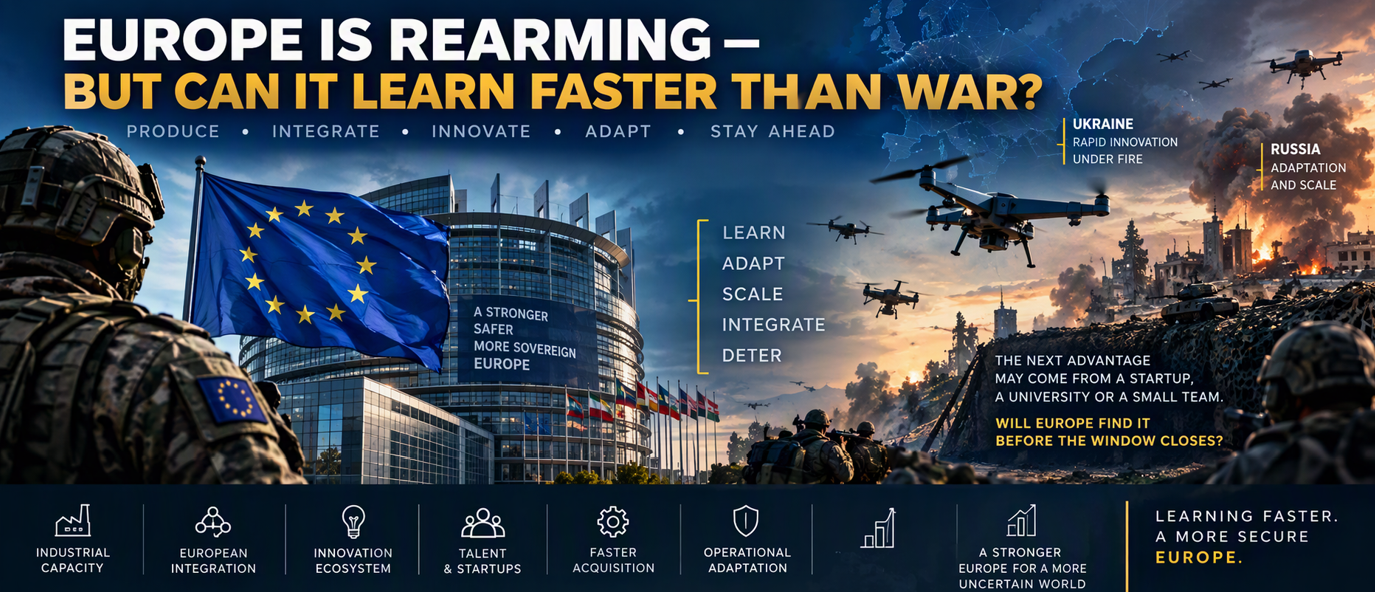
Military Learning Velocity: Two Models of Learning in the War in Ukraine / by Diego Bavio

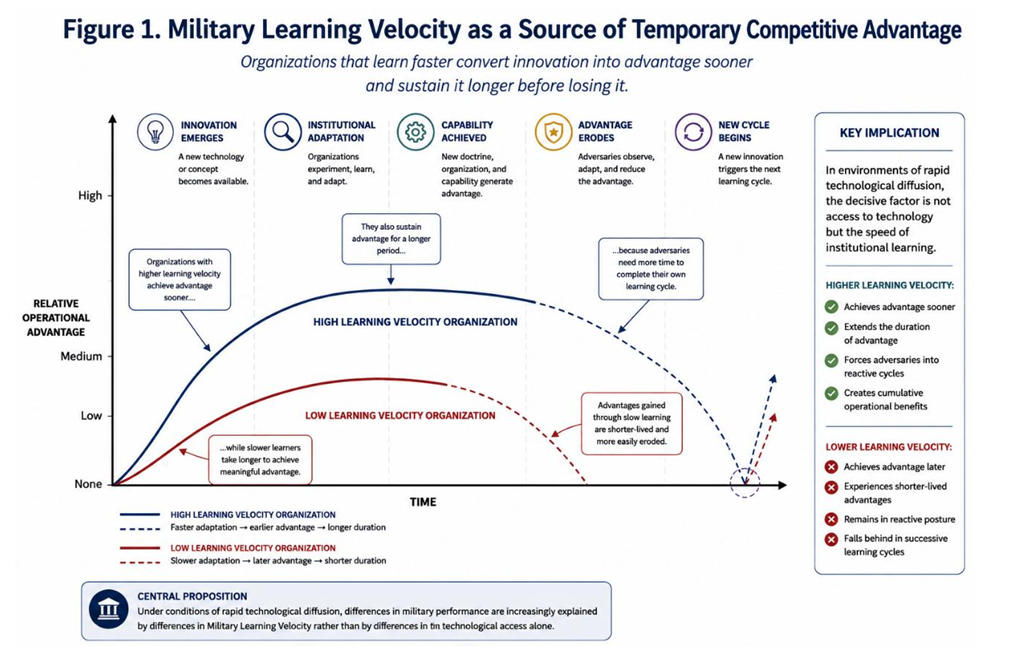
When we began developing the concept of Military Learning Velocity (MLV), we defined it as a learning race between adversaries seeking to create a window of operational opportunity: a period during which the speed of adaptation makes it possible to gain a military advantage over an opponent that has not yet developed an effective response.
The emergence of drones used as munitions provided an initial illustration of this hypothesis. The speed with which these systems evolved, incorporated new capabilities, and changed their employment methods showed how traditional military development and procurement cycles were beginning to lose relevance in the face of much shorter adaptation processes.
However, the evolution of the war in Ukraine has revealed something more significant. MLV does not manifest itself in only one way. Two adversaries subjected to the same operational pressure have developed different learning models, shaped by their industrial capabilities, available resources, and organizational structures.
Russia and Ukraine are engaged in the same learning race, but they are not running it in the same way.
Both have managed to turn their learning processes into tactical advantages with effects that extend beyond the immediate battlefield.
Russia: learning to produce, adapt, and scale
Russia’s military-industrial capacity is a fundamental variable in understanding its evolution during the conflict. Despite sanctions, technological restrictions, and Ukrainian attacks against industrial and logistical facilities, Russia has retained sufficient industrial depth to sustain the war effort and expand the production of certain systems.
In an initial phase, the recovery and modernization of Soviet-era stockpiles helped keep the front supplied while industry reorganized production lines and expanded capacity. Tanks, armored vehicles, artillery, and other systems stored for decades were refurbished to offset losses and sustain the volume of operations.
But the process was not limited to recovering existing equipment. At the same time, Russian industry developed new versions of familiar systems, incorporating modifications derived from operational experience.
The Pantsir family is an example of this process. The evolution from the S1 to the S1M, SM, and SMD configurations shows how an existing air-defense architecture can incorporate new radars, expand detection capabilities, and modify its interceptor mix in response to emerging threats. The introduction of small interceptors to counter drones also reflects an adaptation to the economics of air warfare: using lower-cost systems against threats whose interception with conventional missiles can become economically unsustainable.
However, the Geran family is probably the clearest illustration of Russian MLV.
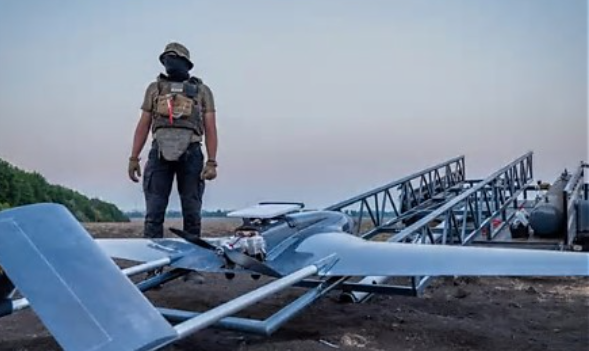
Starting from the Iranian Shahed design, Russia developed a platform that evolved far beyond its original configuration. The incorporation of new navigation and communications capabilities, improved resistance to electronic interference, changes to payloads, and new propulsion configurations ultimately produced a diversified family of OWA (One-Way Attack) systems.
The most significant factor is not each modification considered individually, but the speed of the process. Solutions tested in combat can be incorporated into production, while manufacturers trial alternatives and discard those that do not deliver satisfactory results.
Russia thus demonstrates a form of MLV supported by industrial depth: learning in order to modify products, improve their performance, and scale the solutions that meet battlefield requirements.
The Russian tactical advantage: the superiority of the OWA campaign
The evolution of the Geran family shows how this learning translates into a concrete military advantage.
Russia has developed an air campaign based on the mass and sustained employment of OWA systems, combining different configurations, decoys, propulsion systems, and attack profiles. The progressive incorporation of improvements has increased the complexity of the threats and forced Ukraine to continually revise its defensive mechanisms.
The results should not be measured solely by the number of drones that reach their targets. The scale of the attacks itself generates additional effects: it forces the dispersal of air defenses, consumes more expensive interceptors, requires continuous surveillance, and commits resources to protecting industrial, energy, logistical, and urban infrastructure.
In this case, Russia’s advantage lies in its ability to sustain large-scale aerial pressure and adapt its systems quickly enough to make a stable defensive response difficult.
This is a tactical advantage with strategic consequences. The campaign does not simply seek to destroy targets; it aims to degrade Ukraine’s ability to sustain the war, damage its infrastructure, and progressively increase the material and political cost of resistance.
Russian MLV thus makes it possible to turn the evolution of a product into a means of applying pressure across the adversary’s entire system.
Ukraine: learning to compensate for asymmetry
The Ukrainian model has different characteristics.
From the beginning of the invasion, Ukraine has faced a considerable material asymmetry. Differences in population, reserves, industrial capacity, and the availability of conventional weapons limited its ability to compete with Russia in a traditional war of attrition.
Western military, financial, and technological assistance has been essential to sustaining Ukraine’s defense. However, Ukraine’s ability to transform those resources into new operational solutions is another phenomenon that deserves attention.
Rather than relying exclusively on large traditional industrial complexes, Ukraine developed a distributed innovation ecosystem bringing together military units, technology companies, startups, universities, engineers, and state coordination structures.
This democratized industrial base helped reduce the distance between identifying an operational need and developing a solution. End users participate directly in the innovation process; modifications are tested under real-world conditions, and successful experiences can be transferred to other parts of the armed forces.
But the most important aspect is that learning was not limited to equipment.
Ukraine began developing new methods of military employment based on the technological capabilities available.
Operation Vivaldi: a technological breakthrough that disrupted Russian plans
Operation Vivaldi, conducted in the Lyman sector during 2026, offers one of the most significant illustrations of Ukrainian MLV.
The integration of reconnaissance and attack drones, electronic warfare systems, ground robots, and infantry units made it possible to develop a maneuver that combined the degradation of Russian capabilities with new approaches and methods for employing unmanned systems.
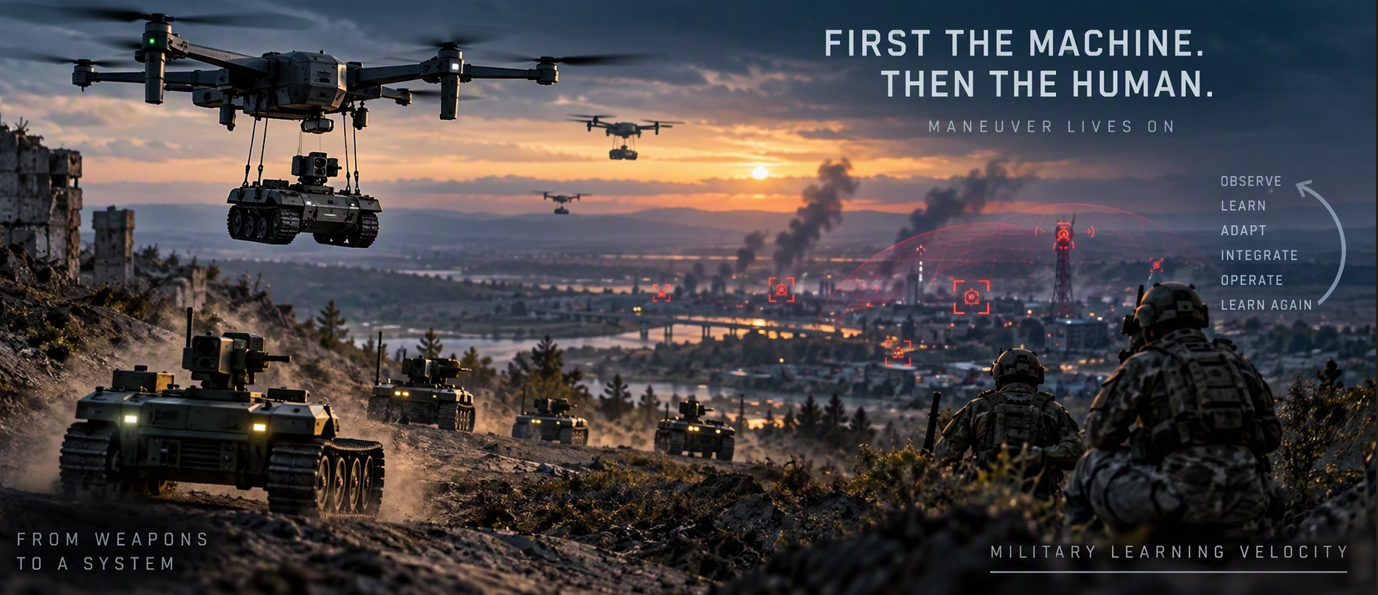
One of its most significant episodes was the use of bomber drones to transport and deploy ground robots deep behind Russian lines. These systems made it possible to overcome terrain obstacles and reach positions that would have been much harder to approach through conventional ground movement.
This was not simply a matter of introducing a new unmanned vehicle. A new form of maneuver was taking shape: a robotic airborne assault, in which one unmanned system carries another to extend its reach and produce effects against the adversary’s defensive disposition.
This technological breakthrough did not remain at the experimental stage. It translated into a tactical victory—limited in territorial scope and temporary in terms of the broader dynamics of the front—that enabled Ukrainian forces to break up the Russian salient north of Lyman and recover positions essential to Ukraine’s defense.
But its consequences went far beyond the immediate result.
Russian command had designed an encirclement maneuver against the Donbas Fortress Belt, with two axes of advance: one from the north, through Lyman and Sviatohirsk, and another from the south, along the Dobropillia axis. The two were intended to converge and complete the isolation of Ukraine’s main defensive positions in Donetsk.
The Ukrainian operation disrupted the northern arm of this plan. The loss of the salient compromised the Russian advance toward Sloviansk, changed the conditions of the campaign, and forced a reassessment of force deployments and the offensive’s immediate objectives.
In other words, an innovation developed at the tactical level succeeded in altering Russian operational plans and affecting the strategic design of its campaign for the winter of 2026.
This is precisely the point worth emphasizing: the robotic airborne assault was not simply a new way of employing drones. It was an innovation that generated a tactical advantage at a critical moment and converted it into an operational effect far greater than the scale of the means employed.
Here we find a different expression of MLV: not merely the speed at which a product evolves, but an organization’s ability to transform itself, its procedures, and its methods of maneuver in order to exploit new technologies.
Two models of learning, one race
Comparing the two adversaries makes it possible to identify two different expressions of Military Learning Velocity.
Russia has greater industrial depth, allowing it to combine the recovery of existing equipment, the modernization of systems, and the production of new generations of weapons. Its learning is expressed particularly in the evolution of specific products and its ability to incorporate modifications at scale.
Ukraine, by contrast, has developed a distributed innovation model that enables it to partially compensate for its material inferiority. Its learning is expressed both in the evolution of indigenous equipment and in the transformation of procedures, organizational structures, and operational methods.
These models are not mutually exclusive. Russia also develops distributed innovation, and Ukraine has its own defense industry, which is seeking to scale its developments. The difference lies in their starting conditions and in how each adversary makes use of its resources.
Ukraine’s experience is particularly relevant because it shows that MLV can become a resource for addressing material asymmetry. Material inferiority does not disappear, but an organization that learns, adapts, and applies solutions more quickly can narrow the gap between its available capabilities and the military effects it needs to produce.
The real advantage: turning learning into strategic effects
The war in Ukraine allows us to advance a central point in the MLV concept.
Technological innovation does not in itself constitute a military advantage. Nor is it enough to develop a superior product or introduce a modification to a weapons system. An advantage emerges when an organization can turn learning into an operational capability before the adversary develops a response.
Russia’s OWA campaign and Operation Vivaldi represent two different expressions of this phenomenon.
In the first case, the evolution of systems and the ability to scale industrial production have made it possible to sustain aerial pressure whose effects reach Ukraine’s infrastructure, logistics, and capacity to resist.
In the second, the integration of distributed innovation, unmanned systems, and new methods of maneuver generated a tactical advantage that disrupted a central component of Russia’s operational design for the winter campaign and the encirclement of the Donbas Fortress Belt.
Both cases show that a tactical advantage can extend beyond its immediate dimensions and affect the strategic course of a war. They also show that such advantages are not permanent: the adversary learns, develops countermeasures, and forces a new adaptation cycle to begin.
The learning race has no definitive endpoint. Each innovation changes the conditions of the conflict, forces the adversary to develop a response, and opens a new window for whoever can adapt first.
The war in Ukraine demonstrates that military advantage does not depend exclusively on who has more resources, but also on who can learn, adapt, and incorporate that learning into operational capabilities before the adversary.
That is precisely the strategic dimension of Military Learning Velocity.