“Hybrid Schmybrid”. Estonia’s Spy Chief Says Europe Is Finally Using the Wrong Word
For years, Europe has comforted itself with a convenient phrase.
Hybrid warfare.
It sounds technical. Academic. Manageable.
A blend of cyberattacks, sabotage, disinformation, espionage, influence operations, and covert action. The term became the perfect diplomatic container for activities that were hostile but fell below the threshold of open war.
According to Estonia's top intelligence official, that language is no longer sufficient.
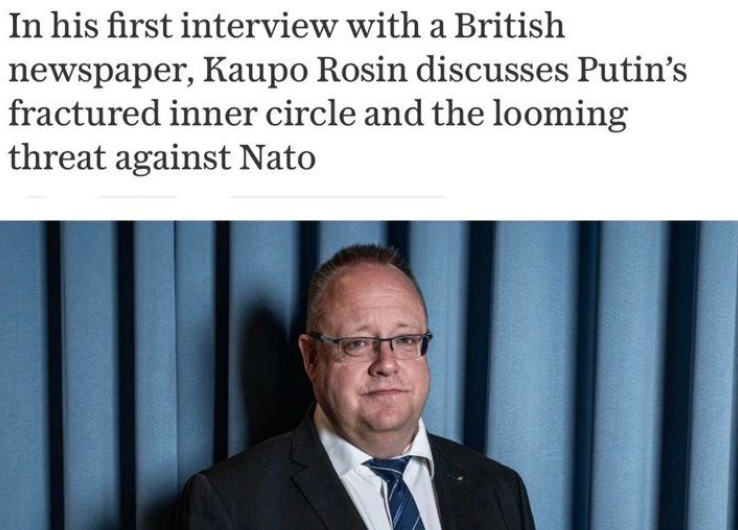
In a rare public interview, Kaupo Rosin, head of Estonia's Foreign Intelligence Service, dismissed the terminology with two words:
"Hybrid schmybrid."
The phrase was striking precisely because intelligence chiefs rarely speak this way.
His argument was simple.
Europe continues to describe Russian sabotage campaigns using language that softens the reality of what is actually taking place. Rosin believes that many actions currently classified as "hybrid operations" would be more accurately described as state-sponsored terrorism.
It is a powerful accusation.
And it reflects a broader shift underway inside the countries that sit closest to Russia's borders.
Nobody understands Moscow better than the states that spent decades under Soviet domination. Estonia, Latvia, Lithuania, Poland, and Finland often reached conclusions about Russian intentions years before larger Western capitals were willing to acknowledge them.
Time after time, those warnings proved uncomfortably accurate.
Today, Rosin believes Europe remains trapped by outdated assumptions.
The evidence is mounting.
Across the continent, authorities have investigated arson attacks, sabotage operations, cyber campaigns, influence networks, suspicious drone incidents, and alleged covert activities targeting critical infrastructure. Governments increasingly view these incidents not as isolated events but as components of a broader strategic campaign.
The debate is no longer about whether these operations occur.
The debate is about what to call them.
Words matter because they shape responses.
"Hybrid warfare" suggests ambiguity.
"Terrorism" implies responsibility.
One term encourages caution.
The other demands consequences.
This linguistic battle is not merely academic. It determines how governments allocate resources, define threats, and communicate risks to their populations.
Yet Rosin's comments become even more interesting when he turns his attention inward, toward Russia itself.
Western observers often focus on public opinion, opposition movements, and street protests when attempting to gauge political stability. Rosin appears unconvinced that these factors will determine Russia's future.
History suggests he may have a point.
Authoritarian systems rarely collapse because ordinary citizens suddenly rise up en masse. More commonly, change occurs when elites lose confidence in the existing order.
As Rosin notes, the more important question is what people with access to money, information, influence, and force structures are discussing behind closed doors.
And according to his assessment, the conversation is changing.
The language of total victory is becoming less common.
More discussions reportedly focus on scenarios for ending the war.
That observation does not imply imminent political transformation.
But it does hint at growing uncertainty within circles that traditionally project confidence and control.
Uncertainty can be more dangerous for authoritarian systems than opposition.
Because opposition is expected.
Doubt inside the elite is not.
Rosin's most provocative insight concerns the future.
Many analysts imagine political change as a gradual process unfolding over years. Elections weaken. Institutions fracture. Public dissatisfaction grows. Momentum slowly builds.
History often operates differently.
The Soviet Union looked permanent until suddenly it wasn't.
The Berlin Wall stood for decades until almost overnight it ceased to exist.
The Arab Spring demonstrated how quickly apparently stable governments can collapse.
Rosin sees a similar possibility in Russia.
"If something changes," he suggests, "it will happen in a very rapid manner."
That assessment echoes one of history's most consistent lessons.
Systems frequently appear strongest immediately before they become vulnerable.
Power concentrates.
Criticism disappears.
Public compliance increases.
To outside observers, everything looks solid.
But beneath the surface, cohesion weakens.
The late Wagner leader Yevgeny Prigozhin's march toward Moscow exposed precisely that possibility. An event that should have been impossible suddenly happened. Defenses vanished. Resistance evaporated. For a brief moment, one of the world's most centralized states appeared surprisingly hollow.
The system survived.
But the illusion of invulnerability did not.
That may ultimately be Rosin's most important message.
Not that change is inevitable.
Not that collapse is imminent.
But that stability and strength are not the same thing.
Russia may appear extraordinarily durable from the outside.
Yet history repeatedly shows that the systems that seem permanent often prove the most surprising when they finally change.
And when they do, they rarely announce it in advance.