Germany’s FENNEK AIR Has a Brutal New Job: Find the Drone, Let AI Decide Faster, Kill It in Seconds
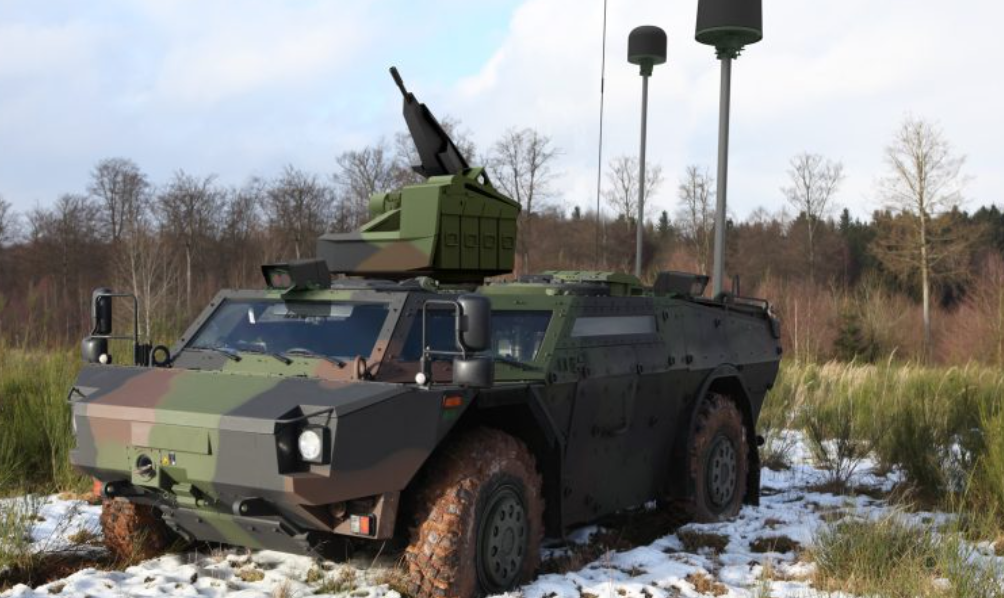
Europe spent decades building armored vehicles to survive tanks, mines and artillery. Now one of Germany’s veteran reconnaissance vehicles is being redesigned to hunt something radically smaller: drones.
KNDS Deutschland has unveiled the prototype of FENNEK AIR, a counter-unmanned-aircraft system that combines the established FENNEK vehicle with artificial-intelligence-assisted sensor processing and the formidable ARX30 30mm remotely operated weapon station.
Its name is revealing: AIR stands for “Artificial Intelligence Revolvergun.”
But the real story isn't the acronym.
It's speed.
The wars of the past few years have demonstrated how dramatically inexpensive drones can compress battlefield decision-making. A small UAV can appear, identify a target, transmit coordinates or attack directly before a traditional command chain has finished processing what is happening.
Against a drone swarm, that problem multiplies.
FENNEK AIR is designed to fight at machine speed.
According to KNDS Deutschland, its integrated AI can evaluate sensor data in real time, identify and track drones and support their engagement. Depending on the level of AI assistance selected by the crew, the system is intended to reduce the sensor-to-shooter cycle to just seconds.
That phrase may ultimately matter more than the cannon.
Modern counter-drone warfare is becoming a race between two loops:
Who detects, understands and acts first?
For the kinetic end of that equation, FENNEK AIR carries the ARX30 weapon station from KNDS France.
Its 30 x 113mm cannon gives the vehicle considerably more punch than the machine guns commonly associated with light reconnaissance platforms. The weapon has a stated practical range of around 1,500 metres and a standard land firing rate of 225 rounds per minute, which can reportedly rise to 720 rounds per minute.
But FENNEK AIR isn't designed to fight alone.
KNDS describes a concept called “Meshed Intelligence”, allowing multiple vehicles to exchange information. That transforms several individual drone hunters into distributed nodes of a larger detection and engagement network.
One vehicle sees.
Another receives the information.
The network reacts.
That matters because the drone threat is evolving too quickly for hardware-centric defense alone. KNDS says the AI element is intended to learn from accumulated data and adapt to emerging drone types.
Yet an important question remains.
The company refers to autonomous operation in describing the system, while also emphasizing that crews determine how extensively AI assists them. Exactly where detection and recommendation end and autonomous engagement begins remains unclear.
That boundary will matter enormously as AI-supported weapons move closer to operational service.
Then there is camouflage.
The FENNEK AIR prototype reportedly combines its weapon and AI architecture with adaptive camouflage intended to alter the vehicle's appearance and make identification by enemy reconnaissance more difficult.
That produces an intriguing reversal.
The vehicle hunts drones while simultaneously trying to deceive the sensors hunting it.
And perhaps the smartest aspect of the concept is that Germany does not necessarily need to begin with an entirely new fleet.
FENNEK has served with the Bundeswehr since 2003, with roughly 250 vehicles in German inventory. Although a new generation of reconnaissance vehicles is already planned to begin replacing it from 2029, KNDS says the AIR mission kit could be integrated into existing FENNEK fleets as well as other platforms.
That could turn an aging reconnaissance vehicle into something unexpectedly relevant to the newest battlefield problem.
And it reflects a broader lesson from Ukraine:
The future of military technology isn't always about replacing old platforms. Sometimes it is about giving them a new brain, a new weapon and a completely different enemy.
The FENNEK was built to find forces on the ground.
FENNEK AIR is being taught to look up.
Because on tomorrow's battlefield, the most dangerous thing approaching an armored vehicle may not weigh 60 tonnes.
It may cost a few thousand euros and fit in the back of a car.